Labradorite pairs best with one quiet stone, not a crowd. Its flash and inward pull are easy to drown, so moonstone or amethyst, which deepen it, beat the heavier protective stones most charts recommend. Often the best partner for labradorite is nothing at all.
The most useful thing anyone can tell you about pairing labradorite is that you probably should not pair it with much. That runs against most of the advice out there, which hands you a menu of six or eight companion stones and a reason for each. Labradorite is the flashing grey feldspar people reach for during change, and crystal practice treats it as a stone of intuition and inner work. Its effect is quiet and inward by design, the visual equivalent of a flash you only catch when the stone turns in the light.
Pile heavy, insistent stones around something that subtle and you do not lift it. You bury it. The real choice with labradorite is not which of eight partners to pick. It is whether to add anything at all, and if you do, how quiet you can keep it.
The stones that let it lead
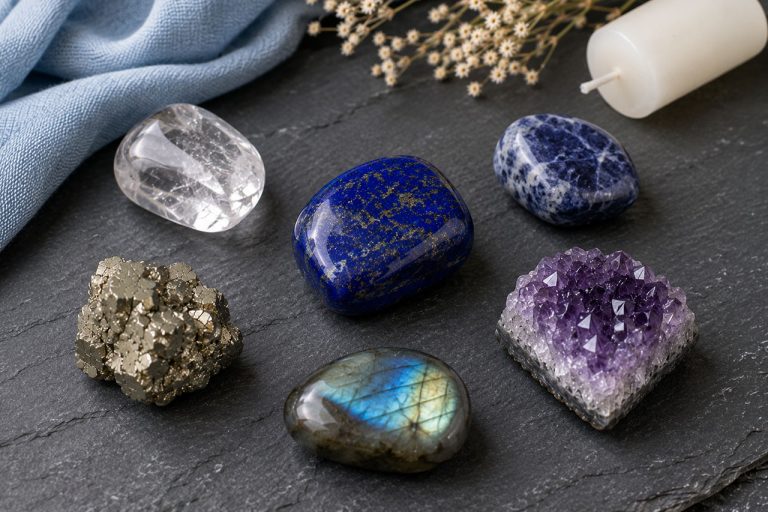
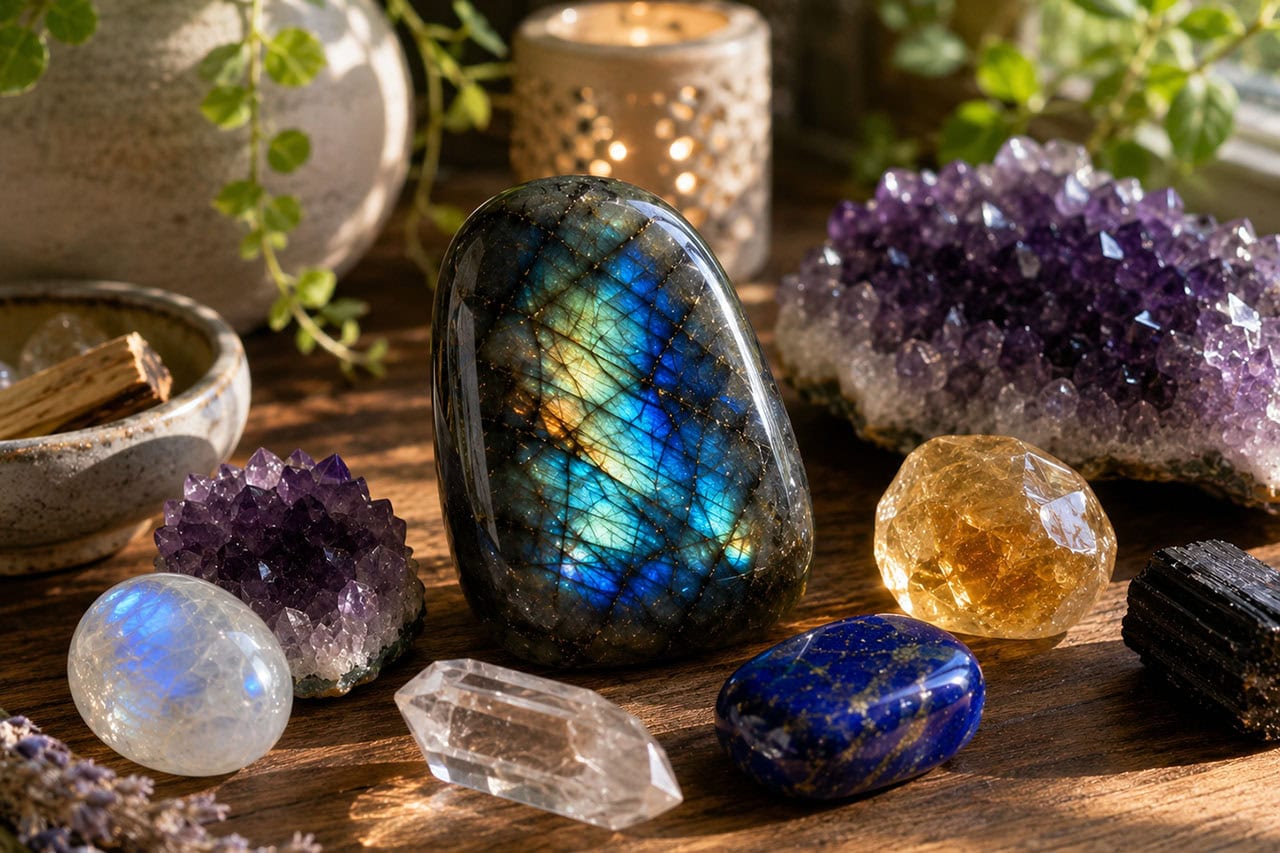
When a partner helps rather than crowds, it is almost always a quiet one. Moonstone is the closest fit. Practice links both stones to cycles and soft perception, and moonstone brings an emotional warmth without ever raising its voice, so the flash still leads and the moonstone sits underneath it. Amethyst does something similar with a steadier base, its calm giving labradorite’s more exploratory quality somewhere to settle, which is why the pair suits meditation without the untethered feeling that deep inner work can bring.
Lapis lazuli is the one case where you add rather than soften, and even it earns its place quietly. Practice ties it to truth and the throat, the energy centre it associates with speaking clearly, so beside labradorite’s inward perception it helps turn what you notice into words. That is a specific job for specific days. If you do not need it, leave it off, as a rule with labradorite generally.
Where the popular pairings go wrong
The pairings you will see recommended most are the ones to be most careful with. Black tourmaline is the usual example. It is a genuinely grounding, protective stone, and pairing it with labradorite is standard advice, but its weight pulls hard toward the physical and away from the inward attention labradorite is trying to hold. In a draining room it can steady you. It will not deepen the labradorite, and often it flattens it.
Denser earthbound stones make the same problem sharper. Hematite and red jasper anchor so firmly in the body that a labradorite worn beside them barely gets a word in. None of this is a rule against ever combining them, and some people want exactly that contrast and use it on purpose. But if you chose labradorite for its flash and its inward pull, the stones that fight it hardest are often the very ones the charts pair it with.
When to wear it on its own
A fair amount of the time the fair recommendation is a single labradorite and nothing else. Worn as jewellery it is already doing what it does best, since the flash answers to movement and light, and a stone that lives on your wrist or at your throat catches both all day long. If you are in the middle of a big change, which is when people tend to reach for it, that steady presence is usually plenty on its own.
When you place it rather than wear it, a desk is the common spot, and amethyst on the same surface for rest is a low-key choice that does not compete for attention. Keep any pairing to one partner and let the labradorite stay the thing you notice.
What it is and how to keep it
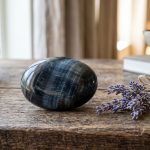
Labradorite is a plagioclase feldspar, and the flash that gives it its name, labradorescence, comes from light striking the fine internal layers where the crystal grew in twinned bands and bouncing back as colour rather than reflecting off the surface. That internal structure is also why it sits softer than the quartz-family stones, around six to six and a half on the Mohs scale of mineral hardness, so it takes daily wear but scuffs over time against anything harder. One more reason not to bury it in a pile of other stones. A periodic cleanse if you wear it hard is care enough, and moonlight is the traditional method if you want one.
The Crystalance Mineral Library has the full profile, including how the flash forms and how to tell labradorite from the stones it resembles. If moonstone turned out to be the one partner you wanted, moonstone versus labradorite is a good one to read, since the two get confused more easily than their pairing suggests.
Sources
- Geology.com, Labradorite: The gem plagioclase feldspar with play-of-color: https://geology.com/gemstones/labradorite/