It depends which sparkle you mean. Druzy and pyrite bounce light off many small surfaces, sunstone and moonstone and labradorite work from inside, and spectral colour comes from light travelling through a stone. Pyrite is the loudest of them and is the one that cannot do that.
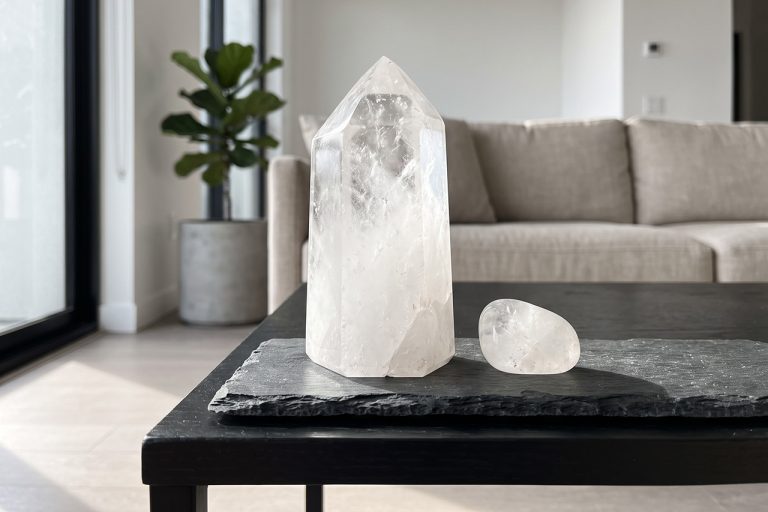
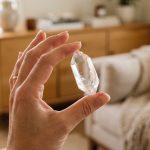
Put a pyrite cluster under a lamp next to a cut piece of clear quartz and the pyrite is the one that stops people. Brighter at a glance, obviously metallic, the thing that gets called treasure. It is also the object there that light never gets inside, and everything the cut quartz is doing depends on light getting inside.
The diamond trade has had a working vocabulary for this since long before crystal shops existed, and it separates three things that ordinary English runs together. GIA’s account of cut quality names them as brightness, “the total internal and external reflection of white light”; fire, “the dispersion of light into the colors of the spectrum”; and scintillation, “the pattern of light and dark areas, and the sparkle when moved.”
Those are three different events with three different causes, and a given material can be very good at one and structurally excluded from another. Nothing on a shop shelf wins all three, and the question in the title has no single answer for that reason.
Fire has a number, and the number is about the inside of a stone
In a 2001 study of round brilliant diamonds, GIA researchers put it in the plainest possible terms: “The dispersion value, 0.044, is the difference between diamond’s R.I. for blue light (431 nm) and that for red light (687 nm).”
Refractive index is how much a material bends light passing through it, and it bends blue light slightly harder than red. Split those two figures apart and you have the spread of colour a stone can produce. Diamond spreads them by 0.044, which is enough to throw visible rainbow flashes out of a colourless stone.
Two things follow, and both matter more than the number does.
The first is that light has to travel through the material for any of it to happen. Refraction takes place as light enters and leaves, so a stone light cannot enter has no dispersion to show, whatever it looks like under a lamp. Any material light passes through has a dispersion figure of its own, since the definition is nothing more than the gap between its refractive index at two wavelengths. What differs between one transparent stone and another is how wide that gap is and whether the cut does anything with it.
The second is that fire has to be cut in. The same GIA study found that “in general these proportions do not overlap”, meaning the proportions that maximise fire are not the ones that maximise brightness, though the authors add that many proportion combinations still give average or better values for both. A cutter is trading one against the other, and the trade is a workshop decision rather than a property of the rough.
Why pyrite is bright and never colourful
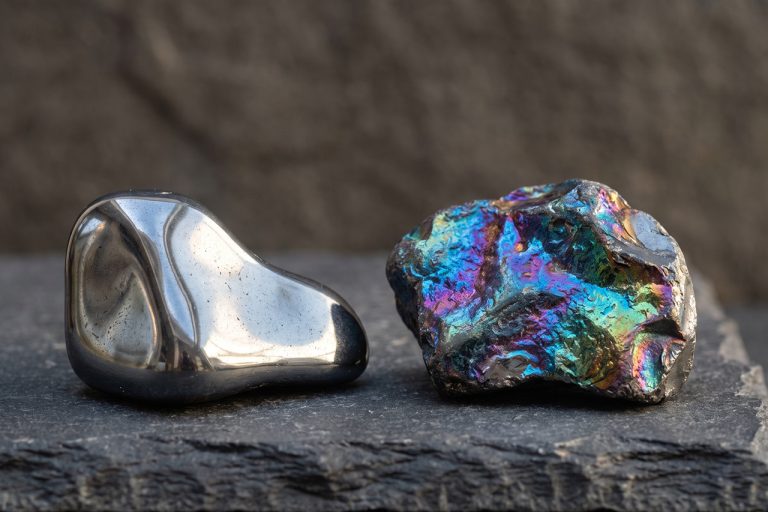
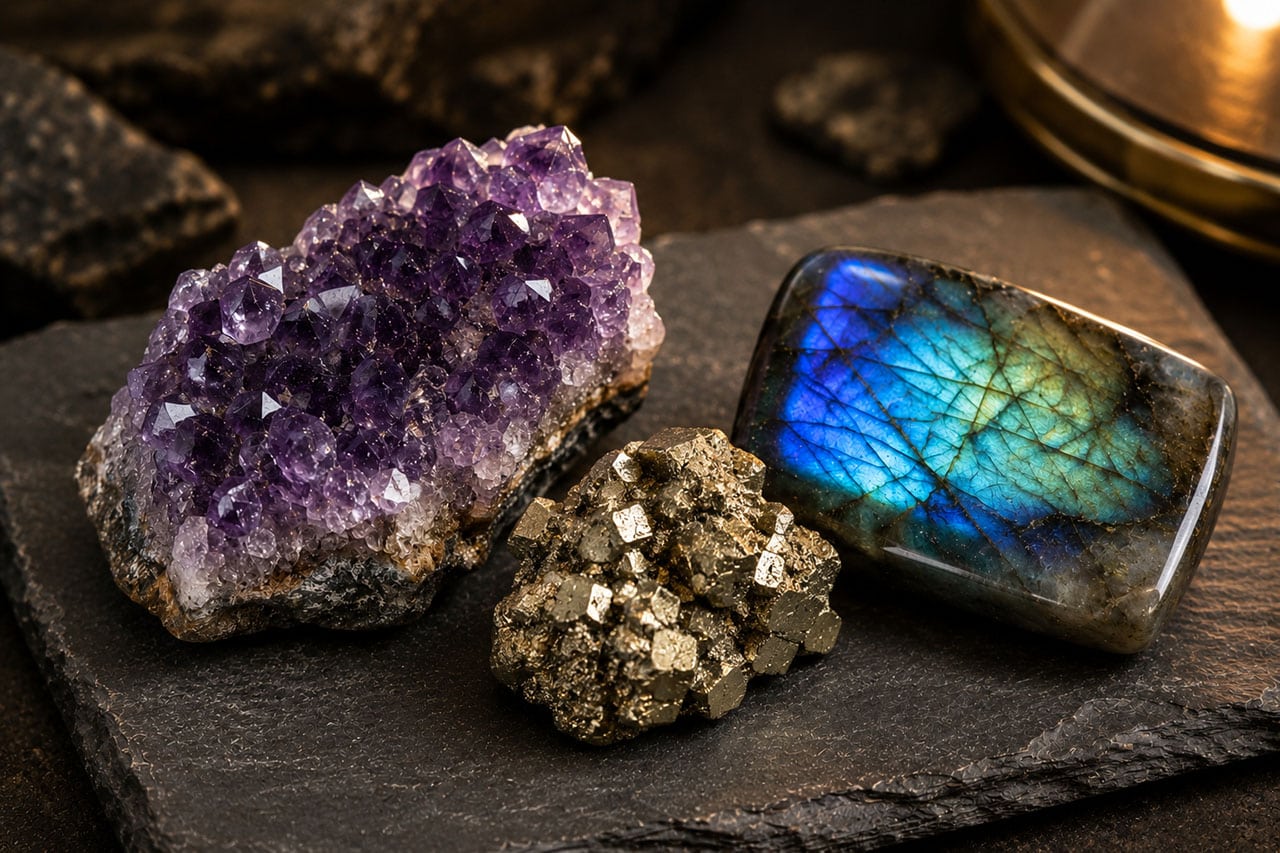
Pyrite is iron sulphide, cubic, hardness 6 to 6.5, and the Handbook of Mineralogy describes its lustre in two words that are hard to improve on: metallic, splendent. The colour line is pale brass-yellow, tarnishing darker and iridescent. The habit line explains the geometry, since pyrite grows in cubes, pyritohedra and octahedra, and a cluster of those is a small landscape of flat faces at hard angles.
That is where the shine comes from. Light hits a flat metallic face and comes straight back off it. The event happens at the surface and is finished there. Nothing travels through the mineral and nothing gets split on the way, so what returns is brass-yellow reflection off many faces at once, which is dazzling and is not fire. Note that the Handbook’s colour line also allows a tarnish that is darker and iridescent, and tarnish is a thin surface film rather than the mineral doing anything with the light it lets through. Different mechanism, same lesson: on pyrite, everything happens on the outside.
The same logic quietly rules out the other named effect people attach to pyrite. GIA defines aventurescence, the glitter of sunstone and aventurine, as “the glittering effect created by isolated and visually discernible flat interfaces scattered in any transparent to translucent gemstone.” Transparent to translucent. The flat interfaces have to be suspended inside something light can reach. In an opaque metallic aggregate they are the outside of the stone, not inclusions within it.
None of that makes pyrite a lesser object. It makes it the clean case of one mechanism doing all the work, and it is why a pyrite cluster looks much the same in every light while a cut stone does not.
Three effects that get called one thing
Sunstone, moonstone and labradorite are all doing something internal, and all three get described in shops as sparkle. GIA’s 2025 review of phenomenal gemstones separates them cleanly.
Aventurescence is the definition above: discrete flat interfaces inside a translucent host, each one visible as a separate glint. The effect is resolvable. You can pick out individual flashes and watch them switch on and off as the stone turns.
Adularescence is the “iridescent sheen of alkali feldspar”, which is moonstone, and GIA describes it as occurring “primarily as a desaturated blue but sometimes light yellow or white, with a billowy, floating appearance resembling moonlight.” Not glints. A soft body of light that seems to sit below the surface and move with your eye rather than with the stone.
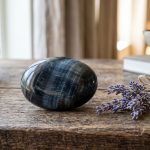
Labradorescence is the “iridescent schiller seen in plagioclase feldspar labradorite from plutonic rocks”, and it reads as broad sheets of colour rather than either points or glow. Tilt a good piece and a whole face goes blue or green at once, then goes grey again.
Glitter in the first case, a soft body of light in the second, whole faces changing colour in the third. A buyer who can tell them apart stops ordering the wrong stone by accident, since a listing will often call all three sparkle and leave it there.
Druzy is geometry rather than an effect
Druzy belongs on any honest list of the sparkliest things in a shop and it is not an optical phenomenon at all. A druzy surface is a crust of very small crystals, each with its own faces, grown across a substrate. Every face reflects independently. Multiply that across a whole crust of them and the surface reads as frost catching light.
The mechanism is the pyrite mechanism scaled down and repeated, then: ordinary reflection from many small flat surfaces. Colour comes from the host mineral rather than from the effect. Amethyst druzy is purple because it is amethyst.
The count of faces is not the whole of it either, because the crust is rarely uniform. Take the small amethyst geode in the collection here, about the height of a large mug: its points run deep violet at the centre and much paler around the edges, and the two zones only read as separate zones when light arrives at an angle. Straight-on light flattens the whole interior into one purple. The sparkle and the colour are both angle-dependent, and they are not dependent on the same angle.
What a lamp does that a window does not
Every effect above is a relationship between a stone and a light source, which means none of them is a fixed property you can buy.
A hard directional lamp is what nearly all of them want. Aventurescence needs a point source to switch individual interfaces on and off. The two feldspar effects need a beam narrow enough to arrive from one direction, which is why moonstone looks so much better in a shop window than on a bookshelf. Pyrite needs nothing in particular and gets away with it. Diffuse indoor daylight softens most of these toward the same mild gleam.
Photographers selling stones know this. A listing image is shot under exactly the conditions the effect wants, sometimes in direct sun, which is a light most rooms cannot supply. Asking what light a photograph was taken in costs one sentence and is the closest thing to a control there is.
Pyrite is the exception again, and this time in the buyer’s favour. Surface reflection off metal barely cares about the source, so a piece of it tends to arrive looking much as it did in the listing.
What divides the whole list, in the end, is a single line in a mineral’s data: whether light gets inside it. That line is on the entry for every stone above, pyrite’s in the Crystalance Mineral Library among them, sitting next to the hardness and the crystal system as though it were an equally minor detail. It is the one that decides what the stone can do under a lamp.
Sources
- GIA, Diamond Cut, for the definitions of brightness, fire and scintillation.
- Reinitz, Johnson, Hemphill, Gilbertson, Geurts, Green and Shigley (2001), “Modeling the Appearance of the Round Brilliant Cut Diamond”, Gems & Gemology 37(3), for diamond’s dispersion value and the finding that fire and brilliance are maximised by different proportions.
- Handbook of Mineralogy, pyrite: FeS2, cubic, hardness 6 to 6.5, lustre metallic and splendent, typically cubic, pyritohedral and octahedral.
- GIA, “Structures Behind the Spectacle: A Review of Optical Effects in Phenomenal Gemstones and Their Underlying Nanotextures”, Gems & Gemology, Summer 2025, for the definitions of aventurescence, adularescence and labradorescence.