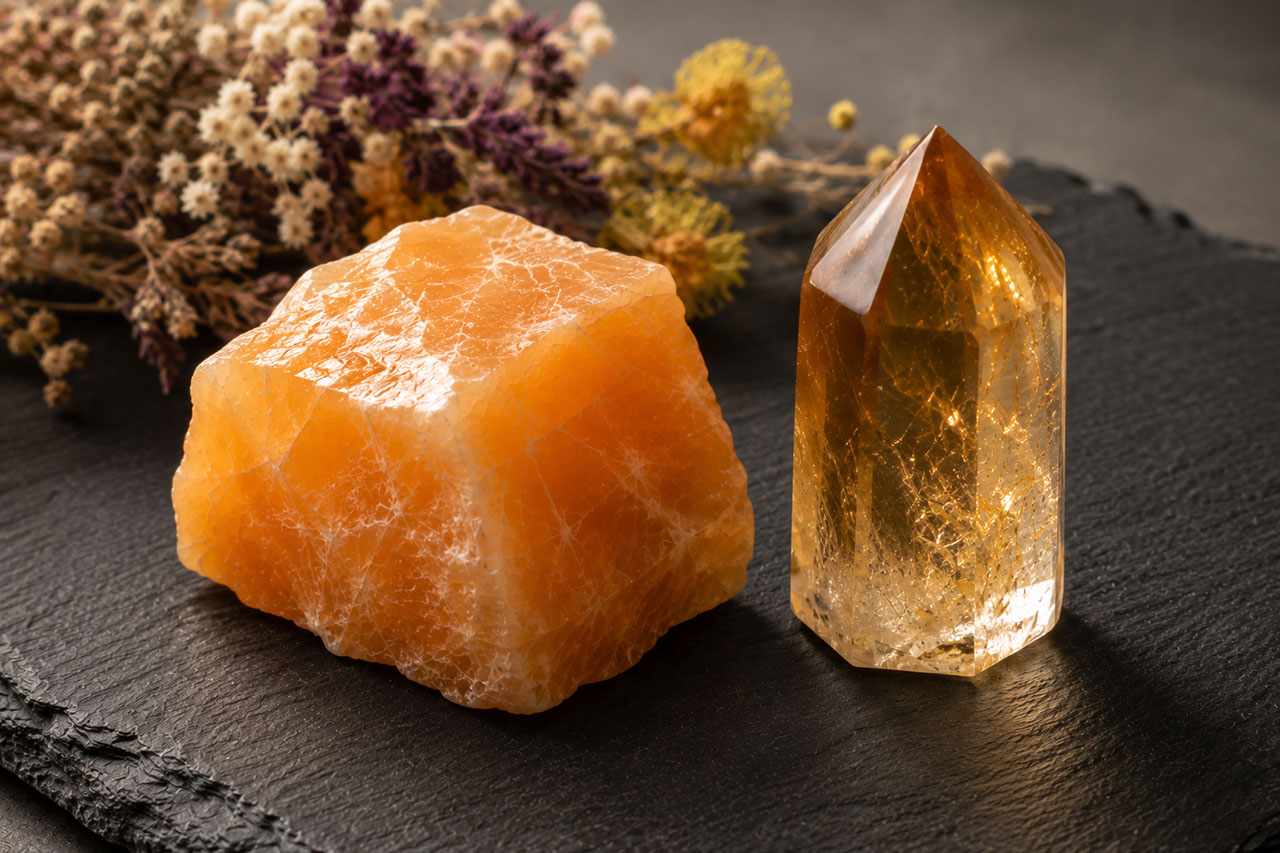
They are entirely different minerals that happen to share a warm orange colour. Orange calcite is a soft calcium carbonate. Citrine is a variety of quartz, and most of what sells under the name is heated amethyst rather than natural golden quartz. They feel different in the hand, and crystal practice asks different things of each.
People mix these two up more often than almost any other pair, and the reason is fair enough. Both are warm, orange to gold, both carry uplifting reputations, and both turn up early in beginner collections, often side by side in the same tray. What gets lost in the resemblance is that they are asked to do quite different jobs, and that one of them is frequently not even the stone the label claims.
The place the two genuinely part company is not in the tray but in what each is for, and in what each is made of.
Two warm stones, two different jobs
Crystal practice sorts these two by where it places them on the body and what it associates with each. Orange calcite it reads as a sacral stone, tied to creativity, emotional flow and the capacity to feel and respond, the stone reached for when someone feels creatively stuck or emotionally flat. Its reputation is for loosening rather than forcing, a gentler kind of emotional warmth than the more confrontational stones are given. Citrine it places higher, at the solar plexus, and ties to confidence and a prosperity-minded clarity, an outward and goal-facing character rather than an inward one. Where orange calcite is asked to help someone feel and create, citrine is asked to help them focus and act. That split shows up even in how each is used day to day. Orange calcite tends to be kept close during creative or emotional work, on a desk or held while thinking something through, while citrine more often turns up where the intent is money or ambition, tucked into a till, a wallet or the corner of a room set aside for work. The colour is the same in both cases and the errand is not.
Those associations are how the tradition has long sorted the two, and they are the reason most people choose between them. They are claims about the practice, though, rather than about the minerals, and the stones themselves tell a plainer story once you turn them over. The look that muddles them is only skin-deep, and underneath sit two minerals with almost nothing in common.
Carbonate against quartz
Orange calcite is calcium carbonate, the mineral CaCO3, and it is soft, sitting at 3 on the Mohs scale, soft enough that a steel blade marks it without effort. It is often semi-opaque to milky, with a slightly waxy look when polished, and its colour ranges from a pale peach to a deep tangerine that comes from trace impurities in the stone rather than from any single element you could name with confidence. Calcite also has a party trick that settles its identity outright: a drop of weak acid on it fizzes, because the acid attacks the carbonate and releases carbon dioxide. That is not a test most people need to run, but it is definitive when it matters, and it is the reason calcite should never be cleaned with anything acidic.
Citrine is quartz, silicon dioxide, and quartz sits at 7 on the same scale, four steps up, which is a large gap in practice. Citrine is properly glassy and ranges from clear to transparent, with the bright lustre of quartz rather than calcite’s softer sheen. That difference in hardness and clarity is the everyday way to tell them apart without any acid: citrine resists a scratch that calcite takes easily, and citrine lets light through cleanly where calcite tends to cloud it.
There is a further wrinkle on the citrine side worth knowing before you buy. Most commercial citrine is not natural. GIA is plain that most citrine on the market is heated amethyst, purple quartz warmed until it turns golden, because naturally yellow quartz is genuinely rare. Heated material often shows a brighter, more orange tone and sometimes a whiter base, while natural citrine tends to a paler, more even golden yellow. Neither is fake exactly, since both are quartz, but a buyer paying for natural citrine is owed the disclosure, and a good seller gives it. The tells are not perfect but they help. Heat-treated stones frequently carry a faint reddish or orange cast and can show a near-white zone toward the base where the colour thins, a hint of the amethyst they were, while a great deal of the deep, uniform, almost brandy-coloured material in shops is heated by default. Natural citrine leans paler and cooler, a soft lemon to honey, and is priced like the rarity it is. None of this changes what the stone can be used for, but it changes what a fair price is, and it is the single most useful thing to know before buying a stone sold under this particular name.
When to reach for each
If you are choosing one rather than both, the question comes back to what you want from it, because the two are genuinely suited to different aims. Citrine is the more traditional choice for anything to do with confidence or a clear head about money, the outward-facing work. Orange calcite suits the inward side, creative blocks, emotional flatness, a wish to feel more rather than think more clearly. Neither is better. They are pointed in different directions, and treating them as interchangeable, which popular writing often does, does both a quiet disservice.
They also pair well for exactly that reason, the calcite bringing the creative warmth and the citrine the clarity to act on it, which suits work that needs both inspiration and follow-through. Someone making something they also mean to sell, or finishing a long project that started as an idea, is the sort of person the pairing is aimed at, one stone for the spark and the other for the steadiness to carry it out. If you keep both, mind the hardness gap when you store them. Calcite is soft enough to be scratched by the quartz, so the two should not be left rattling together in a pouch, and calcite should be kept away from water and acids that a quartz would shrug off. Quartz colour carries its own vulnerability. GIA notes that amethyst can lose some of its colour under prolonged intense light, and since most citrine on the shelf began as amethyst, keeping a citrine out of a bright window over the years is the same sensible precaution. What crystal practice makes of calcite in its own right is covered in what calcite is good for.
The resemblance turns out to be the least important thing about them. A warm orange stone in a beginner’s kit could be a soft carbonate that fizzes in acid or a hard quartz that was purple last year, and the two ask for different care and, if you follow the tradition, different work. Each earns a place for what it is, rather than as a version of a single orange stone, and citrine keeps a fuller entry in the Crystalance Mineral Library for anyone who wants the quartz side on its own.
Sources
- Handbook of Mineralogy, Calcite (CaCO3, hardness 3, perfect rhombohedral cleavage): https://www.handbookofmineralogy.org/pdfs/calcite.pdf
- geology.com, The Acid Test (calcite effervesces in dilute hydrochloric acid): https://geology.com/minerals/acid-test.shtml
- GIA, “Is citrine treated?” (most citrine is heated amethyst; naturally yellow quartz is rare): https://www.gia.edu/gia-faq-treated-citrine
- GIA, Amethyst care and cleaning (quartz colour can fade under prolonged intense light): https://www.gia.edu/amethyst-care-cleaning