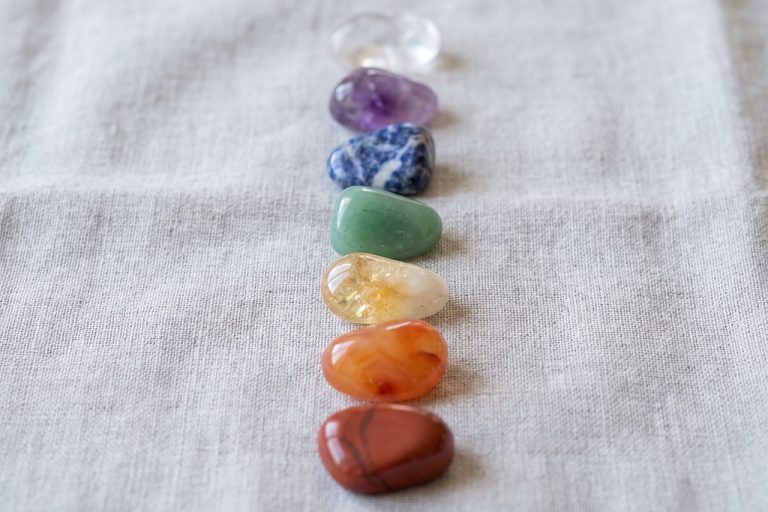
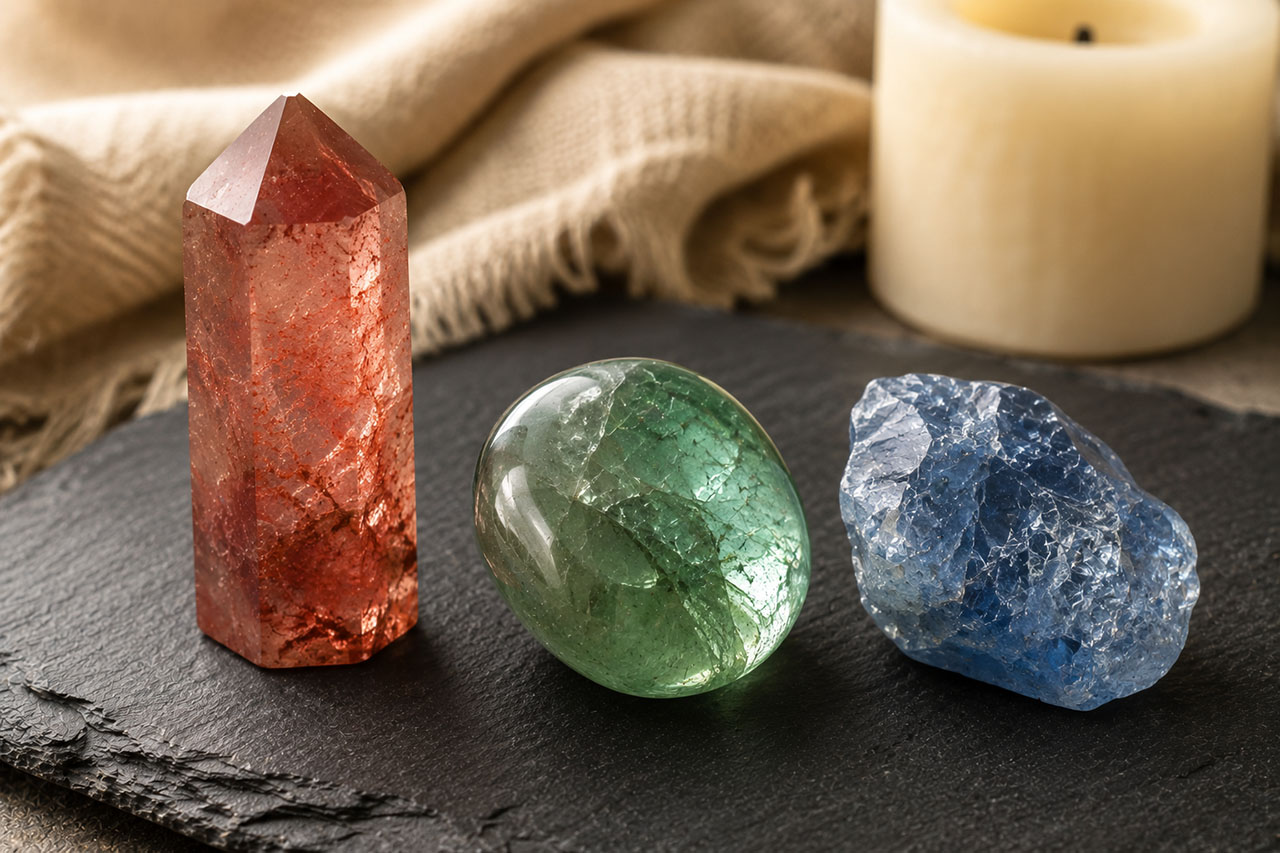
Red quartz goes to the root centre, green quartz to the heart and blue quartz to the throat. All three are quartz, and in each case the colour is what the assignment follows. The mineral underneath makes no difference to it.
That second sentence is the whole logic of the category. Ask a practitioner what red quartz is for and you will get the answers red stones get: steadiness, physical presence, being planted. Green quartz gets the heart answers, warmth and repair. Blue quartz gets the throat answers, saying the thing and saying it calmly.
The three are not related to each other in any deeper way. They share a mineral name and they share the fact that somebody looked at each of them, saw a colour, and filed it. That is how the correspondence charts work and there is nothing underhand about it.
The tradition never has to answer the next question, but a buyer does. Where is the colour?
The red is iron, sitting inside
Take a red quartz and the red is not in the silica. It is iron oxide sitting inside the crystal as inclusions, hematite in the ordinary case, in fibres and plates fine enough to be spread through the host.
Hematite in the lump does not look the way you would expect. The Handbook of Mineralogy gives its colour as steel-grey through dull to bright red, with a cherry-red streak and deep blood-red internal reflections in reflected light. Gemmologists writing up a hematite rose inside a quartz cabochon in Gems & Gemology describe the mechanism: the platelets are very thin, and “these very thin plates reveal a deep red color in transmitted light.”
The red in a red quartz, then, is not a red mineral seen whole. It is a mostly metallic-looking iron oxide, cut thin enough by its own growth habit for light to come through it, dispersed in something clear. Change the thickness and the spacing and the same element does something else: as heat-treated quartz is pushed further, iron exsolves as hematite particles around 100 nanometres across, and the stone moves from yellow towards brown.
Green comes out of an oven
Green quartz has a proper name, prasiolite, and a fairly blunt story behind it. Reviewing the coloured quartz varieties in the Journal of Gemmology, Ulrich Henn and Rainer Schultz-Güttler write that “the so-called natural prasiolite is very rare and in Nature it has probably formed as a result of heating from nearby volcanic activities”, and that “the prasiolite offered on the gemstone market nowadays is heat-treated amethyst, much of it probably coming from the Montezuma mine in Minas Gerais, Brazil.” Their own summary table lists prasiolite in one line as heated amethyst.
The heating has been measured. In a controlled study of twenty South African amethysts, Renping Cheng and Ying Guo found little change below 360 degrees Celsius. At 380 the violet begins to fade and the stone passes through colourless. Between 420 and 440 it turns light green. Keep going and it goes yellow, with about 560 degrees given as the working temperature for citrine.
A piece of green quartz in a shop is, on Henn and Schultz-Güttler’s account, amethyst that somebody stopped heating at the right moment. That is not a scandal and it is not hidden. The silica is unchanged, the colour is stable in ordinary use, and the trade calls the result prasiolite.
One complication, because the same paper carries it. A second green quartz, from the south and southwest of Brazil, is also sold as prasiolite, and its green comes from irradiation rather than heat. The two separate under a Chelsea filter, one showing green and the other red, and the irradiated one loses its colour after an hour or two at 150 degrees. Two different green quartzes, one name on both.
Blue is something trapped inside
Blue is the odd one. Amethyst is quartz coloured from the inside by a defect in the crystal itself, violet all the way through. Blue quartz is quartz with a blue mineral in it.
A team at the National Gemstone Testing Center in Shenzhen set out the general position in Gems & Gemology in 2025 before reporting an exception to it. They begin by saying that “blue color in quartz is usually caused by micro-inclusions of dumortierite.” Other blue minerals do get trapped in quartz, chrysocolla and apatite among them, and “they have not been known to impart a blue bodycolor to quartz.” The exception was three spheres coloured by blue elbaite, a tourmaline, which the authors call a rare case. Being blue and being inside quartz is not, by itself, enough.
Even dumortierite does not guarantee it. In one Brazilian quartz, GIA found blue dumortierite needles through much of the material and colourless dumortierite needles in a single sample, chemically close except for magnesium, which GIA describes as “almost 10 times higher” in the colourless ones: 1070 parts per million atomic against 127. Higher magnesium, less blue, which is not the direction anybody would guess, and the authors say that more research is needed.
Then a laboratory curiosity, and it is not something you can do at home. In llanite, a rhyolite from Llano County, Texas, the blue quartz is blue by scattering rather than by absorption, from ilmenite grains too small to see. Michael Zolensky and colleagues recorded in American Mineralogist that the crystals “are blue only in reflected light, being reddish in transmitted light.” That was on separated grains under a binocular microscope and on a polished thin section, not on anything held up to a lamp, and the same paper adds that it is probable that all blue quartzes do not contain the same mineral inclusions. One Texan rock behaving beautifully, and not a test for your cabochon.
Purple, then green, then blue
Put the treatment findings in order and one line runs through them.
Start with amethyst. Heat it into the 420 to 440 range and it is green, and the trade calls it prasiolite. Take that prasiolite, irradiate it with gamma rays and heat it again, and Henn and Schultz-Güttler record that it comes out “violet-blue to dark blue”, sold as blueberry quartz. Their figures show amethyst, the heated green and the blue all from the same Montezuma material.
Two of the three colours in the title of this article, then, can be the same stone at two stops, and the stone started purple. Citrine is a later stop on that same ramp: keep heating past the green and the yellow arrives.
The reading is untouched by any of that. Crystal practice assigned these colours to those centres because of the colours, and a green stone is green whichever route it took. What changes is what you are choosing between at a table with three of them on it, and the one piece of care advice that matters here.
The hazard is heat
The rule people arrive with is about water, and for these three it is aimed at the wrong thing. Quartz is not water soluble and a rinse does nothing to it.
Heat is the variable. The two colours a technician arranges were arranged with heat, at temperatures a kitchen does not reach and a jeweller’s torch passes straight through. The irradiated green gives up at 150 degrees. Amethyst starts moving at 380. If a coloured quartz is going to change on you, heat will do it, or long strong sunlight, and not the tap.
There is a buying habit that goes with that, learned the slow way. A grape agate cluster we ordered online arrived duller than its listing photograph, which had clearly been shot in strong sun. Nothing about the material had been misrepresented. Coloured quartz behaves the same way in a bright window, and the fix is to assume the indoor appearance is the true one and buy on that.
The answer to where the colour is, in all three cases, is that it is not in the silica. Iron cut thin by its own growth does the red. Heat did the green, at a temperature somebody chose. And the blue belongs to a mineral that happens to be sitting in there. The quartz varieties have an entry each in the Crystalance Mineral Library if you want to see how far apart the three of them really sit.
Sources
- Henn, U. and Schultz-Güttler, R., “Review of some current coloured quartz varieties”, The Journal of Gemmology 33(1 to 4), 2012, pp. 29 to 43, for prasiolite as heat-treated amethyst including the “so-called natural prasiolite is very rare” wording and the Montezuma attribution, for the summary table listing prasiolite as heated amethyst and blueberry quartz as irradiated and heated prasiolite, for the second green quartz from the south and southwest of Brazil coloured by irradiation, separated on a Chelsea filter and bleaching at 150 degrees, and for the roughly 100 nanometre hematite particles that carry heat-treated quartz from yellow towards brown: gem-a.com
- Cheng, R. and Guo, Y., “Study on the effect of heat treatment on amethyst color and the cause of coloration”, Scientific Reports 10, article 14927, 2020, for the twenty South African amethysts and the temperature stages: little change below 360 degrees, violet fading from 380 through colourless, light green between 420 and 440, yellow above that, and about 560 degrees as the working figure for citrine: nature.com
- Liang, R., Ma, Y., Li, H., Du, R. and Chen, M., “Blue Color in Quartz Caused by Elbaite Inclusions”, Gems & Gemology Gem News International, Fall 2025, for blue in quartz usually being dumortierite micro-inclusions, for other blue minerals not being known to impart a blue bodycolour, and for the three resin-impregnated spheres coloured by blue elbaite that the authors describe as a rare case: gia.edu
- Renfro, N., Sun, Z. and Koivula, J., “Dumortierite in Rock Crystal Quartz”, Gems & Gemology Gem News International, Spring 2015, for the blue and colourless dumortierite inclusions, for magnesium “almost 10 times higher” in the colourless ones at 1070 against 127 parts per million atomic, and for the authors’ statement that more research is needed: gia.edu
- Zolensky, M. E., Sylvester, P. J. and Paces, J. B., “Origin and significance of blue coloration in quartz from Llano rhyolite (llanite), north-central Llano County, Texas”, American Mineralogist 73, 1988, pp. 313 to 323, for the crystals being blue in reflected light and reddish in transmitted light under petrographic examination of separated grains and a doubly polished thin section, for Rayleigh scattering from submicrometre ilmenite, and for the statement that it is probable that all blue quartzes do not contain the same mineral inclusions: minsocam.org
- Forsberg, C., Skalwold, E. A. and Bassett, W. A., “Hematite in Quartz: A Rose by Any Other Name”, Gems & Gemology Micro-World, Fall 2017, for the very thin hematite plates of a hematite rose inclusion revealing a deep red colour in transmitted light: gia.edu
- Handbook of Mineralogy, Hematite, Mineral Data Publishing, for the colour given as steel-grey, dull to bright red, with a cherry-red streak and deep blood-red internal reflections in reflected light: handbookofmineralogy.org
- MIN-005 and FAIL-001, Crystalance Personal Experience Library: a grape agate cluster ordered online against a listing photograph shot in strong sunlight, which arrived noticeably duller in ordinary indoor light.