
Tourmaline (Black)
Cyclosilicate
Black, dark brown, blue-black
Vitreous to resinous
7 - 7.5
3.06 - 3.25
Trigonal
Brazil, Pakistan, USA, Africa, Sri Lanka, Australia
Very common; high-quality crystals moderately common
NaFe₃Al₆(Si₆O₁₈)(BO₃)₃(OH)₃(OH)
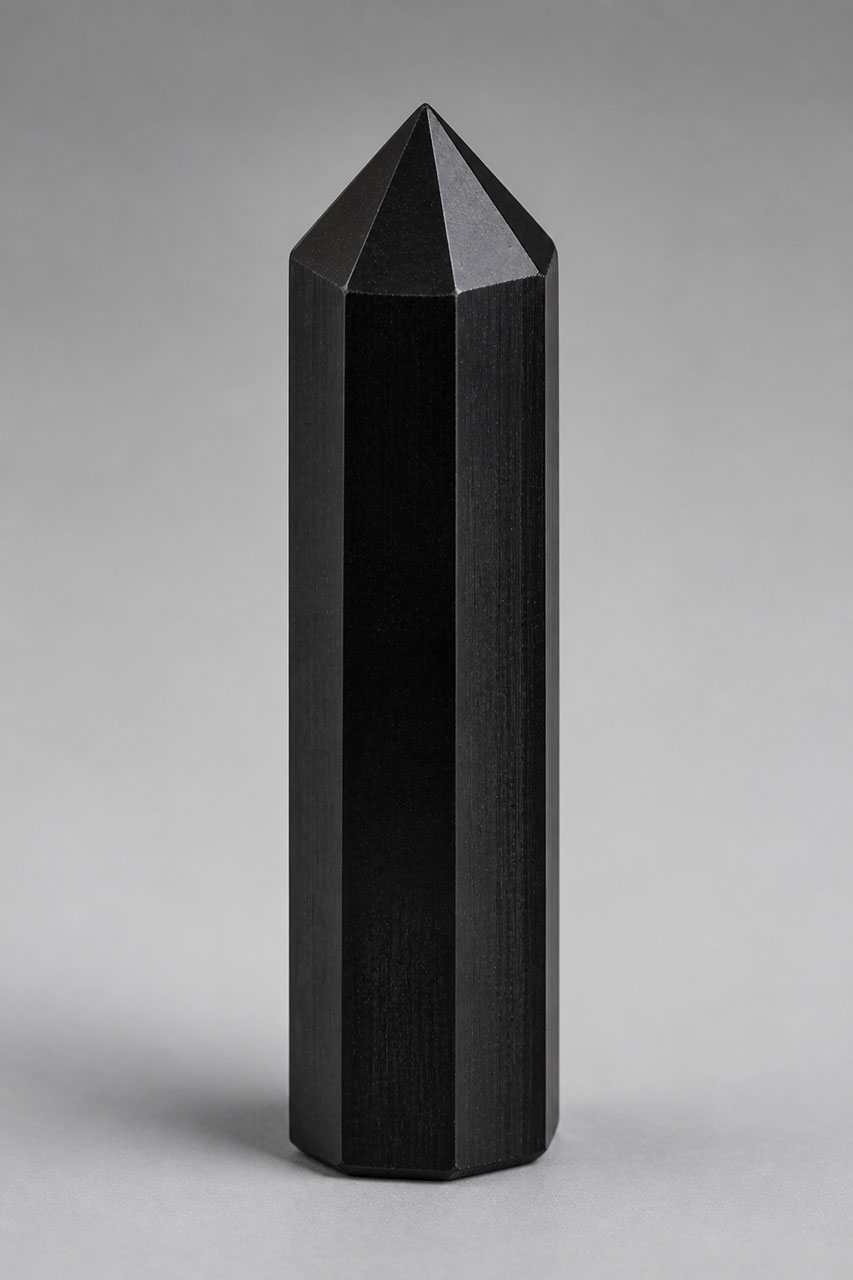
German tin miners called these black crystals "schorl," a name probably taken from a Saxon village, though its exact origin is still debated. In modern crystal practice the stone has gathered a protective reputation that has only grown stronger. Practitioners call black tourmaline Earth's most powerful energetic bodyguard.
Black tourmaline represents nature's own security system, crystallized into striated columns of deep black that seem to absorb light itself. As the most common member of the tourmaline family, it forms in granite pegmatites and metamorphic rocks worldwide, yet its abundance hasn't diminished its metaphysical significance. If anything, its widespread availability seems providential, as if Earth herself ensured her children would have access to this protective ally.
The mineral's journey from geological specimen to metaphysical powerhouse accelerated in the modern era as practitioners discovered what they describe as its unparalleled ability to transmute negative energy. From desk talismans in our electronic age to psychic shielding in energy work, black tourmaline has become the go-to stone for those seeking energetic protection without isolation.
Today, whether placed near computers as a desk talisman, worn as jewelry for personal protection, or used in crystal grids to secure sacred spaces, black tourmaline continues its role as a guardian stone. It remains proof that sometimes the most powerful allies come in the most unassuming packages—basic black never goes out of style, especially when it comes to energetic protection.
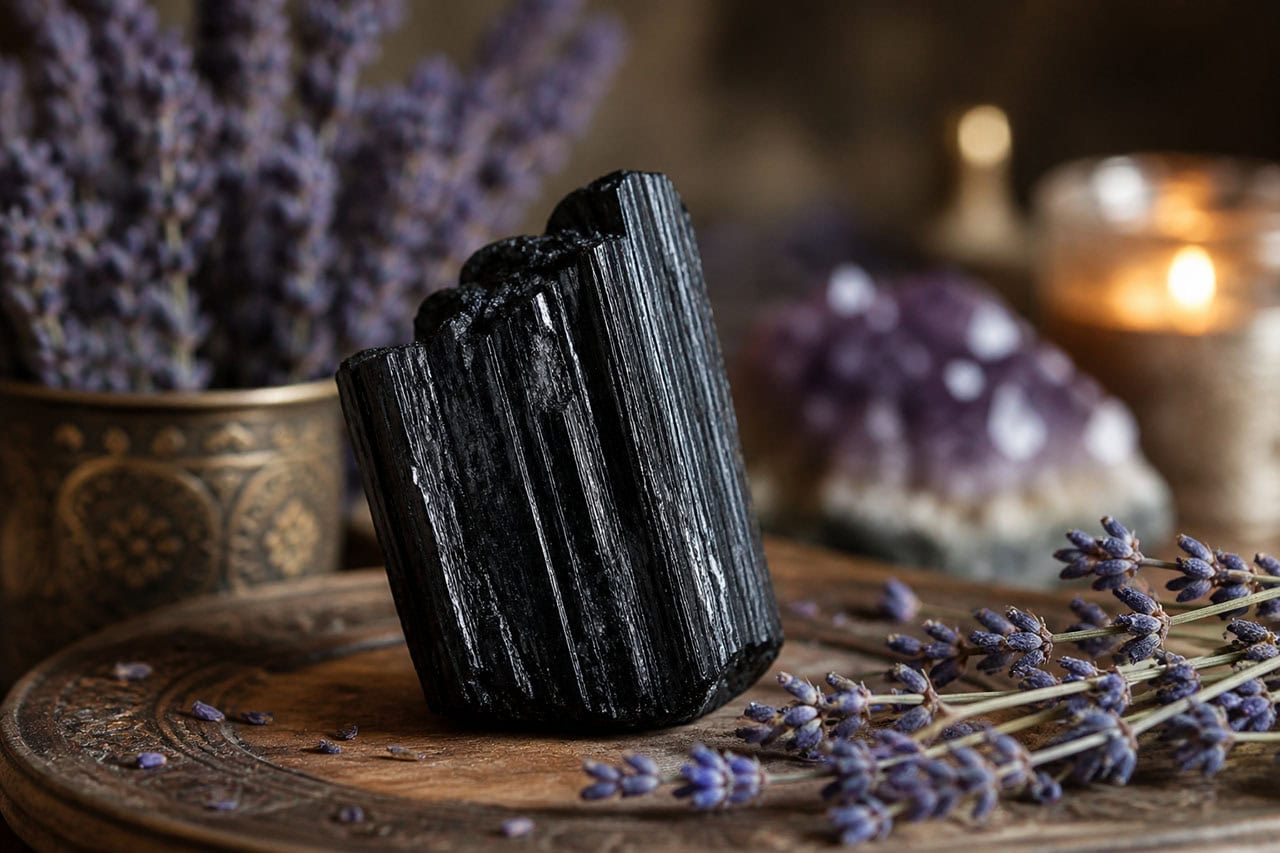
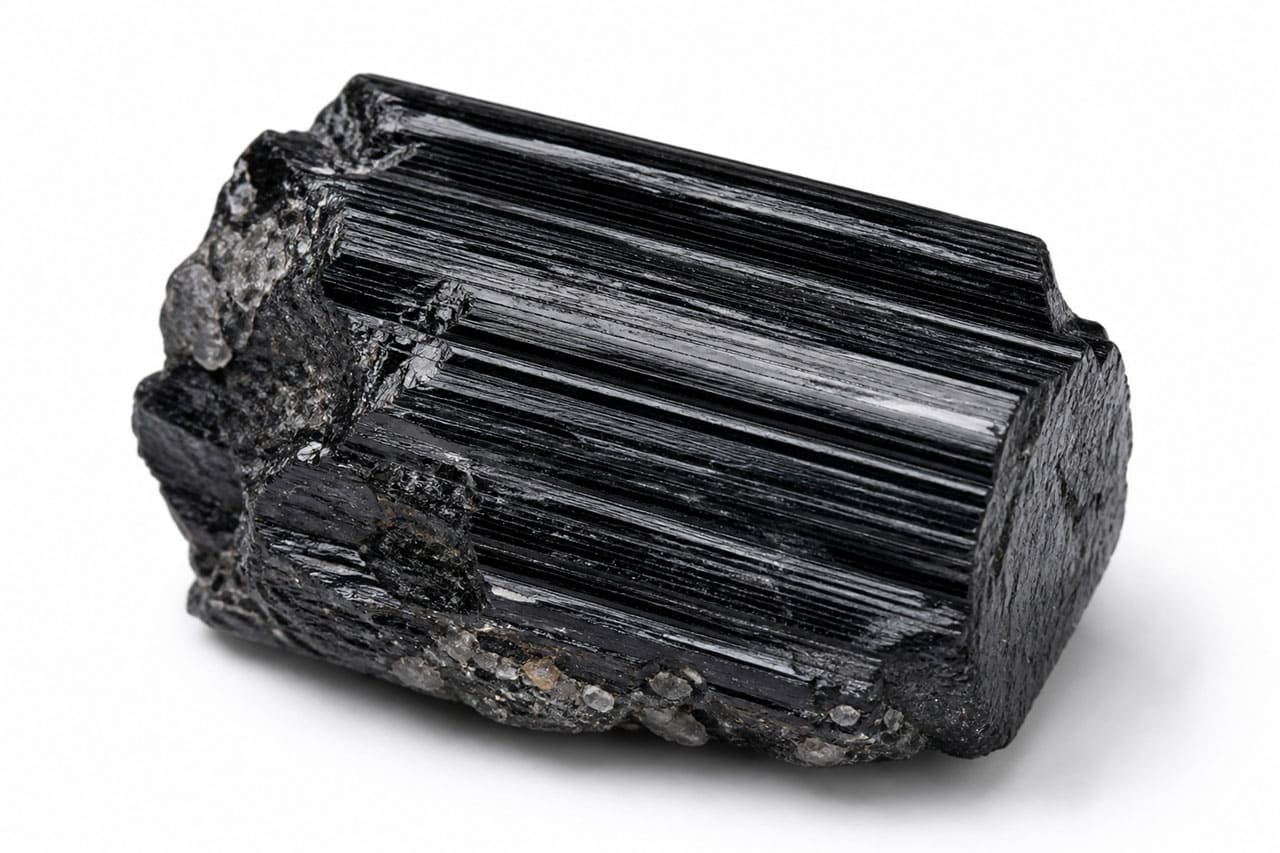
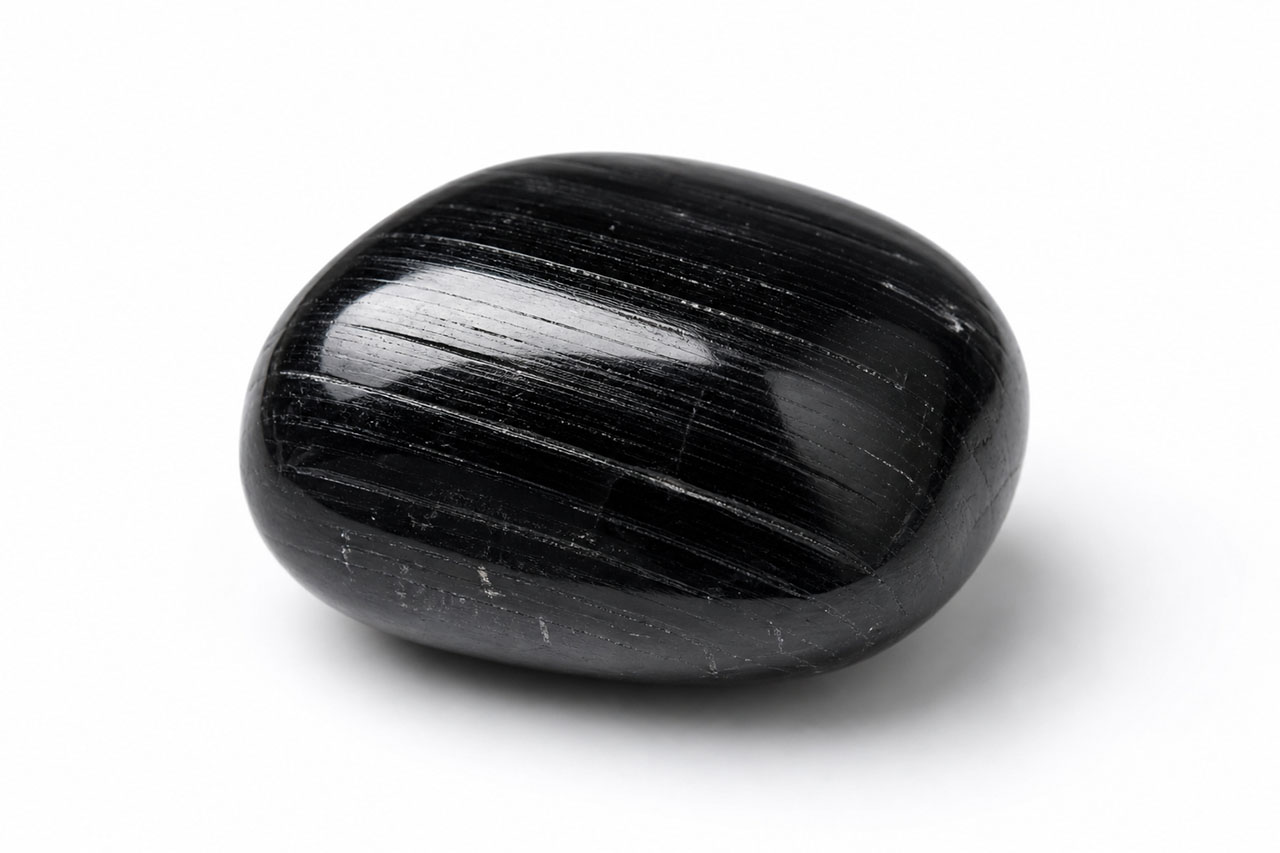
TABLE OF CONTENTS
Properties & Qualities
Physical Properties
Black tourmaline reveals itself through distinctive vertical striations that run the length of its prismatic crystals, creating a corrugated texture that's immediately recognizable. These parallel grooves, formed by the mineral's trigonal crystal system, give even rough specimens an architectural quality, as if nature carved tiny columns from solid shadow.
The color ranges from pure black to very dark brown or blue-black, with the intensity depending on iron content. Unlike some black minerals that appear flat or dull, black tourmaline often shows a subtle shine, a vitreous to resinous luster that catches light along crystal faces and edges. When held to bright light, thin sections may show deep blue or brown translucency, revealing that the "black" is actually extremely dark color.
Crystal habits vary from needle-thin crystals to thick, stubby prisms that can reach impressive sizes. Brazilian specimens often form in radiating clusters called "tourmaline suns," while Pakistani material frequently shows well-formed individual crystals with complex terminations. The crystals often show triangular cross-sections with curved sides, a distinctive feature of tourmaline.
One of black tourmaline's most intriguing properties is its pyroelectricity and piezoelectricity: it develops electrical charge when heated or pressured. This isn't just theoretical; Dutch traders in the 1700s used heated tourmaline to draw ash from their pipes, calling it "aschentrekker" (ash drawer). This electrical property is the root of the stone's modern reputation as a shielding stone, though it does not block electromagnetic fields.
Black tourmaline is hard but brittle, and raw pieces can chip. It breaks with an uneven to conchoidal fracture. Modern lapidaries appreciate its ability to take a high polish, though most metaphysical users prefer it in its raw, striated form.
Metaphysical properties
Within metaphysical traditions, black tourmaline reigns supreme as the ultimate protection stone. Its reputation as an "energetic bodyguard" stems from practitioners' reports of its ability to create an impenetrable shield against negative energies, psychic attacks, and environmental stressors. Unlike stones that protect by hiding or cloaking energy, black tourmaline allegedly transmutes negativity into neutral or positive energy.
The stone's primary resonance occurs with the root chakra, creating what practitioners describe as an "energetic anchor" that grounds spiritual energy into Earth while simultaneously drawing Earth energy up through the body. This bidirectional flow reportedly creates a stable energetic foundation that makes one less susceptible to external influences.
Black tourmaline's electrical properties translate into interesting metaphysical interpretations. Many practitioners describe it as an energetic shield around the aura that deflects negative energies. This has made it a popular desk and bedside stone, though it does not block electromagnetic fields.
The stone's ability to absorb and transmute extends beyond protection. Energy workers report that black tourmaline can help clear energetic debris from the aura, almost like an energetic vacuum cleaner. However, practitioners note that it needs regular cleansing due to this absorptive quality—it's working hard on your behalf.
Contemporary energy workers often describe black tourmaline as providing "protection without isolation." Unlike some protective stones that can make users feel cut off from others, black tourmaline allegedly maintains healthy energetic boundaries while allowing positive connections to flow freely.
Meaning & Symbolism
Physical meaning
In physical symbolism, black tourmaline represents the principle of healthy boundaries and energetic hygiene. Just as the body has an immune system to protect against pathogens, black tourmaline is said to provide a kind of energetic immunity against harmful influences. Its formation in high-temperature, high-pressure environments symbolizes the strength that comes from enduring and transforming challenging conditions.
Its grounding properties extend to physical vitality. Users often report feeling more energetically stable and less drained when working with black tourmaline, as if it helps prevent energy leaks that lead to fatigue. This has made it popular among healthcare workers, teachers, and others in energetically demanding professions.
The mineral's striations running along its length have been interpreted as representing aligned energy flow. Just as the crystal's structure shows clear directional organization, black tourmaline allegedly helps organize scattered energy into coherent patterns.
Athletes and martial artists sometimes work with black tourmaline for what they describe as "energetic armor"—maintaining their own energy field integrity during competition or training. The stone's protective qualities allegedly extend to physical space, helping maintain focus despite distractions.
Spiritual meaning
Black tourmaline's spiritual significance centers on its role as a guardian of spiritual sovereignty, the right and ability to maintain one's own energy field free from unwanted influences. Many practitioners view it as essential for anyone doing spiritual work, as opening to higher frequencies can sometimes make one more sensitive to lower ones as well.
The stone's deep black color connects it to the void, not as emptiness but as the pregnant darkness from which all creation emerges. Working with black tourmaline allegedly helps one become comfortable with the unknown, the shadow aspects of self, and the mysteries that resist easy answers. This makes it valuable for shadow work and integration practices.
In modern shamanic-style practice, black tourmaline is often used for psychic protection during journey work. Its grounding properties help maintain connection to physical reality while exploring other realms, acting as an energetic lifeline that ensures safe return. Some practitioners describe it as creating a "protective circle" similar to those cast in ritual work.
The mineral's formation in pegmatites, the last stage of granite crystallization, has spiritual significance. Just as pegmatites represent the final, most evolved stage of igneous activity, black tourmaline allegedly helps with spiritual completion and integration, ensuring that spiritual growth remains grounded and practical.
Different paths emphasize different aspects. Some focus on its ability to deflect curses or ill wishes, others on its capacity to help maintain energetic integrity during challenging spiritual initiations. Across these practices, it is treated as an ally for spiritual warriors, those who engage with shadow for transformation.
Healing Benefits
Physical healing
Black tourmaline in crystal healing is a matter of practice and tradition, not medicine. Practitioners use it as a grounding stone and place it at the feet or the base of the spine during sessions aimed at a settled, steady feeling.
Many people keep a piece in a pocket, on a desk or by the bed as a reminder to pause and breathe. It does not block electromagnetic fields or radiation, and it is no part of any medical treatment.
Black tourmaline is not a substitute for medical care. If something in your body worries you, see a doctor.
Emotional healing
Black tourmaline's reputation in emotional healing centers on its ability to create what practitioners call "emotional sovereignty"—the capacity to feel one's own emotions without being overwhelmed by others' emotional states. This makes it particularly valuable for empaths and highly sensitive people who struggle with emotional boundaries.
The stone allegedly excels at breaking negative thought patterns and mental loops. Users report that carrying black tourmaline helps them recognize when they're spiraling into negativity and provides the energetic support to shift into more balanced thinking. It's often described as a "pattern interruptor" for destructive mental habits.
For those dealing with worry or fear, black tourmaline reportedly provides a sense of energetic protection that translates into emotional safety. Many users describe feeling like they have an invisible shield that deflects others' negativity while maintaining their own emotional equilibrium.
The mineral is frequently recommended for those in toxic environments, whether at work, home, or in relationships. While it can't change external circumstances, users report that black tourmaline helps them maintain their own energy and not absorb the toxicity around them, creating space for healthier responses.
Practitioners suggest using black tourmaline with awareness during times of change or transition, as its protective qualities can sometimes be so strong they prevent necessary growth. The key is using it for stability while remaining open to positive transformation.
Spiritual healing
In spiritual healing contexts, black tourmaline addresses what practitioners identify as "energy leaks" and "psychic vulnerabilities"—places where one's energy field has been compromised by trauma, attack, or unconscious habits. Its reputation for creating energetic boundaries makes it invaluable for healing these breaches.
Energy healers often use black tourmaline for clearing what they term "energetic parasites" or "attachments"—negative thought forms or entities that drain vitality. The stone's transmutative properties allegedly convert these negative attachments into neutral energy that dissipates harmlessly.
The mineral's grounding force makes it valuable for those experiencing "spiritual emergency"—when kundalini or other spiritual energies activate too quickly or intensely. Black tourmaline reportedly helps regulate these energies, providing stability while integration occurs.
For ancestral healing work, black tourmaline is used to break negative ancestral patterns, particularly those involving victimization, powerlessness, or energetic violation. Practitioners describe it as helping to "seal" ancestral wounds that have left family lines vulnerable to repeated traumas.
Some healers specialize in using black tourmaline for "cord cutting"—severing unhealthy energetic connections to people, places, or situations. Its protective qualities allegedly help maintain the integrity of these energetic boundaries once established.
Use & Care
How to use
- Desk talisman: Place near computers and devices as a reminder to take screen breaks
- Pocket guardian: Carry raw or tumbled pieces for all-day energetic protection and grounding
- Jewelry wearing: Wear as pendants, bracelets, or rings for continuous protective shield
- Home protection: Place in corners of rooms or at entrances to create protective grid
- Meditation anchor: Hold during meditation to maintain grounding while exploring consciousness
- Sleep protection: Place under bed or on nightstand to protect during vulnerable sleep state
- Workspace shield: Keep on desk to maintain energetic boundaries in challenging work environments
- Car protection: Place in vehicle for protection during travel and commutes
- Bath ritual: Place around tub (not in water) during cleansing baths to absorb released negativity
- Grid cornerstone: Use as corner stones in protective grids around home or sacred space
How to cleanse
- Earth burial: Bury in soil for 24-48 hours to discharge absorbed negativity and reground
- Running water: Hold under running water while visualizing negativity washing away
- Smudging: Pass through sage or palo santo smoke—especially important for black tourmaline
- Salt burial: Bury in sea salt overnight for deep cleansing (rinse after)
- Sunlight: Place in full sun for several hours to burn off accumulated negative energy
- Sound cleansing: Use bells, singing bowls, or drums to shake loose absorbed energies
- Breath work: Hold while doing forceful exhales, imagining negativity leaving stone
- Regular cleansing: Black tourmaline works hard absorbing negativity—cleanse weekly or more
- Selenite contact: Place on selenite overnight for gentle but thorough clearing
How to charge
- Earth charging: Place directly on soil to reconnect with Earth's protective energy
- Full sun: Charge in strong sunlight to activate protective and transmutative properties
- Hematite combination: Place with hematite to amplify grounding and protective qualities
- Intention setting: Hold while stating protective intentions clearly and forcefully
- Root chakra toning: Use root chakra frequencies or drums while holding stone
- Black candle ritual: Set beside a black candle during protection rituals, never in the flame
- Storm charging: Some practitioners set it on a windowsill during thunderstorms
- Group charging: Charge in protection circles or group grounding meditations
- Salt circle: Place in center of salt circle under full moon for protective charging
Combining with other stones
- Clear Quartz: Amplifies black tourmaline's protective properties and helps direct energy
- Selenite: Keeps black tourmaline cleansed while maintaining high vibration
- Hematite: Creates ultra-grounding combination for severe energetic disruption
- Smoky Quartz: Enhances transmutation abilities for converting negative to positive
- Obsidian: Different but complementary protection—obsidian reveals, tourmaline shields
- Labradorite: Adds psychic protection to black tourmaline's general shielding
- Amethyst: Brings spiritual protection to complement black tourmaline's energetic shielding
- Rose Quartz: Softens black tourmaline's sometimes harsh energy with love vibration
- Shungite: Adds grounding and protection for modern environments
Identification
Can be mistaken for
- Obsidian: Also black but volcanic glass with conchoidal fracture, not crystalline
- Hornblende: Similar black crystals but different crystal structure and properties
- Augite: Black pyroxene that can look similar but has different crystal angles
- Black Kyanite: Also striated but has perfect cleavage in one direction
- Aegirine: Another black crystal but typically more needle-like with different terminations
- Jet: Black but organic (fossilized wood), much lighter weight than tourmaline
- Hematite: Metallic black with very different luster and much higher density
- Biotite: Black mica that flakes into sheets unlike tourmaline's prismatic crystals
How to spot a fake
- Striation check: Real black tourmaline shows vertical striations along crystal length
- Weight test: Should feel moderately heavy, not light like plastic or coal
- Crystal structure: Look for triangular cross-section with curved sides
- Price consideration: Very cheap black tourmaline, especially large pieces, may be other materials
- Surface examination: Natural specimens show growth patterns, not molded appearance
- Source verification: Know typical appearance from claimed localities for authenticity