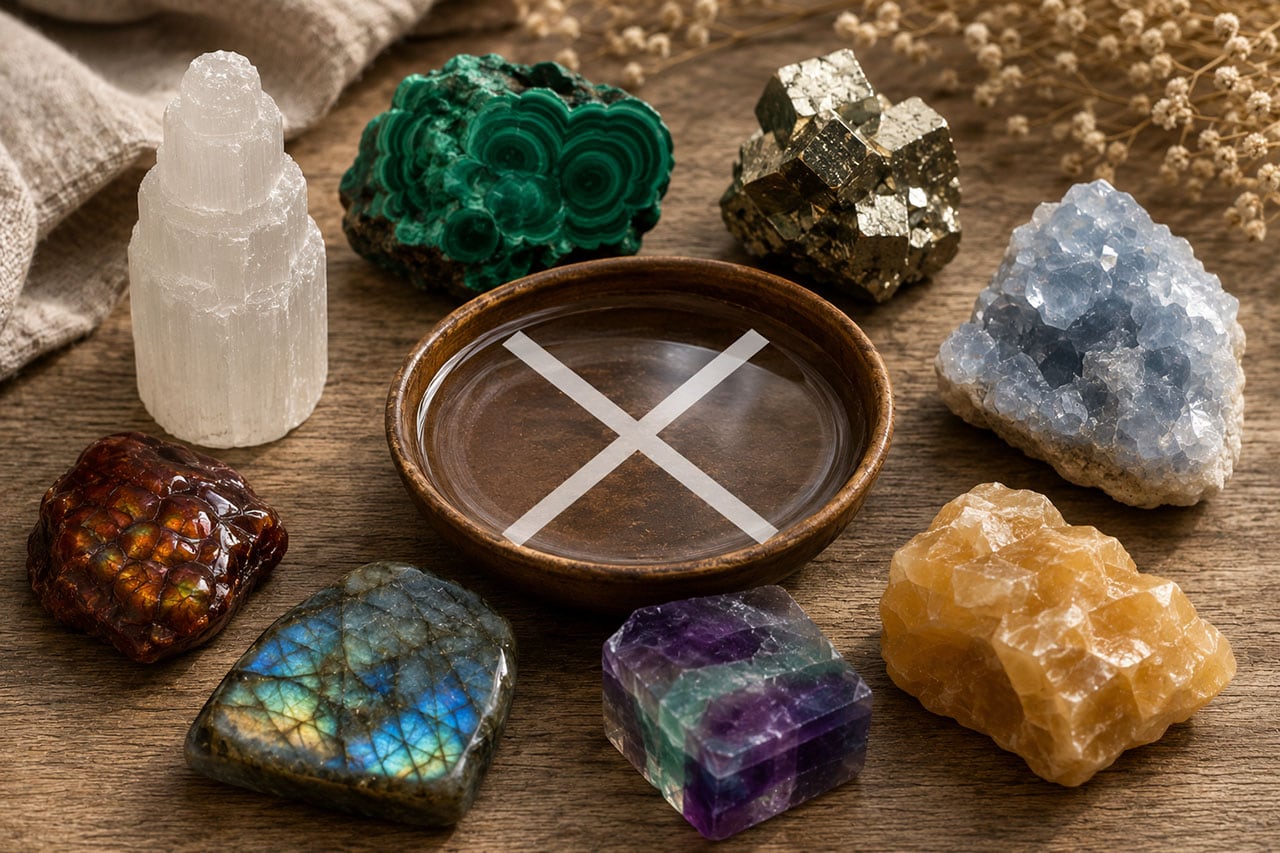
Keep selenite, halite, calcite, celestite, malachite and pyrite out of water, along with most stones softer than about 5 on the Mohs hardness scale. A few dissolve, a few rust, and one or two are toxic. Quartz-family stones are fine.
The list of crystals to keep dry is real, and most of the reasons given for it are borrowed. Crystal sites copy one another, so you will read that water seeps between a stone’s layers, or that a porous crystal soaks up moisture and cracks, phrases that sound like mechanisms but rarely name a real one. Only a handful of stones genuinely cannot get wet. The accurate version of the list is shorter and more specific than the usual one, and it comes down to three things a stone can do in water: dissolve, rust, or poison the water.
The stones that dissolve
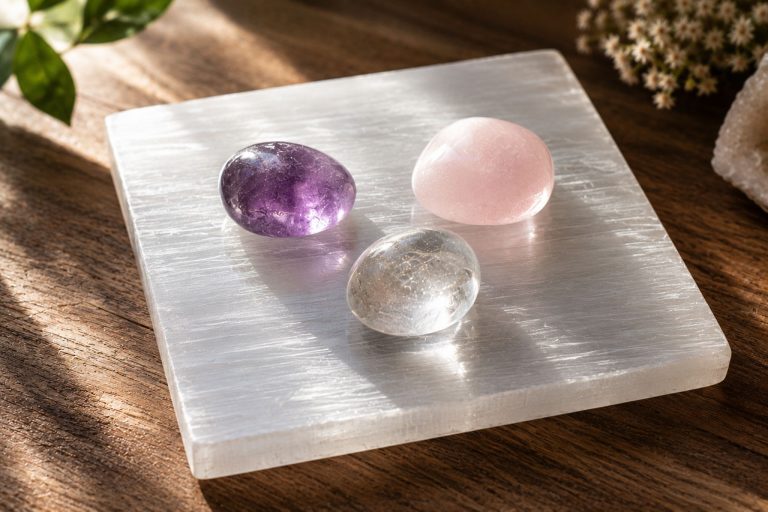
Some crystals simply come apart in water, because the mineral itself is soluble. Selenite is the one to fix in memory. It is a crystal form of gypsum, soft at Mohs 2, and it is soluble, so leave it wet and the surface pits, clouds and eventually gives way. Halite is more dramatic still, because halite is rock salt, and salt dissolves the moment it meets water.
Calcite, in all its colours, is calcium carbonate at Mohs 3 and slightly soluble, so repeated rinsing dulls the surface and softens the fine detail even where a single splash does little. Celestite, a strontium sulfate at roughly Mohs 3 to 3.5 with cleavage that parts easily, loses its delicate blue crystals to water the same way. None of these four is a maybe. Keep them dry and cleanse them by some other route.
The stones that rust
A second group survives water chemically but corrodes because of the iron in it. Pyrite is the clear case. It is iron sulfide, and in the presence of oxygen and water it oxidises, forming iron oxides and sulfuric acid on and inside the stone. Collectors call the slow crumbling that follows pyrite decay, and a polished pyrite cube left damp will bloom rust-brown and, given long enough, fall apart.
Hematite sits on the edge of this group. It is iron oxide already and hard enough, at about 5.5 to 6.5, to take a quick rinse, but it is often listed as water-shy for the same iron reason, so brief contact followed by a proper dry is the safe habit. For the iron stones the rule is not never a drop, but never left wet.
The toxic ones, which matter for water you drink
A third group matters less for the stone than for you, because the mineral is toxic and water is how it reaches you. Malachite is a copper carbonate, the green banded stone, and copper compounds can leach from its surface. Handling it is fine, but malachite should never sit in water you intend to drink, and the gem-elixir recipes that call for it are a genuinely bad idea. Vanadinite is a lead mineral, lead chlorovanadate, and lead is not something to steep in a glass either, so keep it dry, keep it out of any essence, and wash your hands after handling a raw specimen.
When a stone carries a heavy metal, the water question stops being about the stone’s finish and starts being about what you might end up swallowing. That is a different order of caution from a dull surface, and it is the one place in crystal care where getting it wrong can harm you.
The hardness rule, and what it misses
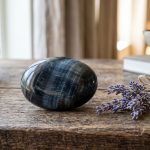
A rough guide gets passed around: keep stones under about 5 on the Mohs scale out of water. It is a fair starting point, because most of the soluble and fragile stones do sit low, with selenite at 2, calcite at 3 and fluorite at 4. Quartz and its wide family, at 7, shrug water off, which covers clear quartz, amethyst, citrine, rose quartz, agate, jasper and tiger’s eye. Black tourmaline, despite a warning copied across half the internet that it is sensitive to moisture, is hardness 7 and not water-soluble, so brief contact does it no harm, though salt water is best avoided for it as for almost any stone.
Hardness is a guide, not a law, and the reasons pinned to it are exactly where care advice tends to go wrong. Pyrite is a hard 6 and still corrodes, because the problem is iron, not softness. The reliable test is not how soft a stone feels but two specific questions: is it soluble, and does it carry iron or a heavy metal? If the answer to both is no, water is almost certainly fine, and if you are unsure about a particular stone, look it up before you dunk it rather than after.
For the stones that must stay dry, the gentle alternatives cost nothing and suit everything: moonlight on a windowsill, sound from a bowl or bell, a rest on a dry salt bed, or the smoke methods set out in how to cleanse, charge, and activate crystals. None of them risks the stone. If you want the fuller map of what is safe in water and what is not, the bathroom and water guide walks through it piece by piece.
Knowing which crystals to keep dry is ordinary care, and with the toxic ones it is a small piece of looking after yourself as much as the collection. When a stone is new to you and you are not certain, the Crystalance Mineral Library lists each mineral’s hardness and care, selenite included, so you can check before the tap runs.
Sources
- Geology Science, Selenite (Gypsum): CaSO4 dot 2H2O, Mohs 2 to 2.5, soluble in water. https://geologyscience.com/minerals/selenite/
- Geology Science, Calcite: CaCO3, Mohs 3, slightly soluble in water. https://geologyscience.com/minerals/calcite/
- Geology Science, Pyrite: FeS2, Mohs 6 to 6.5, oxidises with oxygen and water to form sulfuric acid and iron oxides. https://geologyscience.com/minerals/pyrite/
- Geology Science, Fluorite: CaF2, Mohs 4. https://geologyscience.com/minerals/fluorite/
- Geology Science, Vanadinite: Pb5(VO4)3Cl, a lead-bearing mineral. https://geologyscience.com/minerals/vanadinite/