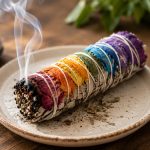
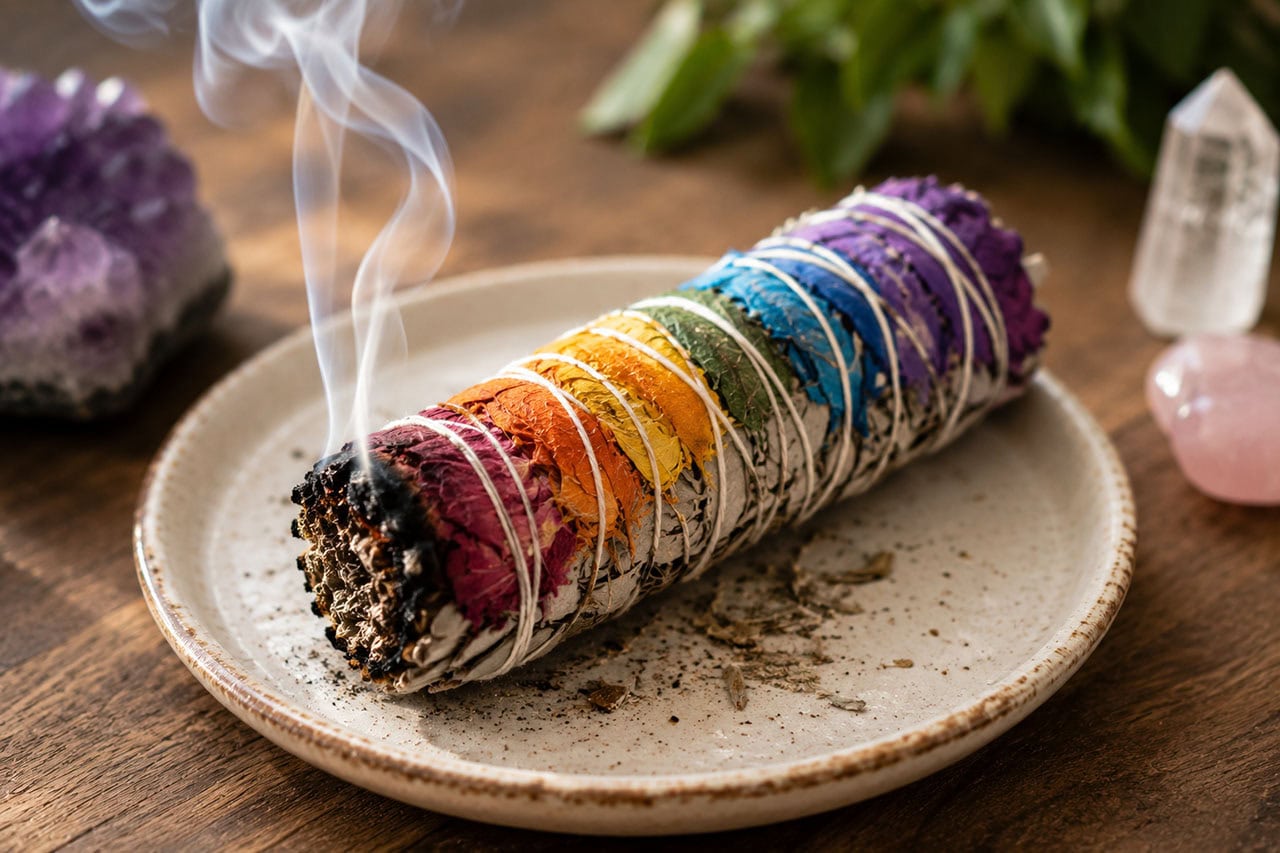
A chakra smudge stick is a smudge bundle (most commonly white sage or a blend of herbs) decorated or built with botanical elements in the seven-chakra colours: red, orange, yellow, green, blue, indigo, and violet. The chakra theme is symbolic rather than functional; the bundle burns the same as a standard smudge stick. Modern crystal practice uses chakra smudge sticks for cleansing and intentional work specifically oriented around chakra-system practice. Here is the working guide.
The “what are chakra smudge sticks?” and “how do you burn a 7 chakra sage?” questions come up because the chakra version of the smudge stick has become widely available in metaphysical shops without much explanation of what makes it different from standard smudge sticks. The honest answer involves both the symbolic difference and the same cultural-source considerations that apply to smudging generally.
What Makes a Chakra Smudge Stick Different
A chakra smudge stick combines several elements.
The base bundle. Usually white sage (Salvia apiana), though some chakra smudge sticks use a blend of herbs including white sage, blue sage, juniper, cedar, lavender, or other plants. The base provides the bulk of the burning material and the primary smoke aroma.
Decorative botanical accents in chakra colours. Dried flower petals, leaves, or small bundles wrapped or tied into the main bundle in the seven-chakra rainbow colours. Common accent botanicals include rose petals (red and pink for root and heart), marigold (orange for sacral), sunflower or yarrow (yellow for solar plexus), eucalyptus or mint (green for heart), lavender or chamomile (blue for throat), purple flowers (indigo and violet for third eye and crown).
The visual presentation. Chakra smudge sticks are usually more visually elaborate than standard smudge sticks, with the colour-banded appearance making them look intentionally decorative as well as functional.
The intentional framing. The chakra version is typically marketed and used with the framing of working through the seven-chakra system, either as a single whole-body practice (clearing all seven chakras at once) or sequentially (focusing on each chakra in turn).
The base burning material is similar to standard smudge sticks. The chakra elements add symbolic and visual richness without fundamentally changing how the bundle functions when burned.
How to Burn a 7 Chakra Sage
The burning practice is similar to standard smudging.
Hold the bundle and light one end. Use a flame source (candle, lighter, match) and hold the bundle in the flame until the leaves catch. Let it burn for 10 to 30 seconds.
Blow out the flame. The bundle should smoulder rather than burn with an open flame. The smouldering produces the smoke for the practice.
Use a heat-safe vessel. Hold a small ceramic dish, abalone shell, or other fire-safe container under the bundle to catch ash and embers. Never burn smudge sticks over flammable surfaces.
Direct the smoke intentionally. For chakra-specific practice, move the smouldering bundle in a sequence from the root chakra area (low on the body) up to the crown chakra area (above the head). This vertical sweep is the most common chakra-smudging pattern.
For each chakra position, pause briefly. State the intention for that chakra or simply hold attention there. Move on to the next when ready.
Extinguish carefully when finished. Press the burning end firmly into sand or a heat-safe surface, or run briefly under cool water (after which the bundle needs to fully dry before reuse). Confirm fully extinguished before leaving the space.
The whole practice takes 5 to 15 minutes depending on how thoroughly each chakra position is held. The bundle can be reused many times across multiple sessions.
Variations on the Practice
A few common variations.
Space cleansing rather than body cleansing. Use the chakra smudge stick to clear a space rather than a body, moving from low corners (root-associated) to higher spaces (crown-associated) of the room.
Single-chakra focus. Use the chakra bundle while focusing on one specific chakra rather than all seven. The bundle is the same; the practice is more concentrated.
Pair with crystals. Lay out chakra-associated crystals (red jasper for root, citrine for solar plexus, rose quartz for heart, etc.) before smudging. Pass the smoke over the crystals as part of the practice. For chakra-stone associations, see how to use crystals for the root chakra and how to set up a crystal altar.
Combine with sound. Use a singing bowl or bell alongside the smudging for a multi-sensory chakra practice. See how to cleanse crystals with words and sound.
Do Chakra Smudge Sticks Work Better Than Plain Ones?
In any measurable sense, no. The chakra elements add visual symbolism and intentional framing but do not change the smoke chemistry or the burning behaviour of the bundle. A practitioner who finds the chakra version more meaningful as ritual will get more out of it; a practitioner who finds the standard bundle equally effective is also right.
The chakra smudge stick is best understood as a more visually elaborate ritual tool oriented toward a specific practice framework (the seven-chakra system). For practitioners whose work is centred on chakra practice, the chakra bundle adds layered symbolism that supports the work. For practitioners whose practice is not chakra-focused, the standard bundle serves the same cleansing function without the extra symbolism.
The Cultural-Source Question
The same considerations apply to chakra smudge sticks as to any smudging practice.
The base material (most commonly white sage) is sacred in specific Native American traditions, particularly among the peoples of California and the American Southwest. Commercial white sage harvesting has raised conservation and cultural-source concerns. The same conversation that applies to using white sage in standard smudging applies to using it in chakra smudge sticks.
For more on this conversation, see are abalone shells sacred, what is copal incense and how to use it, and does palo santo protect.
The chakra system the bundle is themed around is a separate cultural lineage (originating in Indian tantric and yogic traditions, simplified and adapted into the modern Western seven-chakra rainbow system). The combination of Native American smudging materials with Indian-origin chakra symbolism is a product of modern Western eclectic spirituality, drawing from multiple unrelated traditions. Whether this combination feels respectful or fusion-confused is partly a question of how it is held by the practitioner.
A practical alternative for practitioners who want chakra-themed smudging without the white sage concern: chakra smudge sticks made from other base herbs (lavender, rosemary, juniper, cedar) that do not draw from contested Indigenous traditions. The colour-symbol elements remain; the source-tradition layer is removed.
Practical Notes
Storage. Keep chakra smudge sticks in a dry place. The dried botanicals are susceptible to humidity, which can affect both the burning quality and the colour of the decorative elements.
Safety. Treat as fire hazard. Never leave smouldering bundles unattended. Have a heat-safe vessel and an extinguishing method (sand, water) within reach during use.
Ventilation. Smudging produces significant smoke. Ventilate the space during and after the practice. People with asthma or smoke sensitivities should ventilate well or avoid the practice.
Bundle longevity. A single chakra smudge stick lasts many uses (often 10 to 20 sessions depending on bundle size and how long each use is). Trim away charred ends before each use so the burning quality stays consistent.
The Honest Frame
A chakra smudge stick is a visually elaborate ritual tool that combines smudge-burning practice with seven-chakra symbolism. The burning practice itself is the same as for any smudge bundle. The chakra elements add intentional framing for practitioners whose work is oriented around the chakra system. The cultural-source considerations apply to the base material (most commonly white sage) and deserve the same care as for any smudging practice.
For more on the underlying chakra-system practice, see how to use crystals for the root chakra. For the broader cleansing-practice framework, see how to cleanse, charge, and activate crystals. Chakra smudge sticks are one of the more visually appealing crystal-care tools when used with care for both the ritual and the source-tradition considerations. Used carelessly, they become part of the broader concern about how modern Western spirituality borrows from multiple unrelated sources without attending to either. The honest practice is the one that holds the borrowing honestly.