Opal
Mineraloid (amorphous hydrated silica)
Multi-coloured with rainbow-like play-of-color; backgrounds range from white to black; play-of-color displays reds, blues, greens, and more (red being rarest)
Vitreous to waxy
5.5-6
2.09 g/cm³ (relative density)
Amorphous (non-crystalline)
Australia (produces 95% of the world's precious opal), Brazil, Mexico, Honduras, western USA
Common overall; black opals and red-dominant opals are very rare and highly valuable
SiO₂·nH₂O (Hydrated silicon dioxide)
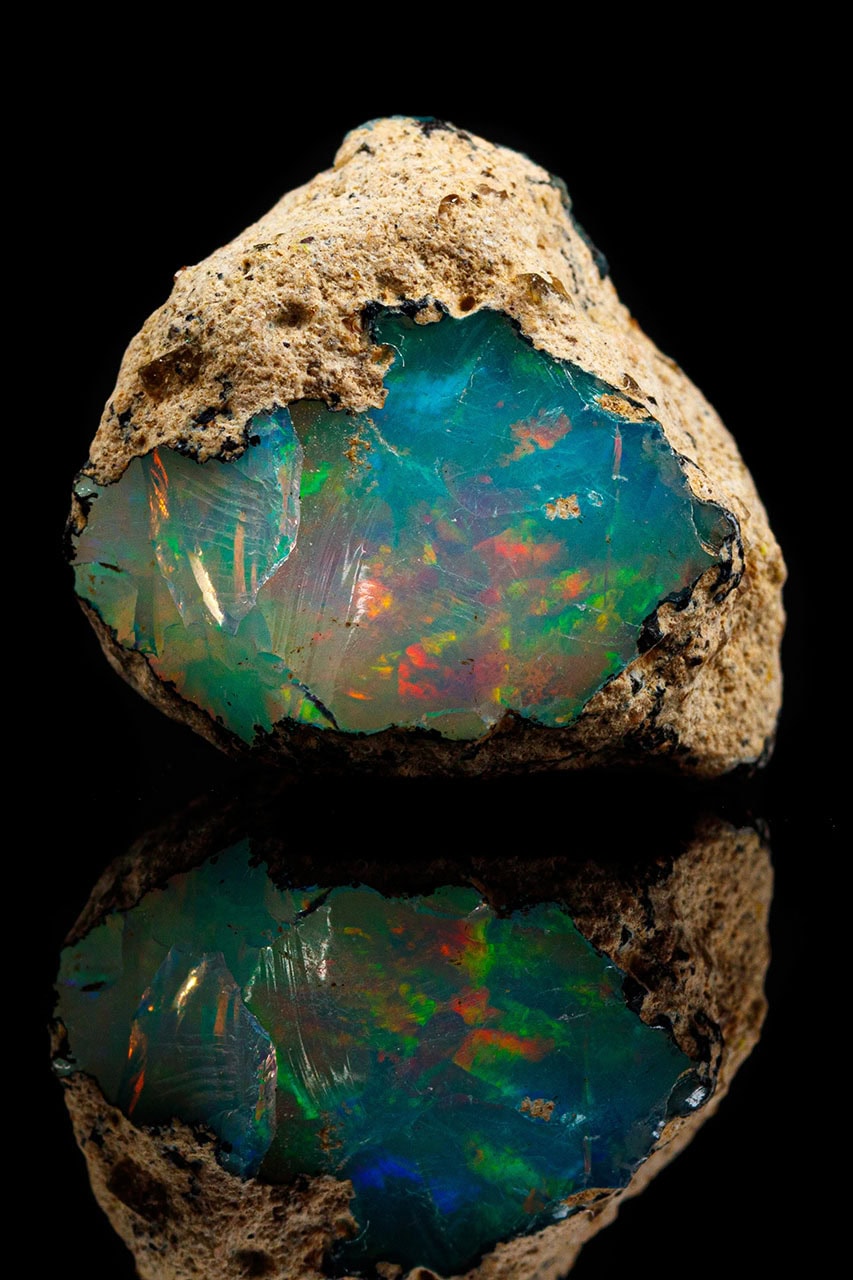
Opal stands apart from nearly every other gemstone as a mineral without a crystal structure—an amorphous mineraloid that captures light in ways no crystalline gem can match. Its very name reflects the wonder it has inspired across cultures: the word "opal" may derive from the Greek opallos, meaning "to see a change (of colour)," or from Sanskrit for "(precious) stone."
The history of opal stretches back thousands of years. Opal artefacts several thousands of years old have been discovered in East Africa, and as early as 250 BC the Romans prized opals believed to have come from mines in Eastern Europe—the ancient world's main source of the gemstone. The ancient Romans revered opal as a symbol of hope and purity, and because opal contained the colors of other gems, they thought it was the most precious and powerful of all. The Bedouins believed that opals contained lightning captured from thunderstorms.
Many Aboriginal Dreamtime stories feature opal, reflecting the gemstone's deep cultural significance in the land that would eventually become its primary source. Australian opals discovered during the late 1800s initially found little favour with European markets, but their commercial value increased dramatically in the 1900s. In 1932, Australia took over as the major producer of opals in the world—a position it holds to this day.
The Australian opal story took a legendary turn in 1915 when a 14-year-old boy prospecting for gold at the edge of the Great Victoria Desert northwest of Adelaide found an opal one night while making camp. This chance discovery started an "opal rush" that founded the settlement of the Stuart Range Opal Field, now known worldwide as Coober Pedy. Together with Lightning Ridge in New South Wales, this region produces the bulk of the world's opal supply.
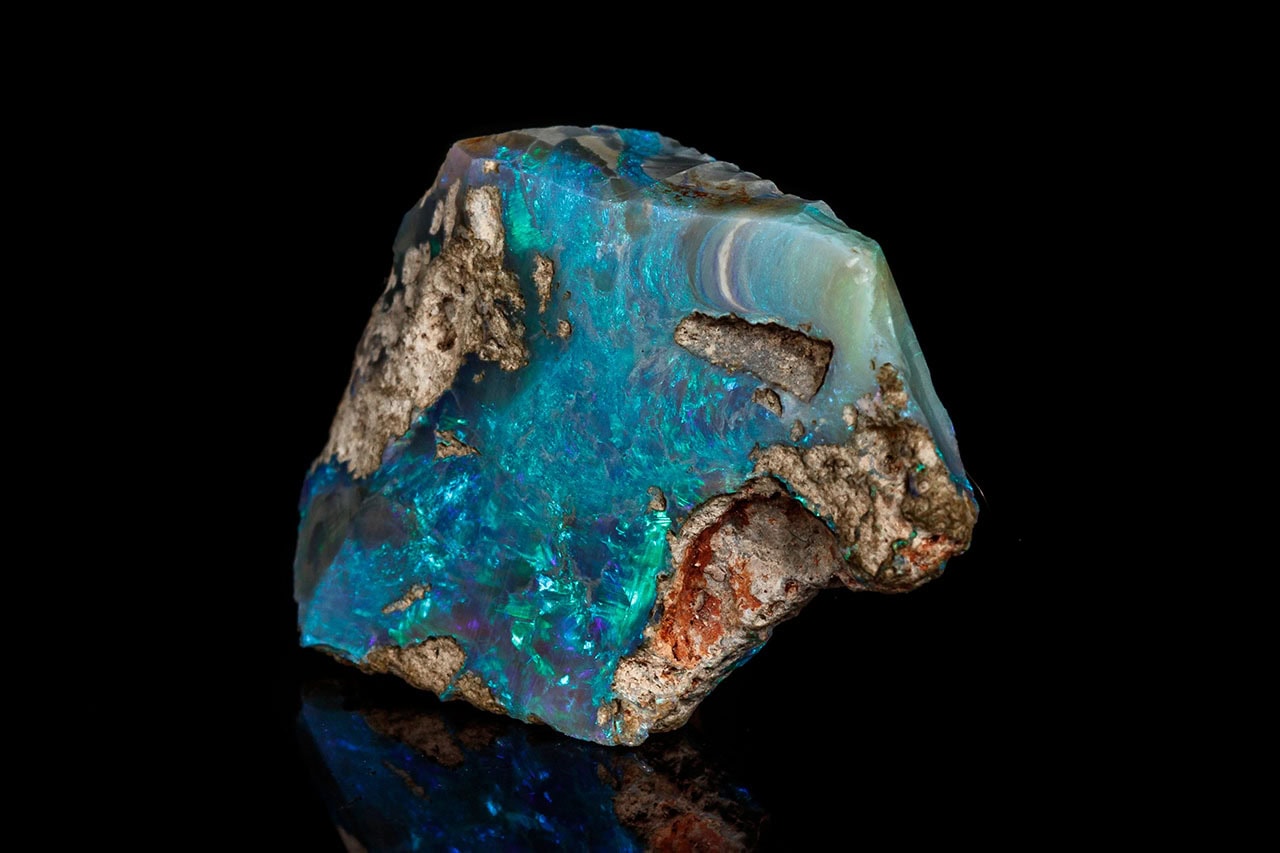
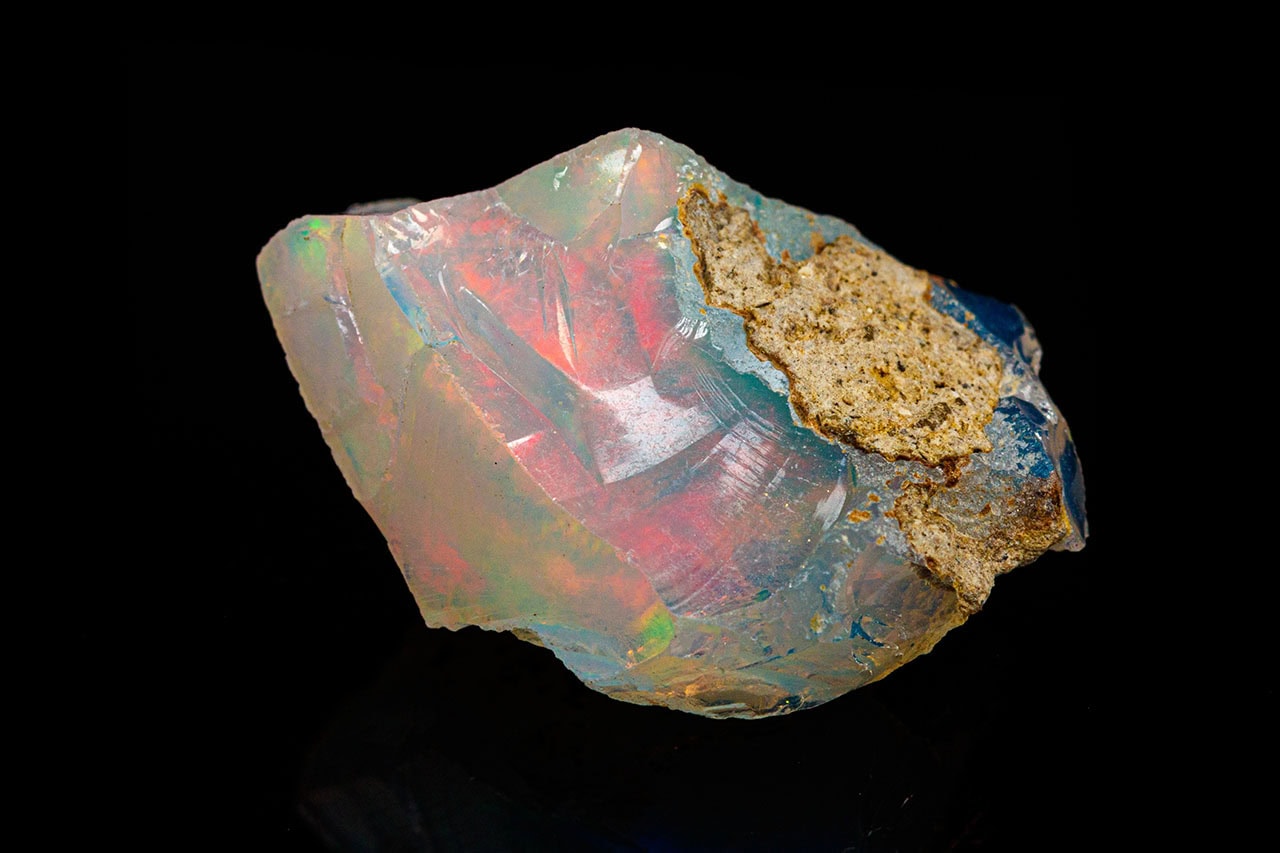
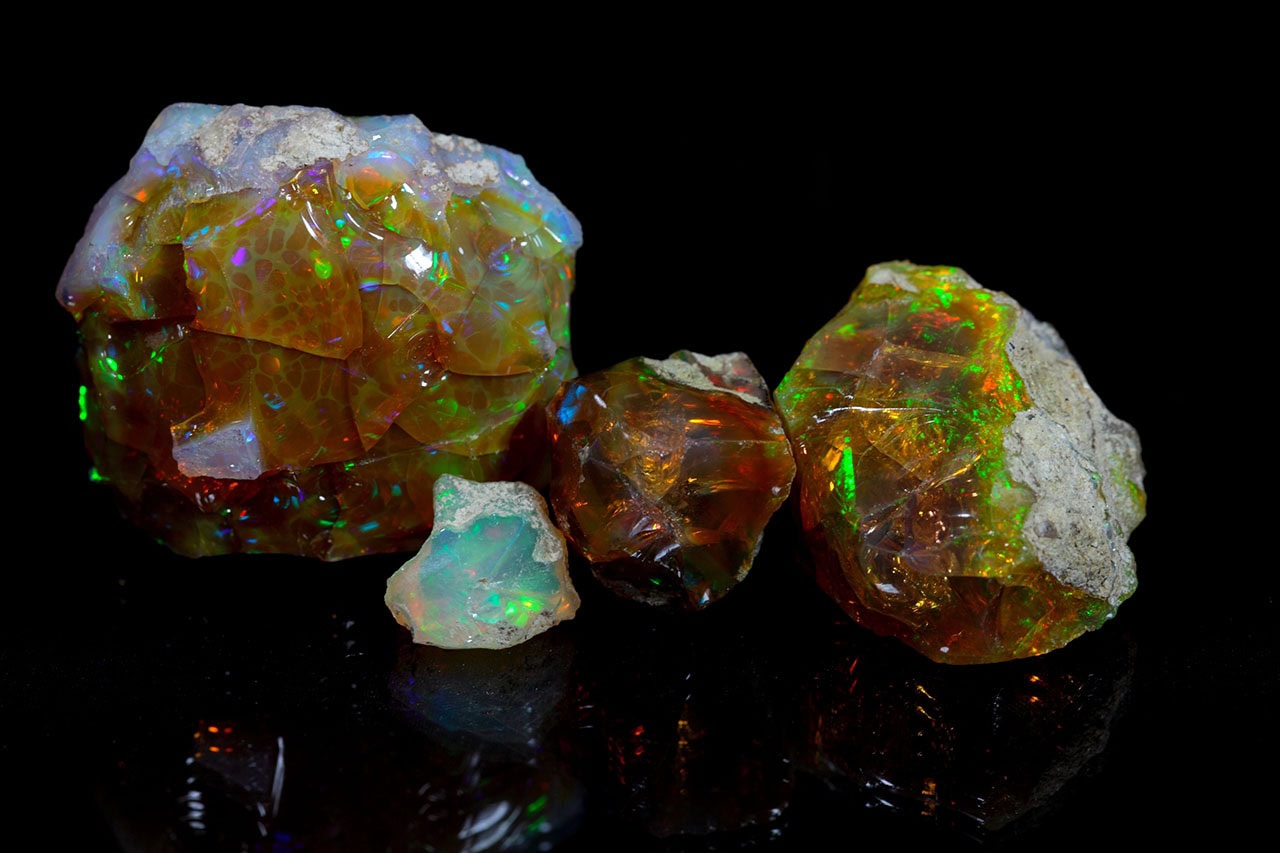
TABLE OF CONTENTS
Properties & Qualities
Physical Properties
Opal is hydrated amorphous silica, SiO₂·nH₂O, containing between three and ten percent water by weight and occasionally as much as twenty. It is properly classed as a mineraloid rather than a mineral, because it lacks the ordered crystal lattice that defines a true mineral species. What it possesses instead is a distinctive internal architecture: in precious opal, microscopic spheres of silica are packed in a regular three-dimensional array, generally between 150 and 400 nanometres across. The uniformity and ordering of those spheres determines whether a specimen shows play-of-colour at all. Where the spheres are irregular in size or randomly arranged, the result is common opal, or potch, which lacks the phenomenon entirely.
The play-of-colour itself is an optical effect rather than a property of pigment or trace element. Light entering the stone is diffracted by the sphere lattice, and the wavelengths that emerge depend on the dimensions of the spheres and the angle at which the stone is viewed, which is why the colours move and change as the piece is turned. Smaller spheres diffract toward the blue and violet end of the spectrum, larger ones toward orange and red. Because red requires both the largest spheres and an exceptional degree of uniformity in their size, it is the rarest and most highly valued play-of-colour, while blue and green are by far the most common.
In measurable terms, opal is a comparatively soft and light gem material. It sits at 5.5 to 6.5 on the Mohs scale, softer than quartz and readily scratched in daily wear, and its toughness is poor, making it brittle despite the complete absence of cleavage. Its specific gravity ranges from 1.98 to 2.25, low enough that a piece feels noticeably light in the hand next to quartz or agate of equal size. The refractive index falls between roughly 1.37 and 1.52, among the lowest of all gem materials, and because the structure is amorphous the stone is singly refractive. Fracture is conchoidal to uneven, lustre vitreous to resinous or waxy, and the streak white regardless of body colour. Many opals fluoresce green or yellowish-green under ultraviolet light owing to trace uranium, with hyalite showing a particularly strong response, and some varieties phosphoresce briefly afterwards.
Opal forms at low temperatures from silica-bearing solutions percolating through rock, filling cavities and fractures and, in the Australian fields, frequently replacing wood, shell and bone to produce opalised fossils. A second route occurs in volcanic settings, where silica-rich waters deposit opal in rhyolite cavities, as with Mexican fire opal. These conditions produce a wide range of material: black opal from Lightning Ridge, white and milky opal from Coober Pedy, boulder opal still attached to its ironstone matrix in Queensland, transparent crystal opal, the orange to red fire opal of Querétaro, and the colourless glassy hyalite. Australia has historically supplied the great majority of the world's precious opal, with Ethiopia, Mexico, Brazil, Honduras, the United States and Slovakia as further significant sources.
The mineraloid's water content governs its behaviour in ways that matter more than any other physical property. Much Ethiopian Welo material is hydrophane, meaning it absorbs water readily, becoming transparent and temporarily losing its play-of-colour until it dries out again; the same porosity allows it to take up oils, dyes and skin products. All opal is vulnerable to crazing, the fine network of surface cracks that develops when internal water is lost, an irreversible change triggered by heat, dry air, prolonged sunlight and abrupt temperature change. Ultrasonic and steam cleaning, extended immersion, harsh chemicals and storage in dry conditions all carry real risk of permanent damage, which is why opal is conventionally handled with more caution than its hardness alone would suggest.
Metaphysical properties
Meaning & Symbolism
Physical meaning
In physical symbolism, opal represents water held within stone — the principle that fluidity and structure are not opposites. It is the only major gem material that carries water as a defining component rather than an impurity, and practitioners read this as making it the mineral emblem of the body's own composition, which is likewise mostly water contained within firmer architecture. Its lack of a crystal lattice extends the reading: opal is understood to represent the parts of physical experience that resist fixed structure altogether — mood, hydration, energy levels, the daily fluctuations that never settle into a stable baseline.
The stone's water content underlies its most consistent physical association, which is with the body's fluid systems. Practitioners link opal symbolically to hydration, lymphatic flow, the kidneys and bladder, and to the eyes and the moisture of the mucous membranes. Its long-standing medieval reputation for strengthening eyesight is frequently cited in this context, though as inherited tradition rather than as a claim about the body. The interpretation throughout is that opal represents circulation in the broadest sense — not blood specifically, but everything in the body that must keep moving and must not be allowed to dry.
Opal's vulnerability to crazing carries a more sobering symbolic weight. When internal water is lost, a fine network of cracks develops through the stone, and the change is permanent. This is commonly read as representing the physical consequences of depletion: what dehydration, chronic exhaustion, prolonged stress and insufficient rest do to a body over time, and the fact that some of that damage does not reverse. Practitioners frequently draw the further lesson that opal is damaged not by force but by neglect — by dry air, heat and being left alone in unsuitable conditions — which is treated as a comment on the kinds of harm that accumulate quietly rather than arriving as injury.
The hydrophane varieties add a second, more hopeful reading. Ethiopian Welo opal absorbs water, turning transparent and losing its play-of-colour while saturated, then recovering fully as it dries. Practitioners interpret this cycle as representing the body's capacity for temporary loss of vitality without permanent damage — periods of illness, exhaustion or diminished capacity from which recovery is genuine and complete. The same porosity, which allows the stone to take up oils and dyes, is read as representing the body's permeability to its environment: the understanding that what surrounds a person is absorbed rather than merely encountered.
Opal is particularly associated with skin, and with the body's surfaces and boundaries. Its play-of-colour occurs at the interface between the stone and the light that enters it, never in the depths alone, which practitioners connect to the skin as the organ where interior and exterior meet. This symbolism appears most often in work concerning appearance, ageing and visible change — the body as a surface that others read. Its softness and low toughness reinforce the theme: opal cannot be worn in a ring for daily hard use, cannot be cleaned by force, and requires accommodation rather than endurance, which is understood to represent bodies that need conditions adjusted around them rather than demands made of them.
Spiritual meaning
Opal's spiritual significance rests on a paradox that practitioners return to constantly: it is a stone with no structure of its own. Lacking a crystal lattice, opal is described as offering no fixed pattern to align with, no directional current, no inherent agenda — and teachers read this as making it a mirror rather than a guide. Where most stones are said to impose a particular quality on the seeker, opal is understood to reflect and intensify whatever is already present. This is the foundation of the widespread teaching that opal reveals the spiritual state one actually occupies rather than the one being cultivated, and why it is described as rewarding for the settled and destabilising for the unsettled.
The stone's water content carries the second major reading. Opal contains up to a fifth of its weight in water, held in suspension rather than chemically bound as it is in most hydrous minerals, and practitioners treat this as symbolising spiritual life that remains unfixed — feeling, intuition and receptivity rather than doctrine or discipline. Traditions emphasising the emotional and devotional over the structured and ascetic frequently claim opal for this reason. It is described as the stone of the seeker who does not proceed by system, and is often contrasted with quartz, the archetypal lattice stone, as intuition is contrasted with method.
Its play-of-colour supports a teaching about the nature of appearance itself. The colours in opal are not contained in the stone but produced by light diffracting through its interior, meaning what is seen exists only in the meeting of stone and observer and changes with every shift of position. Practitioners connect this readily to teachings on the constructed nature of perception, and to traditions in which the visible world is understood as display rather than substance. Opal is consequently associated with the recognition that one's view of reality is partial and positional — worked with less to attain a truer perspective than to hold any perspective more lightly.
Opal's spiritual reputation has been unusually unstable, and this instability has itself become part of its meaning. Classical sources treated it as the most auspicious of stones, with Pliny describing it as containing the virtues of all gems because it displayed all their colours; a nineteenth-century novel then established the association with misfortune that persists in popular belief. Teachers frequently use this reversal as an object lesson in how spiritual attributions are made and unmade, and as an argument for holding inherited lore provisionally. The stone that reflects rather than dictates is, appropriately, the one whose own reputation has proved most susceptible to what people brought to it.
Contemporary practice draws heavily on opal's relationship with water and change. The hydrophane varieties, which turn transparent and lose their fire when saturated and recover entirely on drying, are read as representing spiritual periods in which meaning temporarily disappears — the dry seasons, the loss of felt connection, the phases in which practice continues without evident result. Practitioners describe these as absorption rather than loss, and treat opal as the emblem of faith maintained through such intervals. Its softness and susceptibility to crazing extend the teaching: opal is understood to represent a spiritual life that requires tending and suitable conditions rather than one proven by endurance, and it is commonly worked with by those learning that sustainability matters more than intensity.
Healing Benefits
Physical healing
Traditional healing applications of opal should be understood as energetic and folk practices rather than medical treatments. Crystal healers work with it primarily in the context of hydration and the body's fluid systems, a connection derived from the mineral's water content rather than from any inherited therapeutic tradition. Layouts typically place opal at the kidneys, bladder or lower back in sessions framed around fluid balance and lymphatic movement. Users commonly report a sensation of lightness or of something loosening, though these effects are generally attributed to relaxation and the sustained attention of a healing session rather than to any property of the stone.
The medieval reputation of opal for strengthening eyesight is the one genuinely old application, and it persists in contemporary practice. Energy healers place small polished pieces near, not on, the eyes during sessions concerning eye strain, dryness and visual fatigue, and some extend this to the mucous membranes and the moisture of the sinuses and throat. These applications are historical inheritance rather than evidence, and no crystal practice should replace ophthalmic examination, particularly where vision has changed.
A substantial cluster of applications concerns skin and the body's surfaces. Practitioners recommend opal in layouts addressing dryness, dullness, visible ageing and the appearance of the complexion, working from the same symbolic connection between the stone's surface-dependent play-of-colour and the skin as the boundary between interior and exterior. Pink and white common opal are usually preferred for this purpose over precious material, being considered gentler. Fire opal, by contrast, appears most often in sessions concerning vitality, low energy and sexual or creative depletion, placed at the sacral centre.
Opal is also widely used in work around hormonal and cyclical fluctuation, particularly menstruation, pregnancy and menopause. Practitioners describe it as representing rather than regulating these rhythms, offering a symbolic framework for changes that are gradual, recurrent and outside conscious control. Some also employ it in sessions concerning chronic fatigue and depletion, drawing on the crazing analogy — the understanding that sustained dryness and depletion leave lasting marks. All of these remain firmly within the realm of energy medicine and are unsupported by clinical evidence.
Two practical cautions apply to opal specifically. It must never be used to prepare gem elixirs or crystal waters by direct immersion: hydrophane material absorbs liquid readily and will take up whatever is dissolved in it, and prolonged contact with water risks permanent damage to any opal. Body-layout work should also avoid oils, lotions and prolonged skin contact for the same reason, since porous material absorbs them irreversibly. For anyone managing a diagnosed condition — kidney disease, hormonal disorders, chronic fatigue or eye conditions among them — opal practice is best treated as accompaniment to medical care rather than as an alternative to it.
Emotional healing
Opal's reputation in emotional healing rests on amplification rather than any particular feeling. Users consistently describe it as intensifying whatever emotional state is already present rather than introducing calm, courage or comfort of its own, and practitioners treat this as the defining characteristic to plan around. It is therefore recommended most often to people who have lost access to their feelings — those describing themselves as numb, flat, or unable to locate what they feel — and recommended with real caution to anyone already overwhelmed. The common instruction is to check one's state before putting it on, since opal is understood to magnify the starting position rather than improve it.
Its most established application concerns emotional honesty. Practitioners describe opal as showing back what is actually being felt rather than what a person believes they feel or would prefer to feel, which makes it valued in work on self-deception, denial and long-maintained emotional performance. Users frequently report that it surfaces feelings they had classified as resolved. Teachers generally frame this as the stone's purpose rather than a malfunction, while advising that it be introduced gradually — short periods of wear at first, removed when the reflection becomes more than can be usefully held.
Opal is also widely worked with in creative and expressive contexts, particularly by artists, writers, performers and musicians. The reported effect is heightened access to feeling rather than steadiness, which practitioners describe as useful during generative work and unhelpful during periods requiring composure or difficult negotiation. Many recommend it as a studio or desk stone rather than something worn continuously, kept where creative work happens and left there. Fire opal appears most often in this context, associated with drive and appetite, while white and common opal are considered gentler for daily contact.
The stone has a strong association with grief, mood cycling and emotional weather that will not hold still. Practitioners recommend it for feelings that arrive in waves rather than in a settled state — bereavement in its later stages, hormonal and cyclical fluctuation, and the ordinary instability of periods of change. The reading is not that opal steadies these movements but that it makes them legible, helping a person recognise a passing state as passing. Hydrophane material, which loses its fire when saturated and recovers entirely on drying, is frequently used as the teaching image: emotional capacity can disappear temporarily without being lost.
Practical guidance emphasises pacing and cleansing more than for most stones. Opal is generally not recommended for continuous wear through emotionally difficult periods, for acute crisis, or for those in the early stages of learning emotional regulation, and teachers commonly advise pairing it with grounding or containing stones when it is worked with intensively. It is usually not suggested for children. Practitioners also stress frequent energetic cleansing, drawing on the porosity of hydrophane material as the model, though this must be done without water — smoke, sound or brief moonlight rather than rinsing, which risks permanent damage to the stone itself.
Spiritual healing
Opal is worked with primarily by people who have lost the felt sense of their own spiritual life. Practitioners recommend it during dry seasons — periods when practice continues but yields nothing, when prayer or meditation feels mechanical, when a tradition that once carried meaning has gone silent. The instruction is generally not to seek restoration through it but to keep the practice going while the stone sits nearby. The hydrophane varieties, which lose their fire entirely when saturated and recover fully as they dry, are used explicitly as the teaching object here, and many practitioners keep a piece specifically for these intervals.
Its second application is discernment about one's actual spiritual position. Because opal is understood to reflect rather than direct, it is used by those who suspect a gap between the practice they describe and the one they conduct — people maintaining a discipline out of habit, a tradition out of loyalty, or an identity that no longer matches their experience. It is typically held during quiet sitting with no aim beyond letting the honest state become apparent. Teachers commonly warn that this is uncomfortable work and advise short sessions, since opal is described as offering no encouragement alongside what it shows.
Opal is used extensively in work with perception and attachment to one's own viewpoint. Practitioners draw directly on the fact that its colours exist only in the meeting of stone, light and observer, and change with every shift of position. It appears in contemplative practice concerned with holding conclusions loosely, in work on spiritual certainty that has hardened into rigidity, and among those in traditions teaching the constructed nature of ordinary perception. The common practice is simple observation: turning the stone slowly and watching a colour that was unmistakably present disappear.
For those whose spiritual life is emotional rather than systematic, opal serves as an anchoring stone rather than a corrective. It is recommended to devotional practitioners, to people who arrive at meaning through feeling and beauty instead of study, and to those who have been made to feel their approach is undisciplined. Practitioners describe it as affirming intuitive practice rather than reforming it, and it is often chosen for altars, for creative devotional work, and for ritual conducted without formal structure. Fire opal appears most frequently where the practice involves passion or ecstatic elements, white and crystal opal where it involves stillness.
Guidance on working with opal emphasises conditions over effort, and this is treated as part of what it teaches. It is not recommended for intensive continuous practice, for periods of acute spiritual crisis, or for those seeking to push through resistance by force. Cleansing is advised frequently but never with water, which risks permanent damage — smoke, sound or brief moonlight instead. Practitioners consistently note that a stone which crazes from dryness and heat, cannot be scrubbed, and must be kept in suitable conditions models a spiritual life sustained by tending rather than proven by endurance, and they recommend it particularly to those recovering from practice that became punishing.
Use & Care
How to use
- Check your state first: Put opal on when you are settled rather than distressed, since it is understood to magnify the emotional position you begin from.
- Start with short sessions: Wear it for an hour or two at first and extend gradually, removing it when what surfaces becomes more than is useful.
- Choose pendants over rings: At 5.5–6.5 on the Mohs scale opal chips easily in ring settings, and a pendant sits closer to the heart and throat where it is most often worked with.
- Match the variety to the purpose: Fire opal at the sacral centre for vitality and creative drive, black opal for grounding and shadow work, white and crystal opal for clarity, boulder opal for earth connection, and pink or green common opal for gentle heart work.
- Keep one at your desk: Place it where creative work happens rather than wearing it continuously, as its reported effect is heightened feeling rather than steadiness.
- Use it at the bedside: Opal is widely worked with for vivid dreaming and dream recall, placed near the bed rather than under the pillow where it may be crushed.
- Turn it in meditation: Hold it in changing light and watch a colour that seemed definite disappear, a practice used for loosening attachment to a fixed viewpoint.
- Sit with it during dry seasons: Keep it nearby when practice feels empty, using the hydrophane cycle as the reminder that capacity can vanish temporarily without being lost.
- Prefer common opal for body layouts: Potch and common opal are more suitable for direct skin contact, while precious material is better placed on cloth beside the body than upon it.
- Put it on last: Apply cosmetics, perfume, sunscreen and lotion first and let them dry, since porous hydrophane material absorbs them permanently.
- Take it off first: Remove opal before washing, showering, swimming, exercising, gardening or cleaning, and before any household chemicals.
- Pair it with grounding stones: Black tourmaline, smoky quartz or hematite are commonly used alongside it during intensive emotional work.
- Cleanse without water: Use smoke, sound or brief moonlight, never rinsing, salt or immersion of any kind.
- Store it wrapped in soft cloth: Keep it out of direct sunlight, away from heat sources and radiators, and out of very dry environments such as long-term safe storage.
- Give it rest periods: Opal is generally used as a stone returned to deliberately rather than worn continuously, particularly through difficult stretches.
How to cleanse
- Smoke cleansing: Pass briefly through sage, cedar, palo santo or mugwort smoke, keeping the stone far enough from the ember that it never warms.
- Sound cleansing: Place beside singing bowls, tuning forks or bells and let the vibration carry through, a method entirely without physical risk to the stone.
- Moonlight: Set out for a few hours under the full or new moon on a dry indoor surface, brought in before dawn dew and never left on an outdoor sill overnight.
- Selenite plate: Rest on selenite between uses, a slow passive method well suited to a stone that should be cleansed often.
- Dry salt bed, stone not touching: Set a small dish holding the opal into a larger bowl of salt so the salt surrounds but never contacts the piece, as direct salt scratches and draws moisture.
- Amethyst or quartz cluster: Leave overnight on a cluster, checking that the opal rests on a soft cloth rather than against sharp crystal points.
- Breath and intention: Hold and exhale slowly across the stone while stating that what it has absorbed is released, useful when nothing else is to hand.
- Reiki cleansing: Apply Reiki with the hands held above rather than on the stone, using Cho Ku Rei to clear accumulated energy.
- Soft dry cloth: Wipe gently with a clean microfibre or chamois cloth to lift skin oils and residue, the only physical cleaning opal should receive.
- Earth contact, wrapped: If burying is preferred, wrap first in cloth and use dry soil for no more than a few hours, since damp earth risks both crazing and absorption.
- Rest in darkness: Return it to soft cloth in a closed box for a day or two after intensive emotional work, treated as a cleansing method in its own right.
- Cleanse it often: Opal is conventionally cleansed more frequently than most stones, ideally after each significant session rather than on a fixed schedule.
How to charge
- Moonlight: The safest and most commonly used method — a few hours on a dry indoor surface under the full moon for completion, or the new moon for fresh creative work.
- Indirect daylight: A short spell in bright but shaded daylight rather than direct sun, which dries the stone and risks crazing within minutes.
- Selenite plate: Rest on selenite for slow, continuous charging that suits opal's need for frequent attention without any physical risk.
- Amethyst or quartz cluster: Charge overnight on a cluster, seated on a soft cloth so the points cannot scratch the softer opal.
- Intention setting: Hold while naming what you actually feel rather than what you intend to feel, working with the stone's reflective character rather than against it.
- Creative work: Keep it beside you while painting, writing, playing or making, a method practitioners describe as charging it through the activity it supports.
- Sound bath: Charge during crystal bowl or gong sessions, effective across all varieties and entirely safe for the material.
- Rainbow light: Place where a prism, cut-glass window or crystal throws spectral light across it, echoing the diffraction that produces its own play-of-colour.
- Chakra placement: Charge on the chakra matching the variety — sacral for fire opal, root for black opal, crown for white and crystal opal, heart for pink and green common opal.
- Reiki charging: Apply with hands held above the stone, using Cho Ku Rei for general empowerment and Sei He Ki for emotional and creative work.
- Near living plants: Set among houseplants overnight, where ambient humidity suits opal better than most charging environments.
- Humid air, not water: Leave briefly in a naturally humid room such as a bathroom after use, which restores ambient moisture without any contact with liquid.
- Sacred space: Charge on an altar, beside a creative project, or in any space where the work it supports actually happens.
- Group ritual: Charge during group meditation or ceremony, a method well suited to a stone described as taking on the atmosphere around it.
Combining with other stones
- Moonstone: A close natural pairing, both associated with cycles, intuition and shifting emotional weather; comparable softness makes them safe stored together.
- Labradorite: Shares the diffraction-based optical character, reinforcing themes of perception, veils and what appears only from certain angles.
- Black Tourmaline: The standard grounding companion for opal work, containing what the stone amplifies and widely recommended for beginners.
- Smoky Quartz: Steadies opal's reflective intensity, favoured by those who find themselves destabilised by what it surfaces.
- Hematite: Provides weight and physical anchoring during creative or emotional work that risks becoming untethered.
- Rose Quartz: Softens self-directed criticism when opal reflects back something unwelcome, offering compassion alongside honesty.
- Carnelian: Amplifies fire opal's sacral associations, commonly paired for creative drive, appetite and vitality.
- Sunstone: Adds warmth and outward confidence to opal's inwardness, useful when creative work must eventually be shown to others.
- Citrine: Supports acting on what opal reveals, addressing the gap between seeing clearly and doing something about it.
- Amethyst: Steadies sleep and dreaming, a frequent bedside pairing given opal's association with vivid dreams.
- Lepidolite: Buffers emotional volatility during periods when opal is worn intensively, favoured by highly sensitive people.
- Aquamarine: Extends the water theme toward calm and clear speech, pairing well with blue-green Peruvian opal in particular.
- Larimar: A gentle water-element companion for throat and emotional work, similar in softness and requiring the same careful handling.
- Chrysocolla: Supports emotional honesty and voiced feeling, often chosen for work concerning long-suppressed expression.
- Kunzite: Deepens heart work with pink and common opal, both requiring protection from prolonged light exposure.
- Jet or Obsidian: Provides containment and shadow work capacity when opal reflects material that needs holding rather than expanding.
- Clear Quartz: Used with caution, as it amplifies an already amplifying stone; generally reserved for experienced practitioners.
- Boulder Opal with Ironstone: Not a pairing but a natural one — the ironstone matrix supplies grounding within the specimen itself, often chosen instead of adding a separate grounding stone.
Identification
Can be mistaken for
- Common Opal: The most frequent confusion is within the species itself, as potch lacks the sphere ordering that produces play-of-colour and is often sold simply as opal without qualification.
- Opal Doublets and Triplets: A thin slice of genuine opal backed with ironstone or black glass, and in triplets capped with quartz or plastic; inspect the side profile for a straight glue line and a domed rather than natural top.
- Synthetic Opal: Gilson and similar laboratory material shows a distinctive columnar or lizard-skin pattern with colour patches that continue straight through the stone rather than shifting irregularly.
- Opalite: Not opal at all but manufactured opalescent glass, uniformly milky with a blue-white sheen and no play-of-colour whatsoever, despite the misleading name.
- Moonstone: Shares a milky translucency and a mobile sheen, but moonstone's adularescence is a single floating blue or white glow rather than distinct multicoloured flashes, and it is harder at 6–6.5.
- Labradorite: Also shows moving spectral colour, though labradoresence appears in broad sheets across cleavage planes rather than in the small irregular patches typical of opal.
- Mother of Pearl: Produces similar iridescence by a related layered mechanism, but its structure is organic, its lustre distinctly pearly, and its hardness far lower at 2.5–4.
- Ammolite: An organic iridescent material from fossil ammonite shells, showing the same broad-sheet effect as labradorite and frequently sold in composite form.
- Fire Agate: Iridescent brown-based material sometimes confused with fire opal or precious opal, but it is chalcedony, harder at 6.5–7, and its colour arises from thin iron oxide layers.
- Fire Opal without Play: Orange to red Mexican material frequently lacks play-of-colour entirely and is regularly mistaken for citrine, hessonite or heat-treated glass on appearance alone.
- Chalcedony and Agate: Common opal of the pink, blue and green kinds is routinely confused with these, though opal's specific gravity of about 2.1 is markedly lower than chalcedony's 2.6 and it is singly refractive.
- Hyalite: Colourless glassy opal is easily taken for quartz or glass until viewed under ultraviolet light, where its strong green uranyl fluorescence is diagnostic.
- Glass: Ordinary glass imitations betray themselves through gas bubbles, swirl lines and mould seams, and glass shows none of the angle-dependent colour movement of true play-of-colour.
- Plastic and Resin: Considerably lighter than opal's already low density, warm rather than cool to the touch, and soft enough to be marked by a pin.
- Owyhee and Common Blue Opal: Genuinely opal but sold at prices implying precious material, so the absence of play-of-colour is worth confirming before purchase.
- Dyed Hydrophane: Ethiopian material readily absorbs colouring agents, producing convincing "black opal" whose dye concentrates visibly in the pores under magnification.
How to spot a fake
- Weigh it in the hand: Opal's specific gravity of roughly 2.1 is low, but glass sits near 2.5 and plastic far below, so a piece that feels either too heavy or implausibly light is worth questioning.
- Look for the glue line: View the stone from the side rather than face-on, as doublets and triplets reveal a flat, straight junction between the opal layer and its dark backing.
- Check the dome: Natural solid opal cut as a cabochon usually has an irregular base and varying thickness, while composites show a uniformly thin colour layer over a perfectly flat seat.
- Examine the pattern direction: Synthetic Gilson opal displays colour patches with a columnar structure that runs straight down through the stone, visible from the side as vertical bands.
- Look for lizard skin: Laboratory-grown opal frequently shows a regular scaly or snakeskin cell pattern under magnification, far too orderly to occur naturally.
- Test the colour movement: Genuine play-of-colour shifts patch by patch as the angle changes, whereas printed foils, coatings and glass show colour that moves as a single sheet or not at all.
- Search for gas bubbles: Round or elongated bubbles under a 10x loupe indicate glass or resin, since no natural opal contains them.
- Watch for swirl lines and seams: Flowing streaks within the body and faint ridges along the edges indicate moulded glass or plastic.
- Question implausible black opal: Genuine black opal from Lightning Ridge is expensive and comparatively scarce, so cheap black material is usually a doublet, dyed hydrophane or smoke-treated stone.
- Inspect the pores for dye: In treated Ethiopian material the colouring agent concentrates in the porous structure and along fractures, visible as darker threading under magnification.
- Note any sugar or smoke treatment: Carbon introduced into hydrophane opal to darken it produces a sooty, slightly granular appearance in the body colour, distinct from the even tone of natural black opal.
- Reject the name opalite: This is manufactured glass with a milky blue-white sheen and no play-of-colour, sold under a name deliberately close to opal.
- Feel the temperature: Opal stays cool against the skin for several seconds, while plastic and resin warm almost immediately.
- Try a wet test cautiously: Hydrophane opal changes visibly with moisture where glass and plastic do not, but a fingertip of water on an inconspicuous area is the limit, as immersion risks permanent damage.
- Ask for the locality and type: Reputable sellers name the field — Lightning Ridge, Coober Pedy, Queensland, Welo, Querétaro, Virgin Valley — and state plainly whether a stone is solid, doublet or triplet.
- Distrust flawless uniformity: Natural opal shows variation in pattern density, thickness and colour distribution, so a batch of identical stones at a low price is almost certainly synthetic or composite.