Bornite
Sulfide
Copper-red to brownish-bronze on fresh surfaces; iridescent purple, blue, and multicolored tarnish
Metallic
3-3.25
4.9-5.3
Orthorhombic (pseudo-cubic)
Alaska (USA), and various sulphide ore deposits worldwide
Common as ore; rare as well-formed euhedral crystals
Cu₅FeS₄ (Copper iron sulfide)
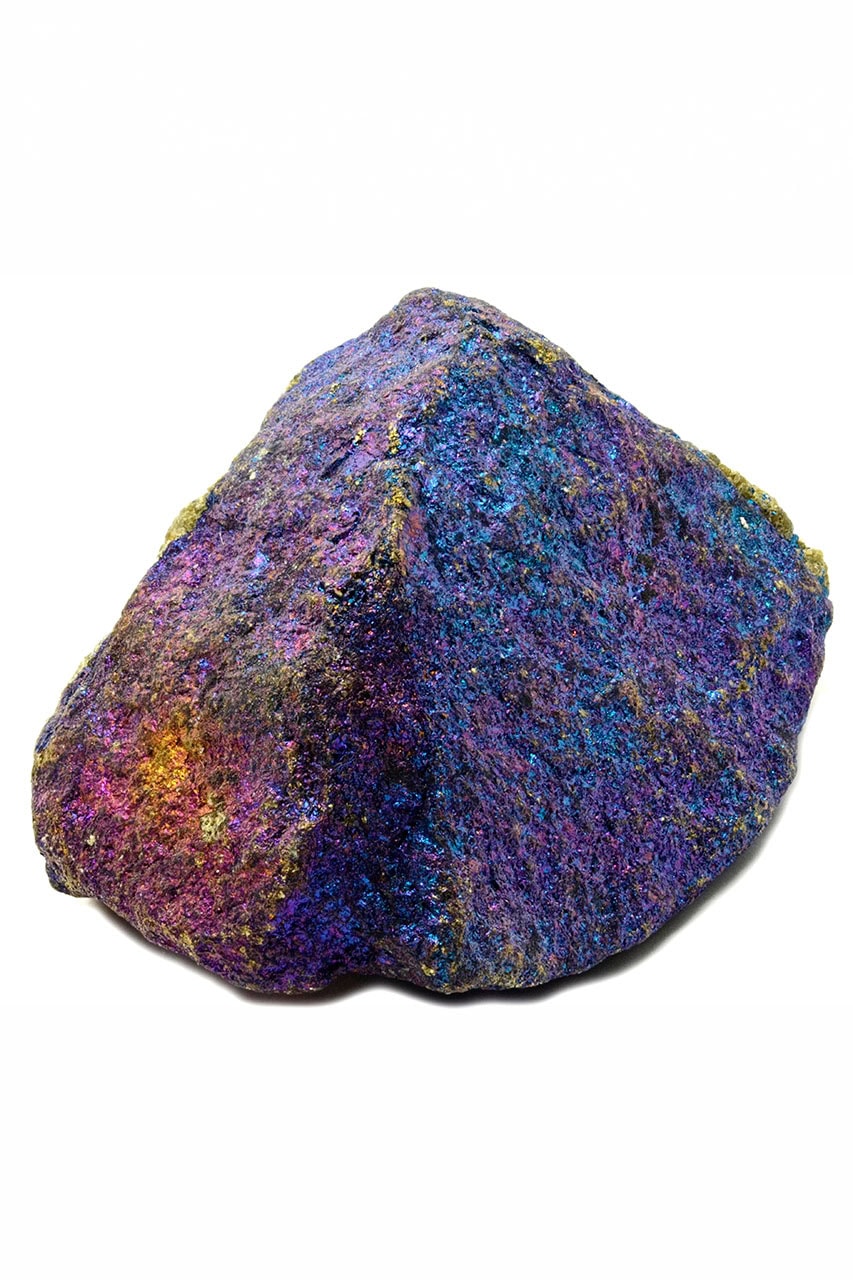
Bornite, popularly known as "peacock ore," ranks among the most visually arresting minerals in the sulfide family. With a chemical composition of Cu₅FeS₄, this copper iron sulfide crystallizes in the orthorhombic system, though it displays what mineralogists call a pseudo-cubic habit—meaning its crystals approximate cubic shapes despite belonging to a different crystallographic system.
The mineral's enduring popularity stems largely from its spectacular iridescent tarnish. While freshly broken surfaces reveal a copper-red to brownish-bronze color, exposure to air rapidly transforms bornite's surface into a kaleidoscope of purples, blues, and other vivid hues. This peacock-like display gives the mineral its common name and makes it instantly recognizable to collectors and rockhounds alike.
Beyond its aesthetic appeal, bornite serves a crucial economic function as an important copper ore. It is typically found as massive or disseminated metallic grains and patches in sulphide ore deposits, where it occurs alongside other copper minerals. While abundant in this form, the mineral is relatively rare as good euhedral crystals—well-formed individual crystals with clearly defined faces—making such specimens particularly prized.
The mineral's significance in modern mining is exemplified by deposits like the Bornite deposit in Alaska, a carbonate-hosted copper-cobalt deposit located near Kobuk, approximately 25 kilometers southwest of associated infrastructure. According to preliminary economic assessments, this deposit forecasts substantial copper production—projected at 1.9 billion pounds of payable copper over a 17-year mine life—underscoring bornite's continuing importance as a strategic copper resource.
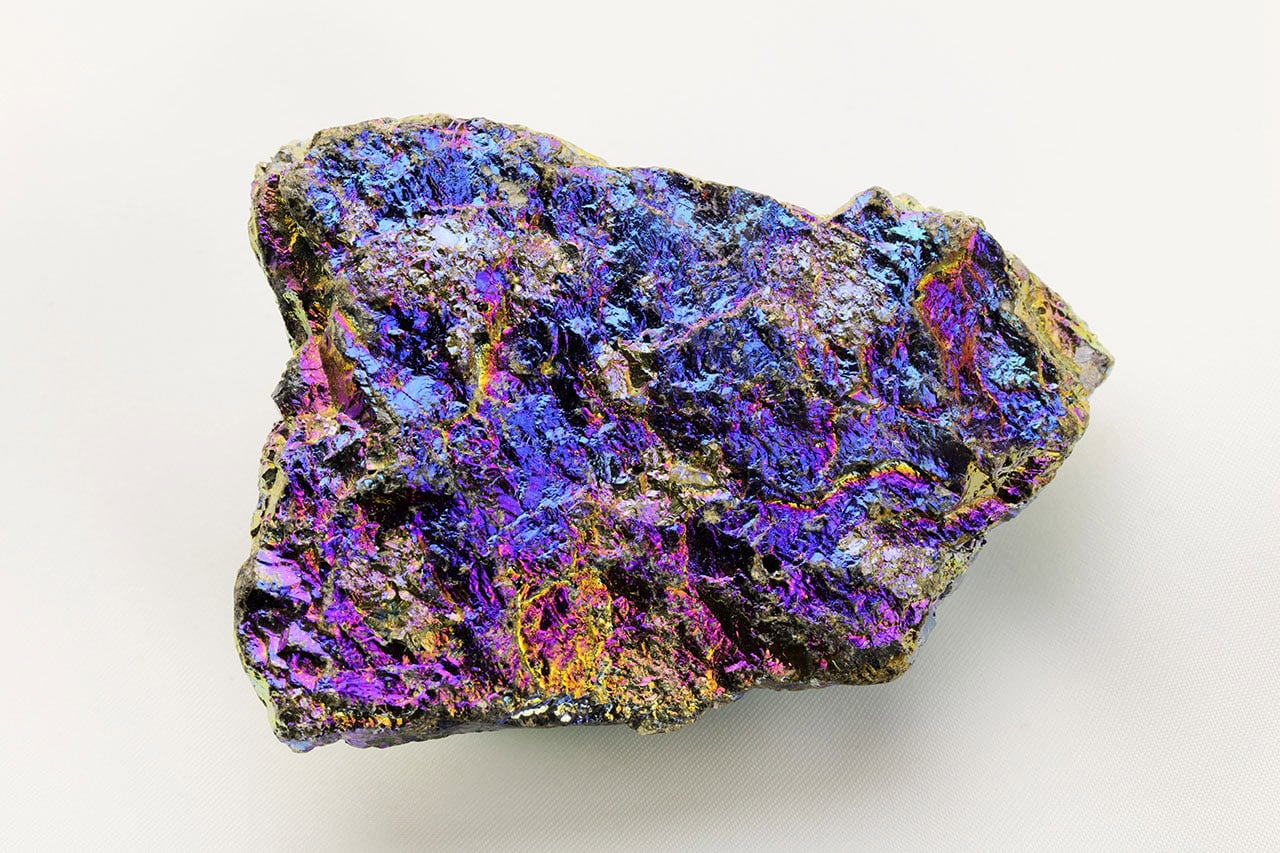
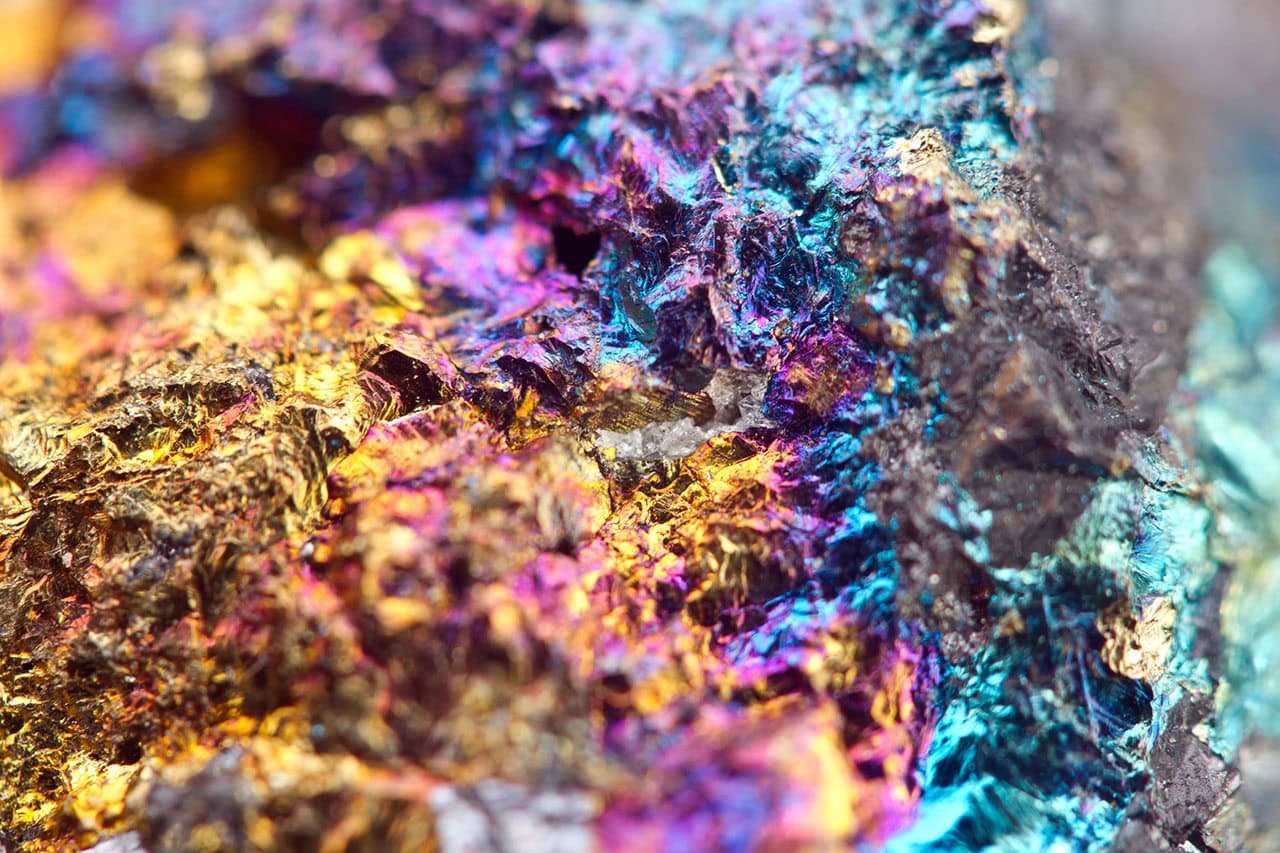
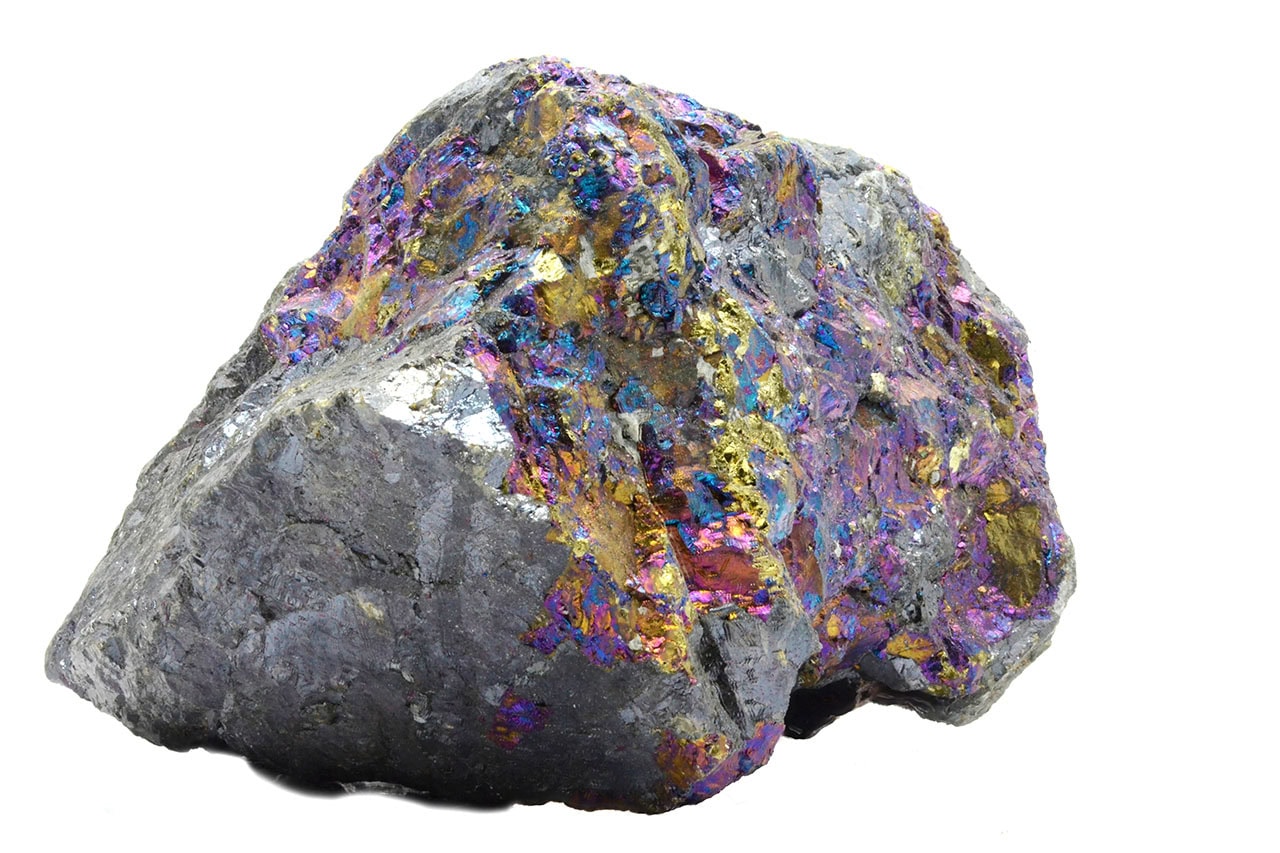
TABLE OF CONTENTS
Properties & Qualities
Physical Properties
Bornite presents a striking duality between its fresh and weathered appearances. On freshly fractured surfaces, the mineral displays a copper-red to brownish-bronze coloration with a distinctly metallic luster. This original color, however, proves fleeting upon exposure to air. The mineral rapidly develops its characteristic iridescent tarnish—a shimmering surface displaying purples, blues, and sometimes reds and greens that has earned it the affectionate moniker "peacock ore."
This iridescence results from surface oxidation, where thin films of altered material on the surface interfere with light to produce the rainbow effect. The phenomenon explains why specimens displayed in collections often show more intense coloration than freshly mined material—the tarnish continues to develop over time.
As a sulfide mineral with the composition Cu₅FeS₄, bornite contains substantial copper, which accounts for both its economic value and its metallic character. The mineral typically occurs as massive material or as disseminated metallic grains and patches within sulphide ore deposits, rather than as distinct individual crystals.
When bornite does form crystals, it crystallizes in the orthorhombic system, though these crystals display a pseudo-cubic habit—they appear roughly cubic despite their orthorhombic internal structure. Well-formed euhedral crystals are relatively rare, making them especially valuable to collectors who seek specimens beyond the more common massive form.
With a hardness of approximately 3 on the Mohs scale, bornite is relatively soft and can be scratched by a knife blade. Its considerable density, reflected in a specific gravity around 5, gives specimens a satisfying heft characteristic of metallic sulfide minerals.
Metaphysical properties
Within metaphysical traditions, bornite's spectacular iridescence has made it a popular stone associated with joy, happiness, and the celebration of life's colorful variety. The peacock-like display of colors is often interpreted as representing the full spectrum of experience, with practitioners viewing the stone as encouraging appreciation for life's diversity and beauty.
The stone is frequently associated with all of the chakras, owing to its rainbow coloration that seems to encompass the full energetic spectrum. Some practitioners use it specifically to align and balance the entire chakra system, viewing each color in its iridescent surface as resonating with a different energy center.
Bornite's copper content adds another dimension to its metaphysical reputation. Copper has long been associated in metaphysical traditions with energy conduction and amplification, and bornite is sometimes valued for these properties, with practitioners describing it as a stone that helps move and circulate energy.
Contemporary energy workers often describe bornite as a stone of happiness and positive outlook, allegedly helping users find joy in the present moment and recognize the beauty in everyday experiences. Its festive appearance translates, in metaphysical interpretation, into an energy of celebration and optimism.
Meaning & Symbolism
Physical meaning
In physical symbolism, bornite represents transformation and the revelation of hidden beauty. The dramatic shift from its plain copper-bronze fresh surface to its iridescent tarnished state symbolizes how exposure to life's elements can reveal unexpected splendor, suggesting that weathering and experience can enhance rather than diminish inner beauty.
The mineral's role as an important copper ore connects it symbolically to value and resource—the recognition that substantial worth often lies within unassuming exterior forms. Just as bornite must be processed to release its copper, the stone symbolizes the extraction of value from raw materials and experiences.
Its association with energy conduction, through its copper content, links bornite to themes of vitality, flow, and the circulation of life force throughout the physical body.
Spiritual meaning
Bornite's spiritual significance centers on its representation of wholeness and integration. The full spectrum of colors displayed in its iridescent surface symbolizes spiritual completeness—the integration of all aspects of being into a harmonious, multicolored whole.
The transformation from plain to spectacular that bornite undergoes carries spiritual meaning related to awakening and revelation. Practitioners may view the stone as teaching that spiritual development often involves a process of exposure and transformation, where the true colors of the soul emerge through engagement with life's experiences.
For those on a spiritual path of finding joy and gratitude, bornite serves as a reminder to appreciate the beauty and color inherent in spiritual experience, encouraging a celebratory rather than purely austere approach to spiritual practice.
Healing Benefits
Physical healing
Traditional healing applications of bornite should be understood as energetic and folk practices rather than medical treatments. Given that bornite is a copper iron sulfide, it should never be used in elixirs, placed in water for ingestion, or used in any way involving internal consumption, as sulfide minerals can be toxic.
Crystal healers have traditionally associated bornite with the body's energy circulation, drawing on its copper content and conductive associations. Practitioners might use it in energy layouts intended to support overall vitality and the smooth flow of energy through the body, though such applications remain firmly in the realm of energy medicine.
The stone's all-chakra associations have led some practitioners to use it for general balancing work, claiming it supports the body's various systems by harmonizing the energy centers that traditionally correspond to physical functions.
Emotional healing
Bornite's reputation in emotional healing centers on its association with joy, happiness, and positive outlook. Users often describe the stone as uplifting, with its festive iridescent appearance allegedly translating into an energy that lifts mood and encourages optimism.
The stone is particularly valued for those struggling with pessimism or the inability to find pleasure in everyday life. Its colorful nature reportedly helps users reconnect with the simple joys and beauty available in ordinary experience.
For those processing difficult emotions, bornite's transformative symbolism—the revelation of beauty through weathering—may provide comfort, suggesting that challenging experiences can ultimately reveal unexpected positive qualities.
Spiritual healing
In spiritual healing contexts, bornite addresses what practitioners might identify as spiritual flatness or the loss of wonder. Its rainbow display allegedly helps rekindle appreciation for the multicolored richness of spiritual experience, supporting those who have lost touch with the joy and beauty of their spiritual path.
Energy healers may use bornite for full-spectrum chakra work, claiming its multiple colors help identify and address blockages across the entire energy system simultaneously. This makes it valuable for general energetic tune-ups rather than targeting a single chakra.
The mineral's integration symbolism makes it useful for those seeking to harmonize disparate aspects of their spiritual life into a unified, colorful whole.
Use & Care
How to use
- Joy and happiness work:Keep bornite in living spaces or carry it to encourage positive outlook and appreciation of life's beauty.
- Chakra balancing:Use during meditation to work with all chakras simultaneously, owing to its full-spectrum coloration.
- Specimen display:Display the iridescent specimens in living or working spaces for both beauty and uplifting energy.
- Meditation focus:Hold during meditation to connect with the stone's celebratory, optimistic energy.
- Energy circulation:Use in energy work intended to support the flow and circulation of life force.
- Mood enhancement:Place where you'll see it regularly to provide visual and energetic mood support.
- Collection appreciation:Value as a collector's specimen, particularly rare euhedral crystals.
- Important precaution:Because bornite is a copper iron sulfide, never use it in elixirs or any application involving water for drinking or skin contact, as sulfide minerals can release toxic compounds.
How to cleanse
- Smudging:Pass through sage or palo santo smoke for energetic clearing—a safe, dry method ideal for sulfide minerals.
- Sound cleansing:Use singing bowls or bells for vibrational clearing without risk to the mineral.
- Selenite contact:Rest on selenite for passive cleansing.
- Visualization:Imagine light flowing through the stone, clearing accumulated energies.
- Breath work:Hold while doing conscious breathing to clear absorbed energies.
- Avoid water:Never cleanse bornite with water, as moisture can accelerate tarnishing, alter the surface, and potentially release harmful compounds.
- Avoid salt:Salt can damage the soft surface and react with the sulfide composition.
How to charge
- Moonlight:Leave under moonlight for gentle charging without risk of damage.
- Crystal cluster:Place on a clear quartz or amethyst cluster to recharge without water exposure.
- Intention setting:Hold while stating intentions for joy, balance, or energy circulation.
- Sound activation:Use bells or tuning forks to charge with vibrational energy.
- Brief indirect sunlight:Short exposure to indirect light can energize, though avoid prolonged direct sun that might accelerate surface changes.
- Group charging:Charge in circles focused on joy and celebration.
Combining with other stones
- Clear Quartz:Amplifies bornite's joyful energy and helps broadcast its uplifting properties.
- Chalcopyrite:Another copper-iron sulfide with similar iridescence; enhances bornite's energy circulation and joy associations.
- Citrine:Combines for amplified joy, abundance, and positive outlook.
- Carnelian:Adds vitality and motivation to bornite's celebratory energy.
- Amethyst:Balances bornite's exuberant energy with spiritual calm and awareness.
- Black Tourmaline:Provides grounding to complement bornite's high-spectrum, uplifting energy.
- Selenite:Keeps bornite energetically clear while adding high-vibration spiritual energy.
Identification
Can be mistaken for
- Chalcopyrite:Frequently confused with bornite, as both are copper-iron sulfides displaying iridescent tarnish. Chalcopyrite is more brass-yellow on fresh surfaces and is the mineral most commonly sold as "peacock ore" in its acid-treated form.
- Treated chalcopyrite:Much material sold as "peacock ore" in shops is actually chalcopyrite that has been artificially treated with acid to produce intense iridescence.
- Covellite:Can show blue iridescence but has different composition and crystal structure.
- Pyrite:Can show some tarnish but typically maintains its brassy yellow color without bornite's purple-blue range.
How to spot a fake
- Treated chalcopyrite alert:The most common deception involves acid-treated chalcopyrite sold as natural "peacock ore" or bornite. Natural bornite's iridescence develops more subtly than the intense, often garish colors of artificially treated material.
- Color examination:Natural bornite shows copper-red to bronze fresh surfaces developing into purples and blues; suspiciously vivid, uniform, or unnaturally bright iridescence suggests acid treatment.
- Fresh surface check:Breaking or examining a fresh surface reveals bornite's true copper-bronze color beneath the tarnish.
- Hardness test:Genuine bornite has a hardness around 3, being scratchable by a knife.
- Weight assessment:Should feel appropriately heavy given its high specific gravity (around 5); significantly lighter material suggests imitation.
- Source verification:Purchase from reputable mineral dealers who can distinguish natural bornite from treated chalcopyrite and disclose any treatments.
- Price consideration:Be wary of cheap, intensely colored "bornite" specimens, which are often treated chalcopyrite rather than genuine bornite.