Agate
Tectosilicate
All colors; typically banded in multiple hues
Waxy to vitreous
6.5 - 7
2.58 - 2.64
Trigonal
Brazil, Uruguay, Mexico, USA, India, Madagascar, Germany
Very common, though exceptional specimens are highly valued
SiO₂
In the 4th century BCE the Greek naturalist Theophrastus described distinctively banded stones named for the river Achates (now the Dirillo) in Sicily, a name that would echo through millennia. These were agates—nature's masterwork in miniature, where silica-rich solutions had painted impossible landscapes within stone.
Agate tells the story of patience. Each band represents an episode in a slow geological drama, as mineral-laden water seeped through volcanic cavities. Layer by microscopic layer, silicon dioxide precipitated in rhythmic pulses, creating patterns that would make master artists weep with envy.
From the thundereggs of Oregon to the legendary blue lace agates of Namibia, from Brazil's agate-rimmed geodes to Lake Superior's wave-polished beauties, this humble chalcedony has captivated humanity across every culture. Medieval lapidaries counted it a protective stone, and modern metaphysical practitioners consider it Earth's most grounding stone.
Today, agate remains one of mineralogy's great democratizers—common enough that children find it on beaches, yet capable of such extraordinary beauty that single specimens can command museum positions and five-figure prices.
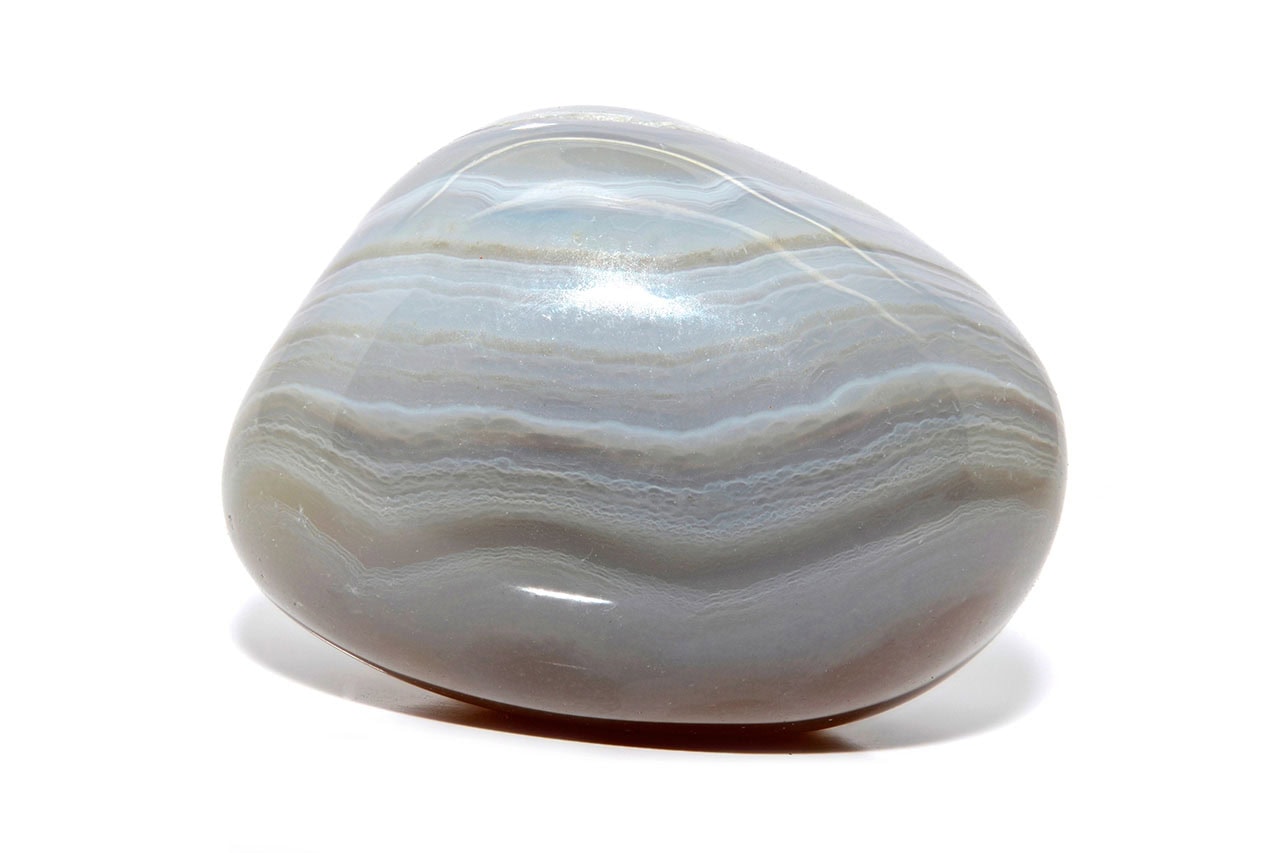
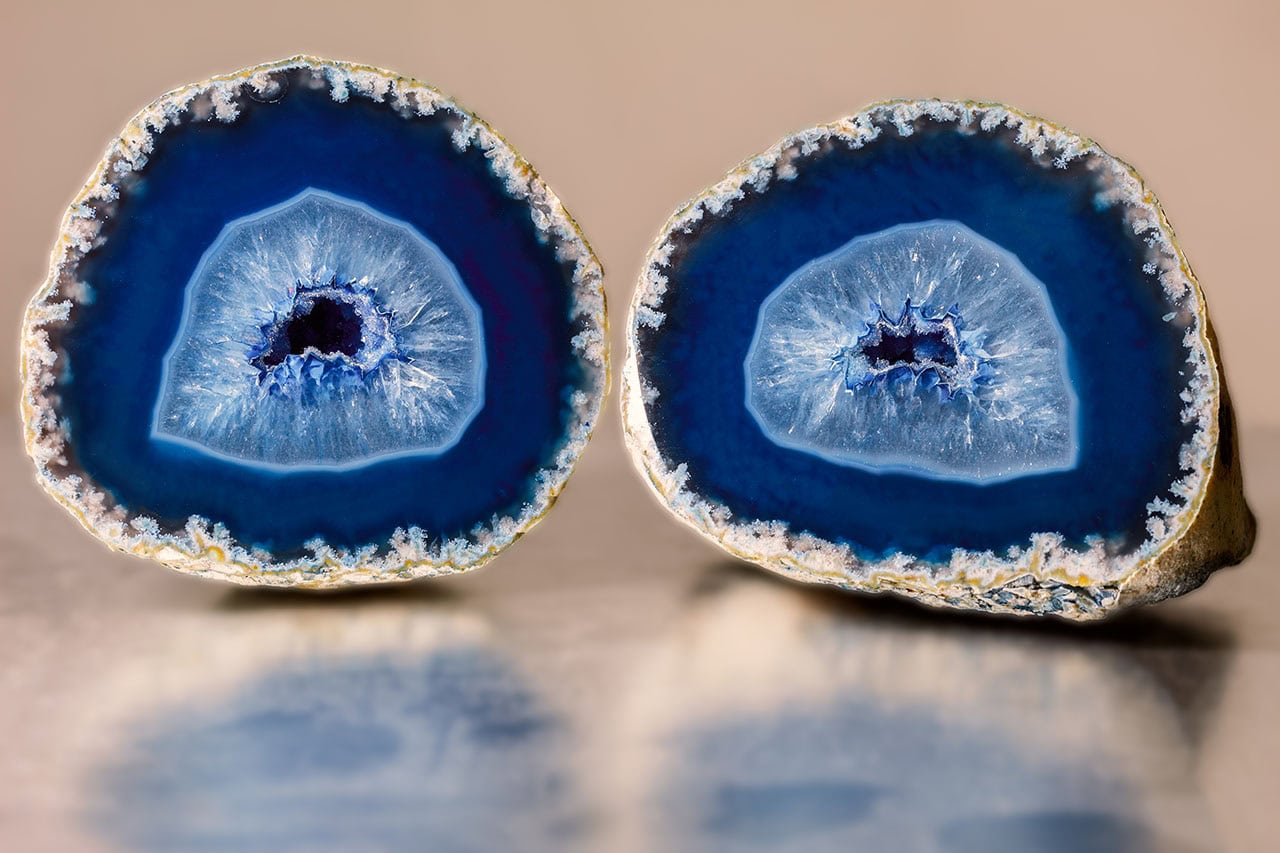
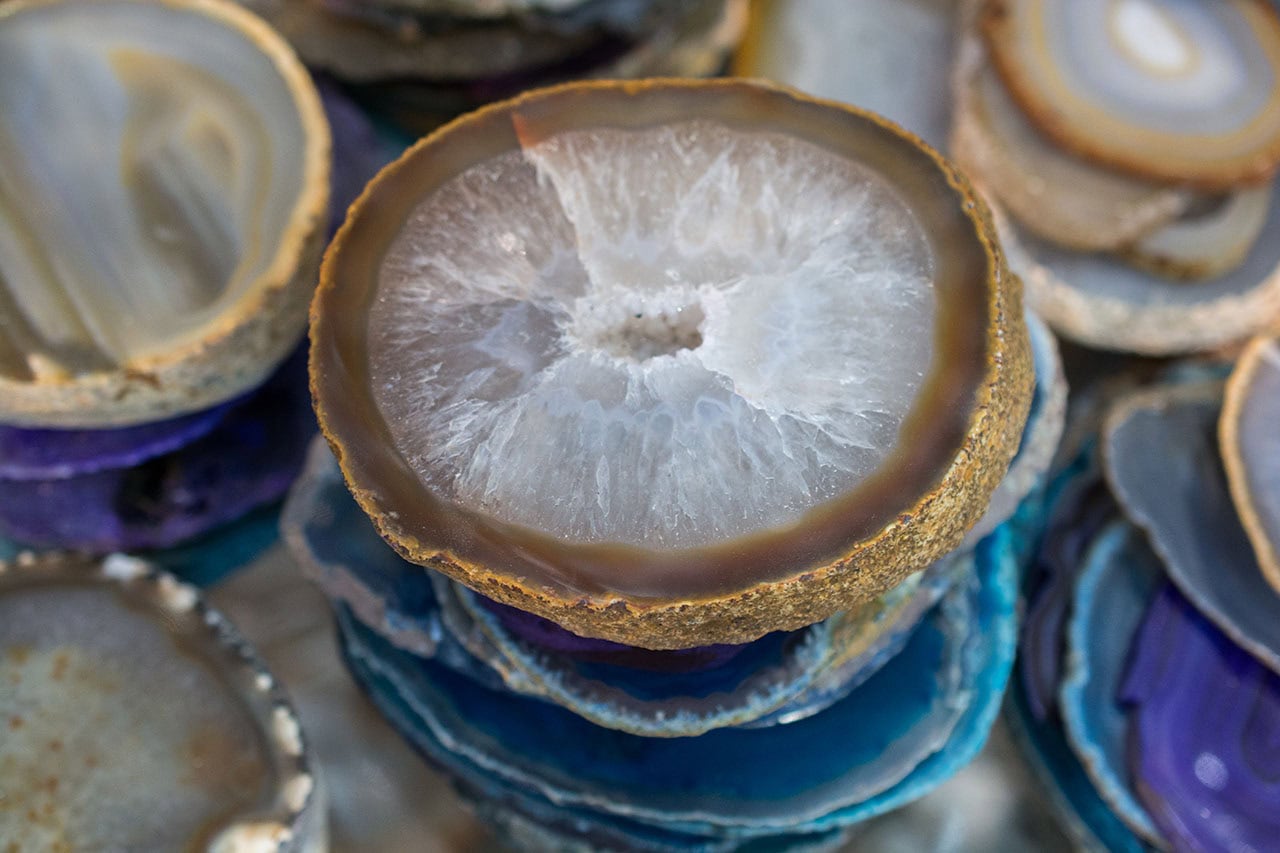
TABLE OF CONTENTS
Properties & Qualities
Physical Properties
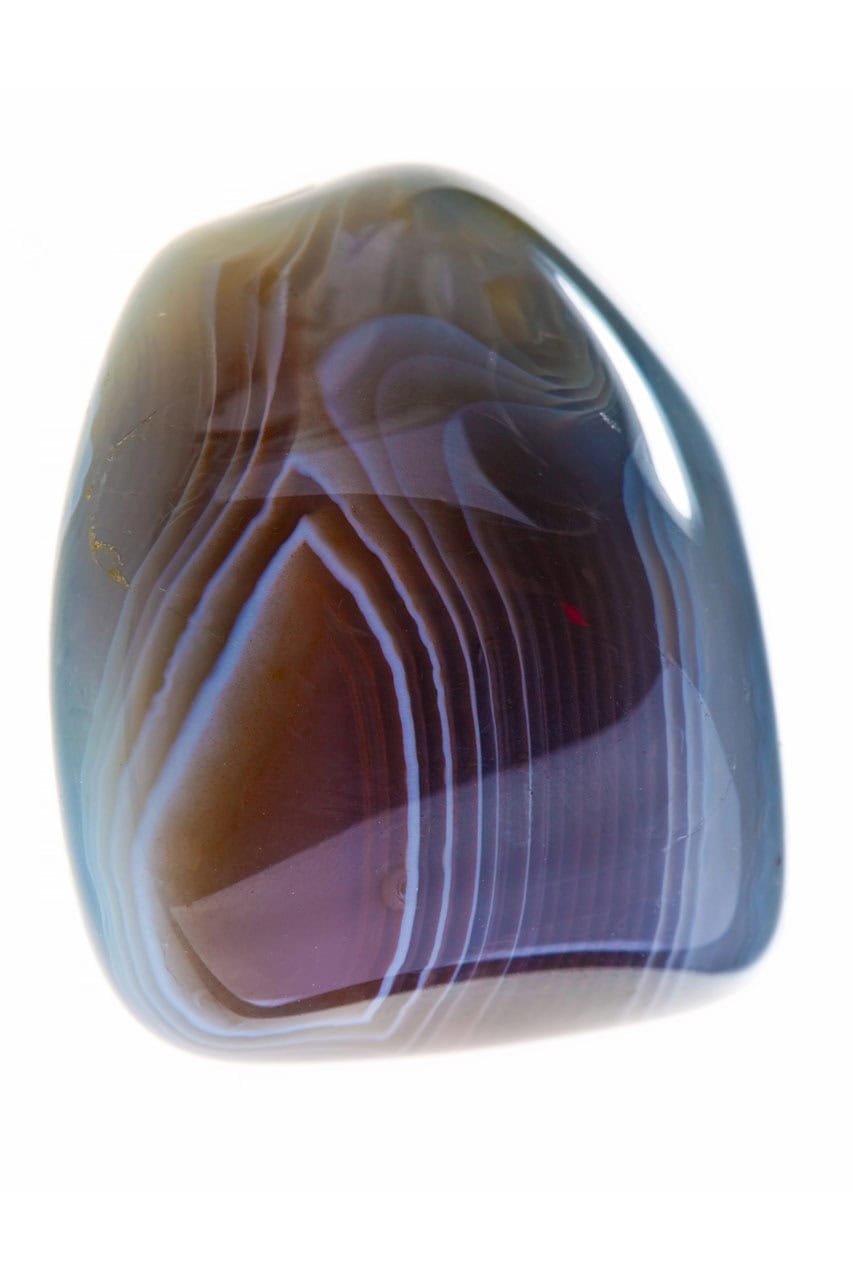
Agate reveals itself as nature's most accomplished abstract artist. No two pieces are ever identical, yet all share the characteristic banding that makes agate instantly recognizable. These bands can be paper-thin or broadly sweeping, following contours that map the ancient cavity where they formed.
The colors can be striking—sunset oranges that glow with inner fire, deep reds, and pale blues. Most of these hues come from trace elements: iron produces the colour of most agate bands, while manganese, chromium and nickel colour some others. Some agates include nearly the entire spectrum in a single palm-sized specimen.
Under magnification, agate's secret structure emerges. It's composed of microscopic quartz crystals so fine they interlock into a dense mass that is still porous enough to take dye. This cryptocrystalline structure gives agate its characteristic waxy luster and allows it to take an exceptional polish that feels almost soft to the touch despite its considerable hardness.
Light behaves uniquely in agate. Thin slices become translucent windows revealing hidden landscapes—dendritic inclusions that mirror winter trees, fortification patterns resembling ancient city walls, moss-like formations that seem to capture prehistoric forests. Some varieties show iris effects when sliced thin enough, breaking white light into rainbow spectrums.
The stone's formation process creates fascinating variations. Waterline agates show horizontal banding from fluctuating water levels. Eye agates form concentric circles like ancient targets. Sagenitic agates trap needle-like mineral inclusions in spray patterns. Each tells its own geological story.
Metaphysical properties
Within metaphysical traditions, agate occupies a foundational position as the great stabilizer—a stone that anchors ethereal energies into physical reality. Unlike high-vibration stones that lift consciousness upward, agate draws energy downward, creating what practitioners describe as an energetic root system.
Different varieties carry distinct energetic signatures. Blue lace agate resonates with the throat chakra, allegedly facilitating clear communication. Fire agate connects to the sacral chakra, stimulating creativity and passion. Moss agate links to the heart chakra and nature spirits. Yet all agates share what energy workers call a "harmonizing frequency" that brings disparate energies into balance.
Agate has a long reputation as a protective stone. Pliny the Elder recorded that in Persia its smoke was believed to turn away storms, and later lore credits it with protecting harvests and clearing the mind.
Modern practitioners often describe agate's energy as feeling like a deep breath—it slows racing thoughts, grounds scattered energy, and creates space for integration. Some report that sleeping with agate produces unusually vivid but peaceful dreams, as if the stone helps process daily experiences into wisdom.
The banded structure itself has metaphysical significance. Each layer allegedly holds different vibrational information, making agate a kind of geological library that can be accessed through meditation.
Meaning & Symbolism
Physical meaning
In physical symbolism, agate represents the principle of slow, steady growth and the accumulation of strength over time. Its formation process—layer after layer of patient deposition—mirrors the way physical health and vitality build through consistent, sustained practices rather than dramatic interventions.
The stone's incredible durability despite being formed from microscopic crystals symbolizes how small, repeated actions create lasting strength. This has made agate popular among athletes and physical trainers who see it as representing the compound effect of daily training.
Its connection to the earth element links it with stamina and endurance. Practitioners say they feel more grounded in their bodies when carrying agate, with improved awareness of physical needs and boundaries. The stone allegedly helps those who tend to "live in their heads" reconnect with bodily wisdom.
Different varieties connect to different physical systems. Red agates are associated with vitality, green with growth, blue with calm. These associations belong to folk wisdom.
Spiritual meaning
Agate's spiritual significance centers on its role as a bridge between heaven and earth. Its formation in volcanic vesicles—spaces created by gas bubbles in cooling lava—has been interpreted as representing the marriage of fire (spirit) and earth (matter), with water (emotion) as the medium of transformation.
Some modern practitioners view agate as a teacher of patience and trust in divine timing. Its bands record eons of geological time, reminding practitioners that spiritual evolution follows natural rather than human timelines. This has made it valuable for those learning to surrender control and trust life's unfolding.
The stone's variety mirrors the diversity of spiritual paths. Just as no two agates are identical, spiritual teachers often use agate to illustrate that each soul's journey is unique while still being part of a greater whole. The common silica composition represents universal consciousness, while individual patterns show unique expressions.
Some practitioners describe agate as enhancing spiritual maturity—the ability to hold paradox, integrate shadow and light, and find beauty in imperfection. Its earth connection keeps spiritual work practical and grounded rather than escapist.
Contemporary shamanic practitioners often use agate as a "journey stone," claiming its bands can serve as maps for traveling between worlds while maintaining a strong anchor to physical reality.
Healing Benefits
Physical healing
Traditional healing systems worldwide have employed agate, though it's essential to understand these as energetic and folk practices rather than medical treatments. No scientific evidence supports agate's physical healing properties.
Modern crystal healers often use agate in layouts designed to stabilize erratic energy patterns, and some place it near the eyes during meditation as a symbol of clear sight.
Agate is not a substitute for medical care. If something in your body worries you, see a doctor.
Emotional healing
Agate's reputation in emotional healing centers on its ability to bring emotional extremes into balance. Practitioners describe it as neither suppressing nor amplifying emotions but rather creating a stable container where feelings can be safely experienced and integrated.
Practitioners say agate helps identify the roots of emotional patterns. Its layered structure allegedly mirrors the layers of emotional experience, helping people recognize how current reactions connect to past experiences.
The stone is particularly recommended for those who experience emotional volatility or feel at the mercy of their feelings. Rather than numbing emotions, agate reportedly helps create enough stability to observe feelings without being overwhelmed by them.
Different varieties address different emotional needs. Blue lace agate soothes the fear of speaking one's truth. Crazy lace agate (with its chaotic patterns) helps find joy in life's unpredictability. Botswana agate, with its subtle grays and pinks, supports those working through grief.
Spiritual healing
In spiritual healing contexts, agate addresses what practitioners call "spiritual fragmentation"—the sense of being scattered across multiple dimensions or torn between spiritual calling and earthly responsibilities. Its integrative properties allegedly help weave disparate aspects of self into a coherent whole.
Energy healers often use agate to repair grounding cords—the energetic connections between the base chakra and Earth's core. They describe placing agate at the feet or base of spine to strengthen these connections, particularly for those who feel "unrooted" or disconnected from physical reality.
The stone's formation through repeated cycles makes it valuable for healing karmic patterns. Some practitioners use banded agate in past-life work, claiming each band can represent a different lifetime or cycle, helping identify and release repetitive patterns.
Agate allegedly helps heal the split between spiritual and material life that many modern seekers experience. Rather than seeing physical life as less spiritual, agate's earth wisdom teaches that matter and spirit are one—spirit crystallized into form.
For those experiencing spiritual crisis or dark night of the soul, agate provides what many describe as a "reality anchor"—preventing complete dissolution while still allowing necessary spiritual transformation. Its stable presence helps keep one grounded during intense spiritual openings. Anyone going through a spiritual crisis deserves real support, and a stone is no replacement for it.
Use & Care
How to use
- Pocket stone: Carry tumbled agate as a touchstone throughout the day, holding during stressful moments for instant grounding.
- Desk placement: Keep larger specimens on work desk to maintain focus and prevent energy scatter during demanding tasks.
- Meditation anchor: Hold or place at base of spine during meditation to maintain earth connection while exploring higher states.
- Sleep support: Place under pillow or on nightstand to promote restful sleep and meaningful dream integration.
- Bath companion: Place agates around bathtub (not in water) to create stabilizing energy field during ritual baths.
- Garden placement: Bury small agates in garden or potted plants to promote healthy growth and earth connection.
- Jewelry wearing: Wear agate jewelry touching skin for continuous energetic support and protection throughout day.
- Grid foundation: Use as corner stones in crystal grids to stabilize and ground the grid's energy into physical reality.
- Workspace grids: Create small agate grids around your computer or desk to keep a steady, grounded workspace.
How to cleanse
- Earth burial: Bury in clean soil for 24-48 hours to discharge accumulated energies and reconnect with earth element.
- Running water: Hold under cool running water while visualizing energies washing away (safe for agate's hardness).
- Sunlight: Place in morning sunlight for energetic renewal.
- Smoke cleansing: Pass through sage, palo santo, or incense smoke for quick energetic clearing.
- Sound clearing: Use singing bowls, bells, or tuning forks to vibrationally cleanse accumulated energies.
- Moonlight bath: Leave under full moon overnight for gentle cleansing and recharging.
- Breath work: Hold while doing conscious breathing, imagining each exhale removing stagnant energy.
- Reiki cleansing: Use Reiki symbols to clear and recharge, particularly effective for programmed agates.
How to charge
- Earth charging: Place directly on soil or grass for several hours to recharge with earth energy.
- Sunlight activation: Expose to sunrise light for 15-30 minutes to activate and energize (dyed agate can fade with long exposure).
- Crystal cluster: Rest on clear quartz or amethyst cluster overnight for amplified charging.
- Intentional programming: Hold while clearly stating intended purpose, visualizing energy anchoring into bands.
- Sacred site charging: Take to natural power spots like mountains or ancient trees for deep earth charging.
- Elemental charging: Expose to all four elements—earth, water (mist), fire (candle proximity), air (wind).
- Group charging: Charge in circle with other agates to amplify collective earth energy.
- Seasonal charging: Charge at equinoxes and solstices when earth energies are most balanced.
- Sound charging: Use drumming or earth-frequency tones to activate agate's ground state.
Combining with other stones
- Clear Quartz: Amplifies agate's grounding while adding clarity and programmability to its stable energy.
- Black Tourmaline: Creates powerful protection combination, with agate stabilizing tourmaline's intense shielding.
- Carnelian: Adds creative fire to agate's stability, excellent for grounded manifestation work.
- Smoky Quartz: Deepens grounding and transmutation abilities, ideal for releasing old patterns.
- Jasper: Another chalcedony that harmonizes perfectly, strengthening earth connection and physical vitality.
- Hematite: Intensifies grounding to almost magnetic levels, useful when you feel very spacey.
- Rose Quartz: Brings heart energy to agate's stability, creating emotionally safe container for healing.
- Amethyst: Balances agate's earth energy with spiritual connection, bridging lower and upper chakras.
- Citrine: Adds solar confidence to agate's stability, excellent for grounded leadership.
Identification
Can be mistaken for
- Jasper: Another chalcedony variety, but jasper is opaque while agate shows translucency and distinct banding.
- Dyed howlite: Often dyed and sold as colorful agate, but howlite is softer and shows different patterns.
- Banded glass: Can mimic agate appearance but lacks natural variations and crystalline structure.
- Onyx: Actually a type of agate with parallel bands, often confused but onyx typically shows straight rather than curved bands.
- Painted rocks: Tourist shops sometimes paint bands on plain rocks; these lack agate's translucency and structure.
- Slag glass: Industrial byproduct can show banding but has different composition and lacks crystalline structure.
- Banded calcite: Softer than agate (3 vs 7 Mohs) and often sold as "Mexican onyx."
- Rhodochrosite: Can show similar banding but is much softer and typically pink to red only.
How to spot a fake
- Dye detection: Overly bright, uniform colors (hot pink, electric blue) indicate dyeing. Check holes or cracks for dye concentration.
- Pattern analysis: Natural patterns show variation and imperfection. Too-perfect bands suggest glass or a painted imitation.
- Translucency test: Hold to light. Most agate lets some light through at a thin edge, though dark and thick pieces may not.
- Weight check: Agate has specific gravity around 2.6. Significantly lighter pieces might be plastic or resin.
- Temperature test: Agate feels cool to touch and warms slowly. Plastic or resin warm quickly.
- Magnification exam: Look for natural inclusions, tiny crystals, or mineral deposits. Round gas bubbles point toward glass or resin, though not conclusively, since natural stones can hold fluid inclusions with a bubble.
- Price evaluation: Extremely cheap "rare" agates are suspicious. Common varieties are affordable, but exceptional pieces command fair prices.
- UV light check: Some fake agates fluoresce unnaturally under UV light due to dyes or treatments.