
Amethyst holds February. Its Greek name means not drunk, which is a claim rather than a description. How a purple quartz came to carry it is a question the ancient record leaves open, and the two accounts that do answer it each arrive with a disclaimer attached.
Liddell, Scott and Jones is the standard Greek lexicon and it is arranged by sense, not by date. Under amethystos it gives an adjective, “not drunken, without drunkenness”; then a substantive, “remedy against drunkenness”, cited to the physician Archigenes as quoted by Galen, to Dioscorides and to Plutarch; then a kind of herb; then the gem; then a kind of grape.
Five senses, and the entry does not join them up. Nothing in it says the remedy was the stone. The citations under the remedy are medical and the citations under the gem are not, and the sense sitting between them is a plant.
A word with more than one job
The order of an LSJ entry can mislead anyone reading it as a chronology, because it is not one. The earliest citation anywhere in this entry belongs to the gem, in the Septuagint, which puts the stone in the vocabulary of the eastern Mediterranean by the third or second century BCE. The medical citations, and Plutarch with them, come from the first and second centuries CE. The gem sense is not a late arrival at the end of a long medical career; if anything it is attested first.
A word that makes a claim about drunkenness is therefore being applied, quite early, to a purple stone, and the lexicon records both facts without proposing a link between them.
That gap is not a failure of the sources. It is what a name of this kind often looks like. Somebody has to supply the join, and two texts do, fifteen hundred years apart: one that reports somebody else supplying it and rejects it, and one that invents its own.
Pliny, and the falsehoods of the magicians
Pliny, in Book 37 of the Natural History, works through the varieties of the stone and the shades of purple, and lists sources in India, Arabia, Lesser Armenia, Egypt, Galatia, Thasos and Cyprus. Then he arrives at what the magi say about it, and he does not hide his opinion. In the Bostock and Riley translation: “The falsehoods of the magicians would persuade us that these stones are preventive of inebriety, and that it is from this that they have derived their name.”
There is the join, in a sentence built to reject it. Pliny goes on to report their other claims for the stone, that wearing it gains access to the presence of kings, and that it averts hail and locusts if a certain prayer is said over it, and then delivers his verdict on the lot: these are “statements which, in my opinion, they cannot have committed to writing without a feeling of contempt and derision for the rest of mankind.”
That is a man describing a trade in explanations and saying he thinks the people selling them know better. What survives of the ancient link between amethyst and sobriety is therefore a hostile witness reporting somebody else’s claim. It is a thinner foundation than the popular account of the name suggests, and a stranger one.
A metamorphosis with the word feigned printed on it
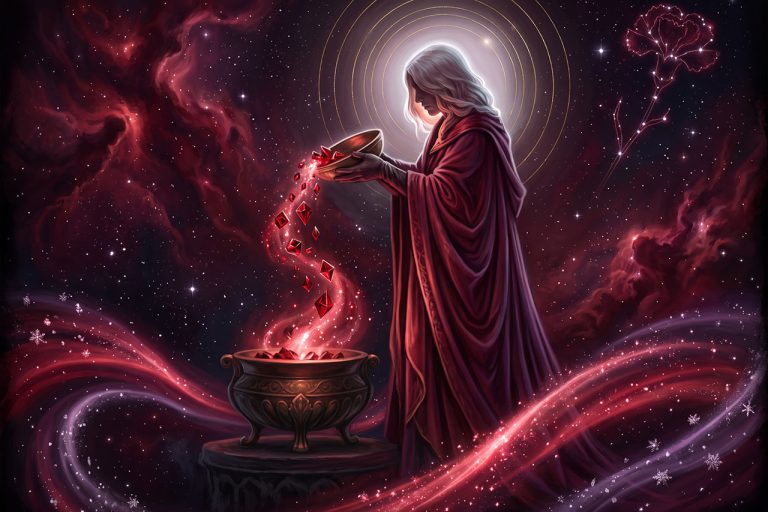
The story usually told runs like this. A nymph called Amethyste is pursued by Bacchus, saved by Diana, who turns her to white stone, and stained purple when the god pours wine over her in remorse. It is generally offered as Greek myth. It is a French poem, and it is a good deal better than the summary.
Remy Belleau published Les Amours et nouveaux eschanges des Pierres precieuses in Paris in 1576, printed by Mamert Patisson at the house of Robert Estienne, with a royal privilege. The edition carried the first twenty-one of his stone poems; ten more went unprinted in his lifetime. The first of the twenty-one is “L’Amethyste, ou les Amours de Bacchus et d’Amethyste”.
Bacchus, in it, discovers that fate and “Diane au chaste sein” stand between him and Amethyste, and loses his temper. He has his chariot yoked and sets his tigers and his ounces on the road, swearing that the first person to come along it will be given to them. What comes along it is Amethyste, “humble se pourmenant pour saluer les Dieux et faire sacrifice a la chaste Deesse”, walking humbly to greet the gods and make sacrifice to the chaste goddess. Set upon, she calls out to Diana: “Ayez pitie de mes chastes amours.”
She is answered. The blood stops in her and her feet go numb. Three times she tries to walk and three times to turn her head, and then she goes as hard as rock. Her scattered tears fall on Indian gravel, where Belleau sets the scene, and set as stones.
No wine is poured. Belleau’s Bacchus is “espouvante d’horreur”, struck with horror, and the poem says that although he was a god he trembled and shook with fear. He calls the sight the worst of all the evils he suffers, and he blames Cupid, Venus, Diana and Destiny rather than himself. What he declares is a memorial rather than a punishment or an apology. He asks that the stone carry his divine anger inside it, “teinte de mes couleurs” (tinted with my colours), and keep whoever bears it from ever getting drunk on his own sweet liquor. He adds that it should make its bearer sober, honest, courteous and quick-witted, worn hidden against the breast or pressed close on the navel.
Belleau then does something a modern reader will not expect. In his prose epistle to Henri III he sets out his own method, offering the king “celle mienne et nouvelle invention d’escrire des Pierres, tantost les deguisant sous une feinte metamorphose, tantost les faisant parler, et quelquefois les animant de passions amoureuses et autres affections secretes, sans toutesfois oublier leur force, ny leur propriete particuliere” (this my own new way of writing about stones, sometimes disguising them under a feigned metamorphosis, sometimes making them speak, and sometimes animating them with amorous passions and other secret affections, without however forgetting their powers or their particular properties).
The sentence straight after it reads: “Ce que j’ay soigneusement recueilly de la fertile moisson des autheurs anciens” (which I have carefully gathered from the fertile harvest of the ancient authors). He claims the properties from antiquity and the metamorphosis for himself, in consecutive clauses, on the first page. The book’s front matter says the same thing in verse. Jean Dorat’s dedicatory poem to Henri III, printed in Latin and again in French after it, assigns four stones to four of the king’s qualities and gives amethyst “l’heur d’un ame temperee” (the good fortune of a temperate soul). The old sense of the word sits at the front of the book that is about to invent an origin for it.
Feinte is the word to sit with. Feigned. Belleau is not passing on something he found and he does not pretend to be. He announces a device, uses it for twenty-one stones and signs it.
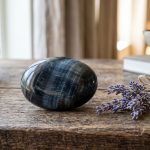
For the mineral rather than the argument about it, the Crystalance Mineral Library has the stone set out on its own terms.
The name still makes its claim. Both accounts of where the claim came from arrive with a disclaimer attached: a naturalist who thought it was a lie sold by professionals, and a poet who printed the word feigned on his method before he used it. Fifteen centuries between the two disclaimers, and the story went on being told anyway.
Sources
- Liddell, Scott and Jones, A Greek-English Lexicon, entry for amethystos, for the five senses and their citations: perseus.tufts.edu
- Pliny, Natural History 37.40, Bostock and Riley, for the magicians, the name, and Pliny’s verdict: perseus.tufts.edu
- Bibliotheque nationale de France, the 1576 edition of Belleau’s Les amours et nouveaux eschanges des pierres precieuses: gallica.bnf.fr
- Reseaux des poetes du XVIe siecle, the 1576 title page and Jean Dorat’s dedicatory verse to Henri III, transcribed from Guy Demerson’s critical edition: reseauxpoetes16e.huma-num.fr
- Remy Belleau, Oeuvres completes, ed. A. Gouverneur, volume III, Paris, 1867, for the dedicatory epistle, “L’Amethyste”, and the editorial note on the twenty-one stones of 1576: archive.org