Why Lepidolite Is Expensive

Lepidolite is a lithium-bearing mica, and its price is shaped less by metaphysical rarity than by the global lithium market. When EV-battery demand pushed lithium prices to record highs in 2022, crystal-grade lepidolite was pulled along. Even after lithium prices crashed in 2024, hobbyist supply has not fully relaxed.

If you have ever wondered why a polished lepidolite tower costs three times what a comparably sized rose quartz costs, you are asking a better question than the one most crystal sites are answering. The standard explanation, that lepidolite is “rare” or “specially soothing,” is not exactly wrong. It is just not the part of the answer that explains the price.

Most sites will tell you lepidolite is expensive because it is harder to find than common quartz. They are not wrong, but they are not telling you the rest. The rest is that lepidolite is a real industrial mineral. It is one of the historic ore minerals of lithium, and the same global supply chain that powers electric vehicles also touches the supply of crystal-grade material on collector and decor shelves.

At Crystalance, we think buyers deserve the actual answer. So here it is.

What Most Sites Get Wrong

Search “why is lepidolite so expensive” and you will read a lot of variations on the same answer. It is a unique purple-pink mica. It carries a soothing energy. It is harder to source than mainstream stones. It is sometimes mistaken for similar-looking lithium-bearing material.

These claims are not false. They are also not the actual mechanism behind the price.

Crystal-grade pricing for any mineral depends on three pressures stacked on top of each other. Geology, which controls how much exists and where. Industrial demand, which controls whether anyone is mining the deposits in volume. Hobbyist demand, which determines how much of the mined material gets diverted to lapidaries and decor sellers rather than chemical processing.

For most popular crystals, the second pressure barely applies. Rose quartz, amethyst, clear quartz, smoky quartz, and similar mainstream stones are essentially byproducts of broader silica-rich geology. Industrial demand for them is small. Their pricing is a function of fashion, locality, and quality grading.

Lepidolite is different. Lepidolite is on the periodic table, and the chemistry is not optional. Lithium ore is what it is. When lithium markets move, the supply chain that produces all lithium-bearing minerals moves with them.

Recycled “rarity” framing on crystal blogs hides this. We are not interested in hiding it.

What’s Actually True: Lepidolite Is a Lithium Ore

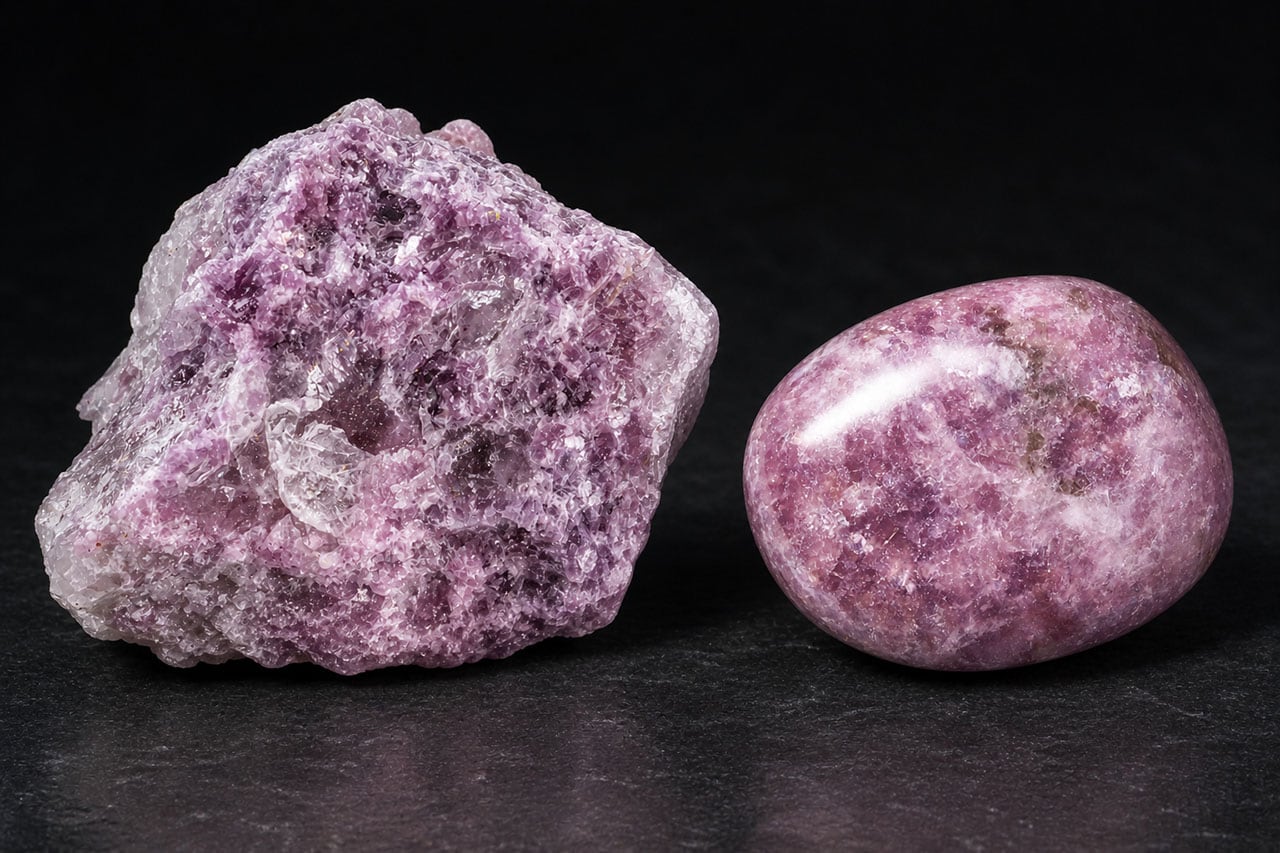
Lepidolite is a member of the mica group, which is a family of sheet-silicate minerals that cleave into thin elastic plates. Its chemistry includes lithium, fluorine, and varying amounts of rubidium and cesium. The pink-to-lavender colour comes from manganese substituting into the structure, typically attributed to divalent manganese in the standard mineralogical references. Hardness on the Mohs scale (the standard 1-to-10 scratch resistance scale) is 2.5 to 4, soft enough to be scratched by a steel knife.

What sets lepidolite apart from the other purple stones is the lithium content. Lepidolite ore typically runs between 1.5 and 3.5 percent lithium oxide by weight, varying with composition and quality. That is high enough that lepidolite has been mined as a primary lithium ore since the nineteenth century, even though it is leaner than the higher-grade spodumene that now dominates hard-rock lithium production.

Today, lepidolite is a secondary lithium source rather than a primary one. Most of the world’s lithium currently comes from two channels: brine extraction in the lithium triangle (Chile and Argentina lead production, with Bolivia holding large but mostly undeveloped reserves), and hard-rock mining of spodumene, the lithium-bearing mineral that now dominates pegmatite-based extraction. The USGS still classifies lepidolite as one of the principal lithium ore minerals found in lithium-cesium-tantalum pegmatites, but it is no longer where the bulk of the world’s lithium comes from.

But lepidolite has stayed in the supply chain. Chinese refiners have invested heavily in lepidolite-based lithium production over the past decade, especially in Jiangxi province, where the city of Yichun is widely described as a global lithium-processing hub. The economics are tight. Lepidolite extraction is relatively high-cost, and Chinese operators routinely scale output up or down with the lithium price. When industrial demand for lithium spikes, mines that hold lepidolite get more attention. When it drops, those operations slow, and the material that gets diverted to specimen markets becomes a different kind of byproduct.

This is the missing context. Lepidolite is a real mineral with a real industrial life. Same supply chain, different shelves. The pretty polished tower on a crystal shelf shares ancestry with the lithium in a phone battery.

How Lithium Markets Drive Crystal-Grade Pricing

Here is the actual answer to the pricing question, in three movements.

The 2021–2022 spike. Beginning in 2021, lithium spot prices climbed steeply as global EV production scaled up faster than refining capacity. Battery-grade lithium carbonate, which had traded around 7,000 to 10,000 USD per metric ton through the late 2010s, climbed to a peak of roughly 80,000 USD per metric ton in late 2022. USGS Mineral Yearbook data corroborate the climb, showing battery-grade prices rising from about 35,000 USD per metric ton in January 2022 to 67,000 USD per metric ton by December of that single year. That is not a small move. That is a more than seven-fold increase in two years.

When the underlying ore commodity surges by that much, the entire mining supply chain responds. New deposits get prospected. Existing operations expand. Specimen-grade material that historically sat in rough form at lapidary shops starts moving faster. Wholesale prices for lepidolite rough rose meaningfully in this period, even though the rough was being sold for lapidary work, not battery production.

The 2023–2024 correction. Lithium prices crashed through 2023 and 2024 as EV demand growth slowed and Chinese refining capacity outpaced supply needs. By early 2024, average lithium selling prices had fallen to around 12,600 USD per metric ton, a roughly 75 to 80 percent drop from the late-2022 peak. Benchmark Mineral Intelligence data showed battery-grade lithium carbonate at around 15,175 USD per metric ton in March 2024, and the price stabilized in the low-teens-thousand-dollar range through the rest of the year.

Crystal-grade lepidolite has not corrected on the same curve. There is a structural reason. Hobbyist supply chains are slower than commodity markets. A wholesaler who paid spike-era prices for lepidolite rough in 2022 is still working through inventory in 2026. Retail prices that drifted up during the spike have not been pulled back down by the same forces that crashed industrial pricing, because retail demand for purple-pink polished mica is not elastic to the lithium spot market in the way industrial demand is.

The current floor. What remains is a price level higher than where lepidolite sat in the late 2010s, and probably higher than the geology alone would support if the lithium-market context disappeared. We are not predicting a collapse. We are pointing out that the current floor is structural, not metaphysical. It is what happens when an industrial mineral has a moment, and the hobbyist market remembers.

If you are buying lepidolite in 2026, you are buying material whose pricing was set during or after a global commodity spike. That is the actual answer.

Where Lepidolite Comes From (And Why That Matters)

Lepidolite is found in granitic pegmatites, which are coarse-grained igneous rocks rich in rare elements. Per mindat.org’s locality data for lepidolite, the major historical and current sources include:

  • Brazil, particularly Minas Gerais state, which has produced significant quantities of lepidolite from pegmatites in the Eastern Brazilian Pegmatite Province for over a century.
  • Madagascar, with material from pegmatite fields in the central highlands.
  • Russia, from the Ural Mountains and other pegmatite zones.
  • Afghanistan, particularly the Nuristan and Kunar regions, which have produced gem-quality lithium minerals including lepidolite.
  • Czech Republic, from historic pegmatite localities in Moravia.
  • United States, with material from Maine, California, and South Dakota historically.
  • Canada, particularly Manitoba and Ontario.

What does this tell a buyer? Locality affects what a piece looks like and what it has been through before reaching a shelf. Brazilian lepidolite tends toward the lavender-pink colour most buyers picture when they imagine the stone. Material from some Asian sources has a denser, more compact lithium-mica look. Pegmatite-rich African material can show interesting intergrowths with tourmaline or quartz, which can either raise or lower its desirability depending on whether you are buying for the matrix or the lepidolite itself.

A reputable seller can tell you the country of origin. Many cannot. That is itself a buying signal.

What You’re Actually Paying For

Lepidolite reaches buyers in several distinct forms, and the price-per-gram is wildly different across them.

Book lepidolite. The natural plate-like form, often sold as a stack of pink-violet sheets resembling pages of a book. Inexpensive on the rough side because it requires minimal lapidary work. Often sold as raw specimens or small palm pieces.

Tumbled and palm stones. Smoothed and polished pieces in the 20-to-100-gram range. Mid-priced. The dominant retail format. Pricing reflects rough cost plus tumbling labour, which is small.

Polished towers and spheres. Significantly more expensive per gram than tumbled material. Towers are hand-shaped from larger rough, which involves selecting material with consistent colour and minimal cracking. The labour and the rough-selection cost both matter here. Lepidolite is soft and tends to fracture along its mica cleavage planes, so producing a clean tower requires care.

Gem-grade lepidolite. Rare, and atypical. GIA’s Gems and Gemology has documented translucent Brazilian material faceted experimentally into stones as large as 23 carats, but neither GIA nor AGTA tracks faceted lepidolite as a standard commercial gem category, and there is no structured wholesale pricing the way there is for sapphires or tourmalines. The mineral’s micaceous cleavage is the primary obstacle to faceting; the low hardness compounds the durability problem. Pieces that do get faceted are collector curiosities, priced specimen-by-specimen on clarity and colour rather than to tier-graded standards.

Lepidolite mixed in with other lithium-bearing minerals. Some material sold as “lepidolite” is actually a co-occurring lithium-mica blend, often mixed with cleavelandite (a feldspar) or pink tourmaline (the gem mineral elbaite, lithium-bearing). This is not necessarily a downgrade. Some collectors prefer composite material for its visual interest. But it is worth knowing what you are buying.

For a 100-gram polished palm stone, retail pricing across major channels in early 2026 typically runs from roughly 12 USD on the low end to 40 USD on the high end, with the higher tier usually reflecting better material and clearer provenance disclosure. Bulk listings on aggregator platforms like Etsy and Amazon push lower still, with small lots of lepidolite (often a mix of rough chunks or unmatched tumbled pieces) starting around 5 USD. The bulk tier is rarely sold with locality or quality information attached.

That is roughly an eight-fold spread between the bottom of the bulk market and the top of the retail tier for what is ostensibly the same mineral. The spread is not random. It tracks vendor sourcing, quality of the rough, the form of material being sold (a single matched piece versus a mixed lot), and how much the seller can or wants to tell you about provenance.

Red Flags at the Cheap End

When a polished lepidolite piece is priced well below the going retail rate, three explanations are common.

Dyed muscovite. Muscovite is the most abundant mica, common, cheap, and naturally a silvery-white to pale brown. The substitution of dyed muscovite for lepidolite is a known concern in collector and lapidary circles, even though the specific case is not heavily documented in peer-reviewed gemological journals. The broader pattern, however, is well-established. GIA’s Gems and Gemology has reported on dyed quartzite sold as “lavender jadeite” and dyed magnesite passing for other ornamental materials, with the same diagnostic in each case: dye concentrates along cracks and cleavage planes rather than distributing evenly through the crystal. Real lepidolite gets its colour from manganese substitution within the structure. Dyed mica shows colour pooling along cleavage where the dye has wicked in. Under a loupe (a small magnifying lens), the two patterns look distinctly different.

Composite or stabilised material. Soft minerals are sometimes infused with resin to make them workable for lapidary purposes. Resin-stabilised lepidolite is structurally sound but it is no longer purely the natural mineral. The treatment is rarely disclosed at the retail level.

Mass-produced fillers. Some inexpensive “lepidolite” pieces sold by aggregators are reconstituted material, meaning powdered mineral bonded back together with a binder, then polished. These look superficially like the real thing in product photos. They are not the same material in any meaningful sense.

No country of origin. This is the simplest red flag and the most reliable. If a seller cannot tell you where their lepidolite came from, they are either reselling material from an importer who would not tell them, or they are not paying attention to provenance at all. Either way, the editorial standard is the same: the absence of locality information is information.

We do not name specific sellers in our reporting. The pattern is what matters, and the pattern is well documented across mass-market crystal retail.

Our Standard for Buying Lepidolite

We have done enough vendor surveying to take a position. Here is what we would tell anyone buying lepidolite in 2026.

Pay for provenance. A seller who can name the country, ideally the region or pegmatite, has done the work to source legitimately. Pay 20 to 30 percent more for that information than you would pay for an anonymous piece. It is the cheapest authority signal you can buy.

Skip the cheapest tier unless you accept what it is. Cheap polished lepidolite is not always fake, but the probability of treatment, dye, or composite material rises sharply at the bottom of the price range. If you are buying for a collection, this matters. If you are buying for casual decor and you accept that the stone may not be entirely natural, the lower tier is fine.

Match the form to the use. Book lepidolite is the most authentic form because it has the least room for trickery. Tumbled stones are reliable middle-ground. Polished towers are where treatment becomes more common, because the smooth finish hides the cleavage character that would otherwise let you read the material at a glance.

Ignore “rarity” framing. Sellers who lean hard on rarity language without sourcing detail are usually substituting marketing for information. Rarity is a real factor in mineral pricing. It is also the easiest claim to make and the hardest to check.

These are not radical standards. They are what we would expect from any seller serious about their own catalogue.

Frequently Asked Questions

Is lepidolite worth the price? 

That depends on what you are buying it for. As a piece of mineral history, a real lithium ore mica with documented locality and visible book structure, lepidolite is excellent value at the mid range. As a generic polished tower bought without provenance information, the value proposition is weaker. The metaphysical claims attached to the stone do not change the geology, and the geology is what determines whether you are getting a real specimen.

Why is lepidolite more expensive than amethyst?

Amethyst is a quartz variety, which makes it abundant globally and inexpensive to mine in volume. Lepidolite is a lithium-bearing mica restricted to granitic pegmatites, which are far less common. Add the lithium-market dynamics described above, and the price gap follows from real mineralogy and real economics, not preference.

Is lepidolite ever fake?

“Fake lepidolite” usually means one of three things in the retail market: dyed muscovite mimicking the colour, resin-stabilised material treated to be lapidary-workable, or reconstituted powder bonded with binder. Outright fabrication is less common than misrepresentation. The signs are dye concentrated along cracks, an unnaturally consistent surface, or product weight that feels off for the size.

Should I buy lepidolite for the lithium content? 

No. The amount of lithium in a small palm stone is mineralogically real but not biologically meaningful. We do not endorse any claim that holding or wearing lepidolite delivers lithium to the body in any usable form. The chemistry matters for understanding the mineral and its market. It does not matter for any wellness use.

Does the price of lepidolite still depend on lithium markets?

Less directly than it did during the 2022 spike, but yes. Crystal-grade pricing tends to lag commodity markets by a year or two on the upside and longer on the downside. We expect lepidolite prices to drift toward their pre-spike geology-driven floor over the coming years, but the timing depends on how quickly hobbyist supply works through spike-era inventory.

A Closing Standard

Lepidolite is not expensive because it is mystical. It is expensive because it is a real lithium ore at the intersection of a small hobbyist market and a large, recently turbulent industrial market. That is not a less interesting answer. It is a more interesting one.

If you are buying lepidolite, ask the seller where it came from. Pay extra for provenance. Walk away from the bottom of the price range unless you understand what you are paying for. These are the standards we hold to our own buying, and the standards we think any honest seller should be able to meet.

For more on what lepidolite is and where it sits in the broader mica family, see our Lepidolite mineral page. For our broader thinking on what to expect from sellers, see our notes on how to buy real crystals and our position on buying crystals online.

Crystalance Editorial Team