Yes. Ordinary window glass passes nearly all of the light a sill needs, moonlight included, so nothing about the method changes indoors. Direct sun is the part that needs thought, and only for a few stones.
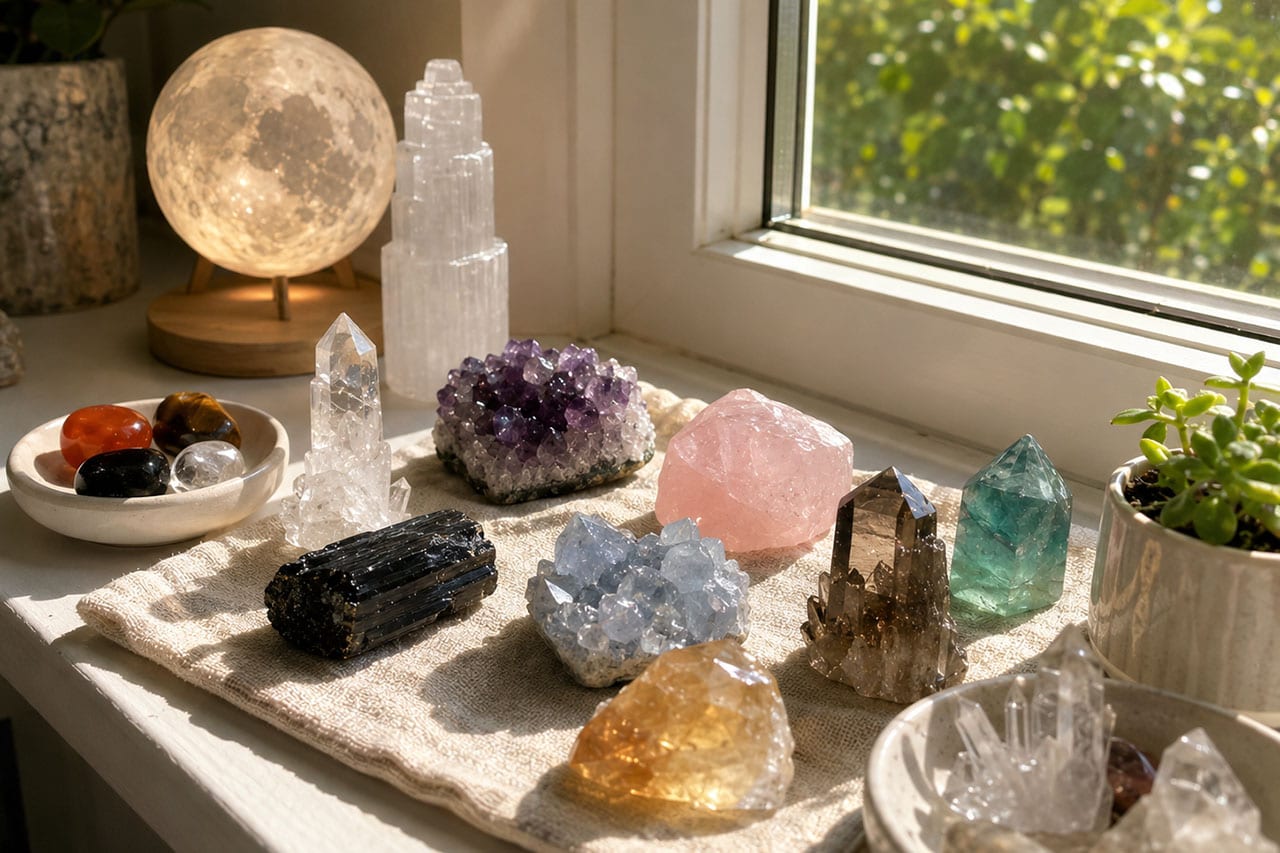
The thing that sends people to a window in the first place is the instruction about the full moon. Crystal practice says to put your stones out under it and bring them back in the morning, and for anyone in a flat without a balcony that instruction has exactly one landing place.
What goes wrong on a sill has nothing to do with the glass. It is that the sill is doing two jobs at once. The stones you leave there overnight in October are the same stones still sitting there in July.
How a night on the sill goes
In crystal practice, cleansing is held to take something off a stone and charging to put something back. They are separate steps with separate methods, and the full sequence has its own article. Moonlight is the method most often given for the second one.
The convention is the full moon, usually extended to the night either side. Past that the practice is not fussy, and most of what makes it go well is ordinary housekeeping.
- Put the stones out once the moon is up rather than at bedtime out of habit, and bring them in when you get up.
- A cloth or a shallow dish underneath stops anything rolling off and keeps grit away from a polished face.
- Use whichever window the moon reaches. You do not need a compass for this. What you want to know is which sill gets the sun at four in the afternoon, because that is the one to keep clear afterwards.
- Nothing will look different in the morning. The practice has never claimed a visible result, and a stone that seems brighter at breakfast is a stone with morning light on it.
A sill is often among the coldest surfaces in the room in winter, and condensation collects there. For quartz that means nothing at all. For pyrite it means a great deal, and that belongs to a different article.
The glass is not the problem
Vitro’s technical data sheet for its clear product gives transmittance for 6 mm glass as zero at 300 nanometres, 3.5 percent at 320, 51.5 percent at 340, and 87.7 percent at 400, which is well inside the visible band. The National Glass Association puts the same thing in a sentence: standard clear glass “screens out nearly all UVB radiation but does little to screen UVA.”
Moonlight arrives essentially untouched. Sunlight loses a sliver at the short end and comes through otherwise intact, warmth included. A sill works as well as a doorstep.
Coated and tinted glazing sold to cut solar gain is the exception, and it takes more of the spectrum than plain float glass does. If a west-facing room stays bearable through an August afternoon, that is the glass you have.
Where the sun changes the question
Ultraviolet is not what does most of the fading. The Canadian Conservation Institute, whose job is stopping museum objects from fading, says that for colours sensitive to light, ultraviolet “usually contributes less than half of the fading and often only one tenth.” The rest is ordinary visible light. Glass barely touches that.
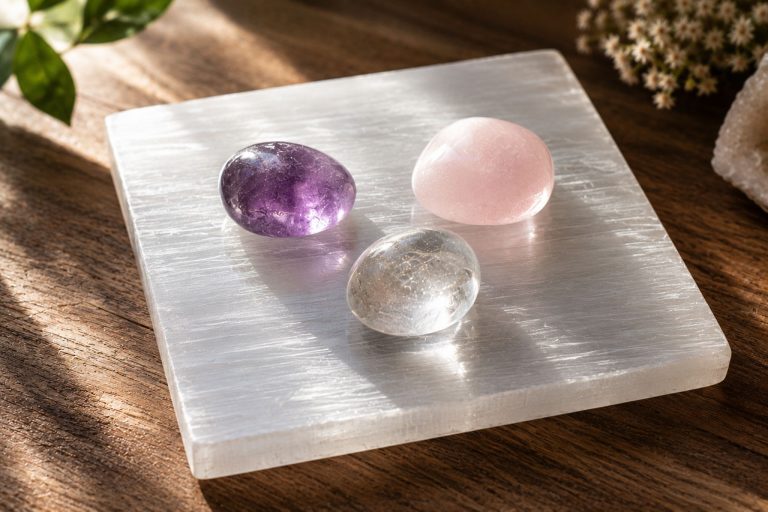
Rose quartz can come straight off the worry list. GIA’s care page calls it “generally stable when exposed to light and heat”, and work published in American Mineralogist found the pink of massive rose quartz comes from fibrous inclusions rather than from a colour centre. Thirteen samples of those fibres lost their colour on heating to between 430 and 750 degrees Celsius.
The stones that do belong there are the ones whose colour comes from a lattice defect. GIA’s durability guide groups citrine with amethyst, kunzite and topaz as gems that “can fade or change color from prolonged exposure to light.” Celestite belongs there too. A National Park Service Conserve O Gram on geological storage lists “maxixe beryl, blue celestite, and some brown topaz” among minerals that can fade, and says light sensitive specimens should be kept in closed cabinets rather than put on display. Opal is a separate case with a different cause. GIA’s opal page warns that “heat from intense light can cause fracture lines called crazing”, so the risk there is thermal rather than optical.
Amethyst is genuinely disputed, and it should be left that way. GIA says some amethyst colour can fade with prolonged exposure to intense light. Causes of Color, the Nassau-derived reference, says amethyst is stable to light and loses colour only when heated to between 300 and 500 degrees Celsius. Two respectable sources, flatly opposed, and no way to settle it from a windowsill. Treat a bright sill as the risk GIA describes and nothing is lost either way.
Cumulative exposure is what the conservation work measures. A 2025 study in Minerals recommends displaying light sensitive minerals below 50 lux, and the Canadian Conservation Institute puts the daily outdoor average at 30,000. A sill in full sun is past that ceiling long before the afternoon is over. The figure describes a display position that a stone occupies for years.
Why moonlight was the easy answer all along
Full moonlight measures between 0.05 and 0.2 lux at mid latitudes, according to a 2017 paper in Astronomy and Geophysics written partly to correct the inflated figures still in circulation. Set that against the 30,000 lux daily outdoor average and there is nothing in a moonlit night capable of bleaching a colour centre or crazing an opal.
Sunlight has one measured effect on quartz, and it runs the other way from charging. Quartz buried in sediment absorbs and stores a radiation dose from the faint natural radioactivity around it, over thousands of years, and the USGS luminescence dating laboratory dates the sediment by measuring that dose. Its own description of the reset runs to a line: “The sunlight bleaches away the luminescence signal and resets the time ‘clock’.”
A sunny sill is not a bad place to keep a crystal. It is a decision about one stone at a time, and the per stone answers sit in the Crystalance Mineral Library, where celestite is filed under celestine.
Overnight, then, on whichever window you have. The stone that will show the difference is the citrine left on the afternoon sill for a summer.
Sources
- Vitro Architectural Glass, technical data sheet for clear float glass. vitroglazings.com
- National Glass Association, FB34-12, Screening Out Ultraviolet Radiation with Laminated Glass, 2023. glass.org
- Canadian Conservation Institute, Agents of Deterioration: Light, Ultraviolet and Infrared. canada.ca
- GIA, Rose Quartz Care and Cleaning. gia.edu
- American Mineralogist, on the fibrous inclusions behind the colour of massive rose quartz, 2001. caltech.edu
- GIA, More Than Mohs: Gem Durability. 4cs.gia.edu
- National Park Service, Conserve O Gram 11/2, Storage Concerns For Geological Collections, 1998. nps.gov
- GIA, Opal Care and Cleaning. gia.edu
- GIA, Amethyst Care and Cleaning. gia.edu
- Causes of Color, WebExhibits. webexhibits.org
- Sitzia and others, Minerals 15(9) 999, 2025. mdpi.com
- Kyba, Mohar and Posch, How bright is moonlight?, Astronomy and Geophysics 58(1), 2017. academic.oup.com
- USGS Luminescence Dating Laboratory. usgs.gov