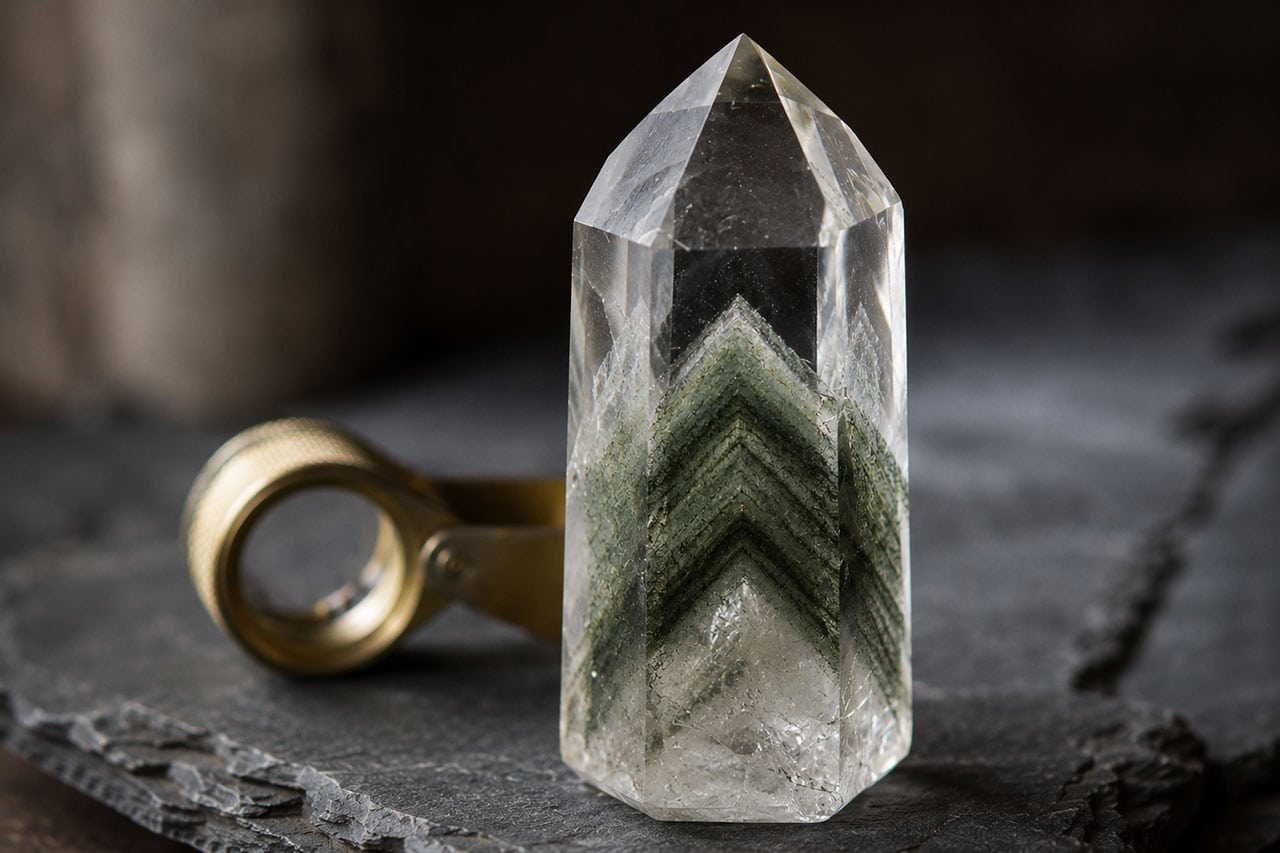
Yes. Phantom quartz is clear quartz that paused while it was growing. A film of another mineral settled on the faces it had at that moment, and later quartz sealed the film inside. The outline you can see is the shape the crystal had when it stopped.
A new kind of phantom quartz appeared in the trade a few years ago, sold as beads, pendants and spheres, and a package of it went to the Taiwan Union Lab of Gem Research for identification. Under the microscope the ghosts inside resolved into regular networks of small crack clusters around a dark central point, which the lab put down to laser impact. One sphere, 17.68 millimetres across, carried six fractures along the ridgelines of a pseudo-hexagonal pyramid that had been drawn rather than grown. Gems & Gemology published the note in the winter of 2020.
Imitation runs one way, and here it ran from clear quartz towards phantom quartz. Somebody spent skill and machine time turning plain rock crystal into the version with a ghost in it, which is a reasonable guide to which of the two a shop can charge more for. The two are the same mineral, silicon dioxide, hardness 7 in both cases.
The two names pull in opposite directions while the material underneath stays put. Clear quartz is sold on being empty and phantom quartz on holding something.
A crystal that kept its own earlier surface
The outline is not a bubble, and it is not a fracture, though it sits where both of those sit and can pass for either at a glance. Writing in Gems & Gemology, the Taiwanese lab gives the working definition: phantom quartz generally refers to rock crystal carrying prismatic or pyramidal growth zonation that represents early crystal faces covered by minerals. The ghost was the outside of the crystal once, and everything around it arrived later.
Quartz grows out of hot water carrying dissolved silica, and the water does not stay the same. An impurity introduced during crystallisation sticks to the faces the crystal has at that moment and is enveloped when growth resumes, which is Mindat’s account of the mechanism. The film left behind is barely a film at all, a dusting sitting exactly where the surface used to be.
Once you have looked at one properly a phantom is easy to trust, and its geometry is why. A fracture inside quartz runs wherever the stress went, at whatever angle it liked. A phantom cannot. It has to lie parallel to the faces of the crystal around it, because it is those faces, from earlier and at a smaller size. A crystal that paused more than once carries several phantoms, each inside the last, and the innermost is the oldest.
The minerals that draw the outline
The colour of a phantom says more about the water than about the quartz. Clinochlore, clay minerals, limonite and fuchsite are the coatings that generally produce the effect, by the Gems & Gemology definition. Mindat pairs chlorite with the green phantoms and kaolinite with the pinkish ones. Limonite, which GIA elsewhere calls a rusty mixture of hematite and goethite, is behind the brown. Chlorite itself is a group of sheet silicates, the kind that turn up through metamorphic and hydrothermal ground.
None of that is chosen by the crystal. The fluid drew whatever it happened to be carrying on the day it stopped bringing silica. Minas Gerais in Brazil and the Itremo area of central Madagascar are the major sources Mindat gives for the green material.
Quartz is not the only mineral that does this. It is only the one the effect is famous in. GIA opened a note on a phantom in a diamond by saying that “when we think about phantoms as inclusions, quartz typically comes to mind”, then described triangular phantom faces that had probably once been an iron sulfide, pyrrhotite among the candidates, and had since altered to limonite. The alteration came after the diamond had closed over the surface, so the phantom in that stone is no longer made of whatever drew it. This diamond had kept an earlier surface too, and the authors say they have never seen another like it.
How phantoms are priced against each other
Buying a phantom means overriding an instinct. Hold transparent stones to the light and the reflex is to prefer whichever has least inside, and phantom quartz invites exactly that inspection before asking you to disregard the result. Closer looking is what settles it. The outlines stop reading as damage the moment you notice how neatly they sit, and nothing that cracked or chipped a quartz crystal by accident would leave a shape that regular behind.
How much more a phantom point fetches than a plain one of the same size is not something we have measured. We have measured how phantoms are priced against each other. In a sweep of European and American online sellers we ran in 2026, the price tracked legibility rather than rarity, and phantoms themselves are common. Chips and faint tumbles are five to twenty euro. Above that, most of the volume sits between twenty and eighty, small points and polished towers with a phantom you can see but not admire. Eighty to two hundred and fifty buys a clean terminated point with the outline distinct and centred, and past that you have left the mass platforms for specialist dealers. A piece moves up that ladder on how sharply the outline reads and how centred it sits, and damage to the surrounding crystal pulls it back down.
The Taiwanese note is not about prices, and does not need to be. The pieces it describes, a sphere and a pendant, had both been cut, so the crystal’s own faces were gone and nothing was left on the outside to check the inside against. A polariscope found the optic axis, and it mostly did not line up with the growth zoning the engraving had drawn. On an uncut point that comparison is free and needs no instrument, because the faces are still there on the surface and a grown phantom runs parallel to them. Gems & Gemology added that the internal stress those regular, oriented cracks generate appears to reduce the toughness of the host crystal, a practical reason to prefer material that grew its own phantom.
Where the tradition and the mineral agree
Crystal practice reads phantom quartz as a stone of growth, a past kept rather than shed. The crystal did keep its earlier stages and they are still visible, so a buyer turning one in the light is looking straight at the thing the description is about. What the tradition adds on top is a direction. It reads the sequence as progress, an earlier self outgrown, where the mineralogy records only that conditions changed and changed back. That direction belongs to the tradition rather than to the stone, and it is a fair thing for a tradition to contribute.
In an uncut point the film sits sealed under later quartz, out of reach of anything done to the surface, so a phantom point needs nothing that a piece of plain clear quartz does not. One Mineral Library entry serves both.
What the record will not give up is the pause itself. The shape is exact. Nothing in it says when.
Sources
- The definition of natural phantom quartz as rock crystal with prismatic or pyramidal growth zonation representing early crystal faces covered by minerals such as clinochlore, clay minerals, limonite or fuchsite; the laser-engraved imitations examined at the Taiwan Union Lab of Gem Research, the 17.68 mm sphere with six fractures along pseudo-hexagonal pyramid ridgelines, the crack clusters put down to laser impact, detection by microscope and polariscope, and the note on internal stress reducing toughness. Gem News International contribution by Shu-Hong Lin, Yu-Ho Li and Huei-Fen Chen: Gems & Gemology, Winter 2020, A New Phantom Quartz Imitation.
- Quartz as SiO2 with a hardness of 7, variable by direction and form: Handbook of Mineralogy, Quartz.
- The phantom as a ghost-like inclusion showing an earlier growth stage, the adhesion-and-envelopment mechanism, and kaolinite and chlorite as the pinkish and green examples: Mindat, Phantom Crystal.
- The chlorite group as magnesium-iron aluminium sheet silicates common in metamorphic and hydrothermal settings: Mindat, Chlorite Group.
- Green phantom quartz from chlorite, with Minas Gerais and the central Madagascan localities of Ihovitra and Itremo given as the major examples: Mindat, green phantom quartz.
- Phantoms outside quartz, limonite described as a rusty mixture of hematite and goethite, and the diamond whose phantom faces were probably an iron sulfide altered to limonite: GIA, Gems & Gemology Summer 2025, Quarterly Crystal: Unique Phantom in Diamond.