No, they are not the same stone, though they are close relatives. Moonstone and labradorite are both feldspars, and both owe their shimmer to the same underlying trick of light. The difference is in what kind of feldspar each one is, which changes the shimmer from a soft floating glow into a full spectral flash.
Hold a good moonstone next to a good labradorite and the family resemblance is obvious. A light seems to move inside each one as you tilt it, sourceless and shifting, unlike the fixed sparkle of a faceted gem. That shared effect is why the two are so often confused, and it is also the clue to telling them apart, since both sheens begin as one trick of light and part ways only in how finely the stone is layered.
The difference in that layering is far too small to see directly, yet its results are easy to tell apart across a table.
Two feldspars, one optical trick
Feldspars are the most common minerals in the earth’s crust, and they are not a single thing but a family, sorted by which metals sit in the lattice alongside the aluminium and silicon. Moonstone belongs to the alkali branch. It is mostly orthoclase intergrown with a second feldspar, albite, the two having separated out as the crystal cooled into thin alternating layers. Labradorite belongs to the other main branch, the plagioclase series, the calcium-sodium feldspars, and it sits well along that series, with between about half and seventy per cent of its make-up on the calcium side.
Both stones share the ordinary feldspar properties. They sit around 6 to 6.5 on the Mohs hardness scale, hard enough for jewellery but not immune to a scratch, and they cleave along flat planes the way feldspars do. On those counts a moonstone and a labradorite are much alike. The parting of the ways is optical, and it happens inside those thin internal layers.
Why one glows and the other flashes
The sheen in both stones comes from light meeting stacked layers below the surface and bouncing back changed. What differs is the spacing and the make-up of the layers, and that is enough to turn one effect into two.
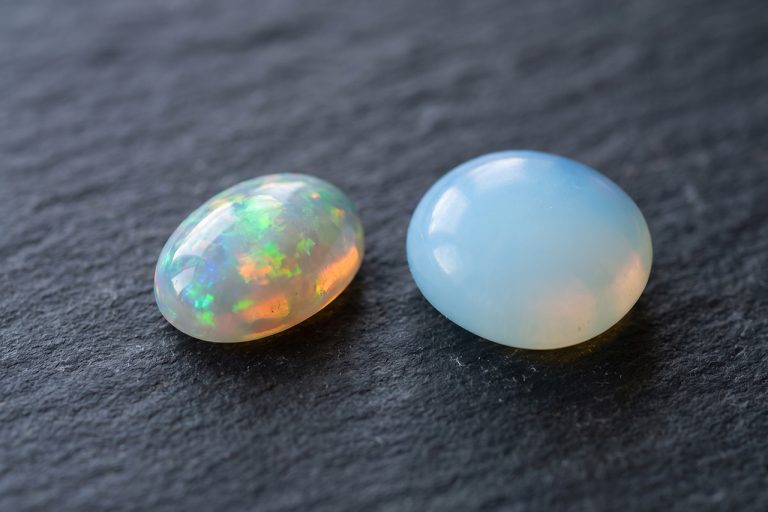
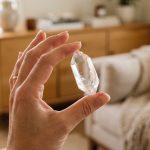
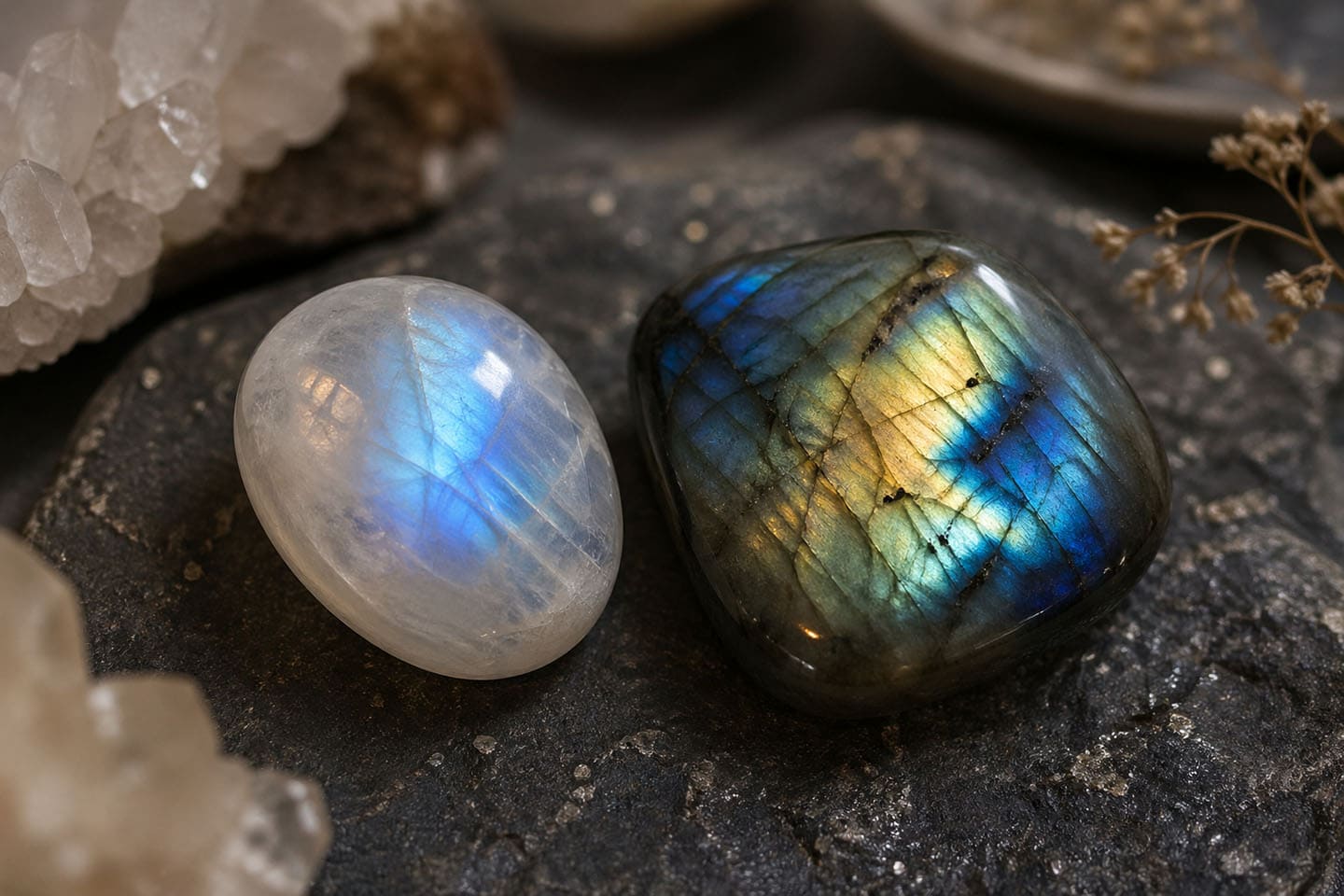
In moonstone the layers are the intergrown orthoclase and albite, and when light falls between them it scatters in many directions at once. The eye reads that scattered light as a soft billowing glow, blue or white, that seems to sit just under the surface and to drift as the stone moves. Gemmology calls it adularescence, after Mount Adular in the Alps, an old source of fine material. It is diffuse by nature, a glow rather than a beam, because scattering sends the light everywhere.
In labradorite the layers are finer and more regular, lamellae left behind as the plagioclase unmixed on cooling, and they are spaced at just the right scale, a small fraction of a thousandth of a millimetre, to interfere with visible light rather than merely scatter it. Interference sorts light by wavelength, so instead of a white glow the stone throws distinct colours, blue and green and gold and sometimes violet, in flashes that switch on and off as the angle changes. This is labradorescence, and it is the more theatrical of the two precisely because the layers are tuned finely enough to split the spectrum. Same starting point, light inside layered feldspar, two different results because the layers are built to two different scales.
What the base colour gives away
For telling a stone in the hand, the quickest read is the body colour in ordinary daylight, before any flash is coaxed out of it. Moonstone’s base is pale, white or grey or a soft peach, and the stone is usually translucent, with that lit-from-within quality that makes it look as though a light were trapped inside. Labradorite’s base is dark, grey to grey-green, and it is largely opaque, its colour sitting on the surface rather than glowing through. Set them side by side out of direct light and the labradorite is clearly the darker stone.
Then tilt each one. Moonstone answers with a single sheen, blue or silvery, sliding across the surface. Labradorite answers with the rainbow, several colours breaking and vanishing as it turns, and once you have seen a strong specimen do this it is hard to mistake for anything else. The finest of that strongly flashing material, dark-bodied and lit with the full spectrum, comes from Finland and carries its own trade name, spectrolite. Labradorite itself is named for the coast of Labrador in Canada, where it was found as boulders, which came surprisingly late for a stone this striking and is a reminder of how much of the mineral world was named only once someone thought to look.
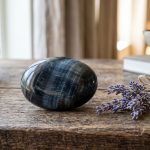
One pairing trips people up more than the others, and it needs naming because the daylight test still settles it. Black moonstone has a dark base and can look, at a glance, like a moody labradorite. The difference is what the darkness does under tilt. Black moonstone gives back a single silvery-to-blue sheen floating over the surface, the same adularescence as its paler cousins, only against a darker ground. Labradorite gives back the spread of separate colours. Translucency helps too. Even a dark moonstone keeps something of that lit-from-within translucence at its edges, where light finds a way through, while labradorite stays stubbornly opaque and shows its colour only as a surface flash. Hold each to a lamp and the moonstone lets a little light pass; the labradorite does not.
The jobs practice gives them
The two stones diverge again in what crystal practice asks of them, and here the difference is one of association rather than of chemistry. Practice reads moonstone as a stone of cycles, intuition and emotional attunement, tied closely to the moon and its phases, with the paler and darker varieties given their own shades of that meaning. It is cast as inward and reflective, the stone for turning attention toward one’s own weather. Labradorite it reads quite differently, as a stone of transformation and protection and of seeing what is not obvious, more outward-facing and more active in character. One is asked to help someone look in, the other to help them look out and through. Because both are feldspars of a similar hardness, a piece that sets them together wears evenly and cleanses the same way, which is part of why the two turn up side by side in so many designs. That shared durability is a practical fact about the minerals, separate from whatever meaning a wearer brings to the pairing.
These associations are how people have organised a long relationship with two shimmering stones, and they stand whatever the feldspar chemistry turns out to be. The stones do sit naturally together, both being feldspars with a shared kind of light, and pairing them is common, which we look at in what crystals go well with moonstone. What practice does not do is treat them as interchangeable, and the reason it does not is the same reason the mineralogy gives. They are near relatives with different optics, and the different optics came to stand for different work. If you are unsure which of the two you are holding, let the daylight decide before the flash does. Labradorite has its own page in the Crystalance Mineral Library, for the mineral in more detail than a comparison allows.
Sources
- GIA, Moonstone (a variety of orthoclase intergrown with albite; adularescence from light scattering between stacked layers): https://www.gia.edu/moonstone-description
- Encyclopaedia Britannica, Labradorite (plagioclase feldspar, roughly An50 to An70; named from the coast of Labrador): https://www.britannica.com/science/labradorite
- Labradorite, mineralogical summary (labradorescence from exsolution lamellae spaced 128 to 252 nm; hardness 6 to 6.5; spectrolite from Ylamaa, Finland): https://en.wikipedia.org/wiki/Labradorite