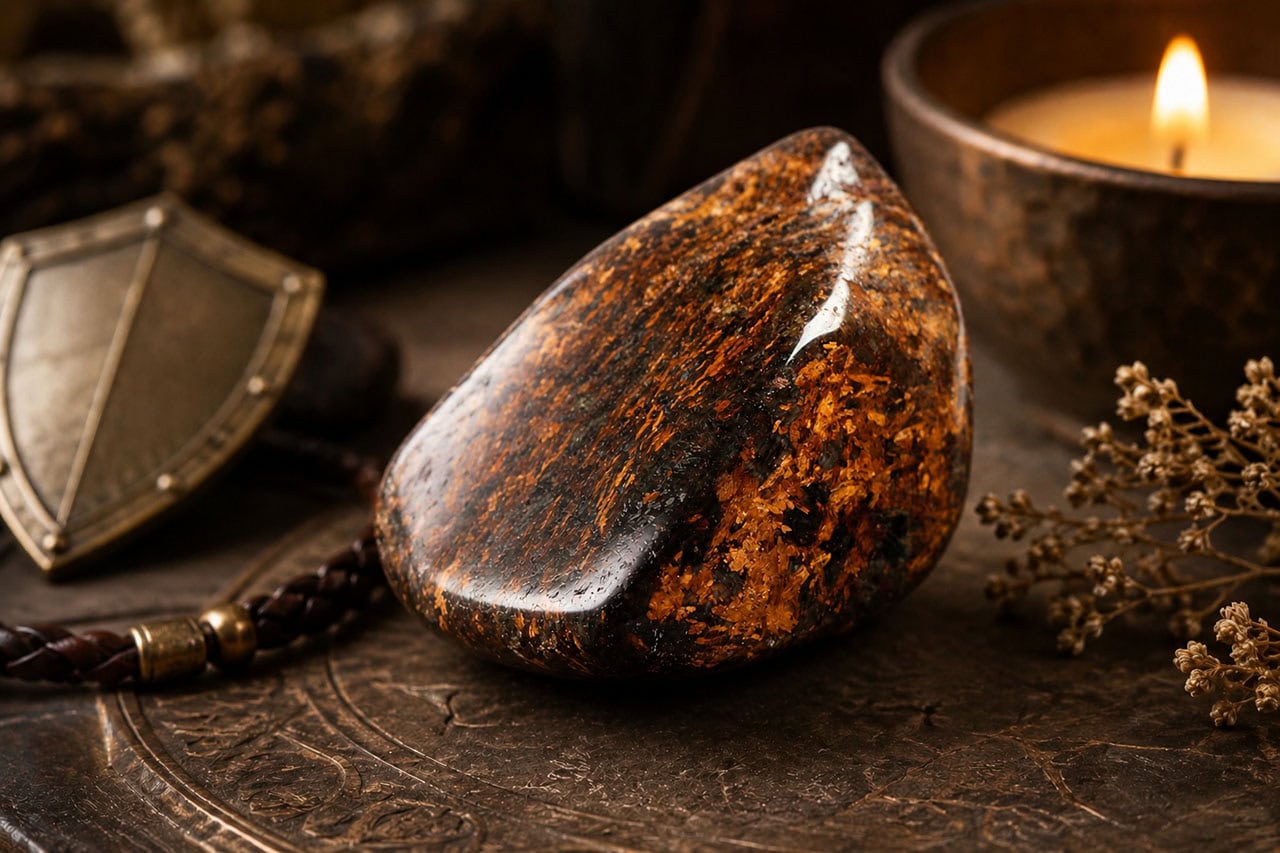
Yes, bronzite is associated with both. It has a long-standing reputation as a stone for self-assurance and courageous decision-making, and it’s also considered a protective stone, particularly against negative energy directed at you by other people. It’s the kind of stone that tends to find people who are looking for something steadier than carnelian and warmer than black tourmaline.
Honestly, bronzite is one of those stones that doesn’t get talked about much in beginner guides, which is a shame. Most people stumble onto it when they’re already a few stones in and they realize what they’ve actually been looking for is something that builds the inner ground first, and the protective layer second. That’s bronzite’s specific niche.
Look, plenty of stones promise confidence. Plenty promise protection. What makes bronzite worth knowing about is that it does both at once, and the way it does both feels practical rather than dramatic.
How Bronzite Works in Practice
Bronzite is a member of the pyroxene mineral family, which is the same group that gives us hypersthene and enstatite. It’s named for its distinctive bronze-like sheen, a soft metallic shimmer that comes from light catching the parallel inclusions inside the stone. Geologically it’s an iron-rich silicate, and that iron content is part of why it has the warm, slightly anchoring quality people describe when they hold it.
In crystal work, bronzite is most often associated with the root chakra (the energy center connected to physical safety and stability) and the sacral chakra (the one tied to creative drive and gut-level decision-making). That dual placement is what gives it the confidence-and-protection combination. Confidence isn’t just a feeling, it’s a posture you take when you feel safe enough to take it. Bronzite is associated with building both layers of that, the safety underneath and the willingness on top.
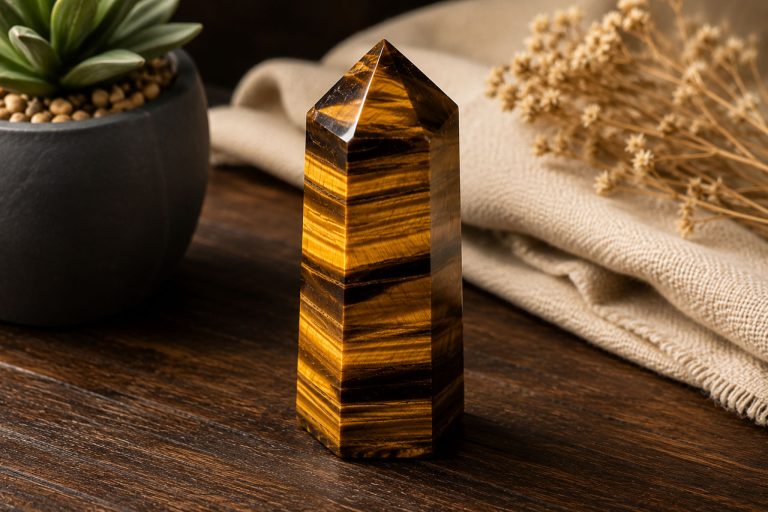
Where bronzite differs from a stone like tiger’s eye, which also gets called a confidence stone, is in tone. Tiger’s eye is bright, decisive, almost a little pushy. Bronzite is quieter. It supports the kind of confidence that doesn’t need to perform.
What Bronzite Is Used For
Bronzite has a few specific use cases that come up consistently in crystal practice. Here are the main ones.
Building steadier self-trust. People who second-guess themselves chronically, who replay decisions for hours after making them, often gravitate toward bronzite. Its associations are with the kind of confidence that comes from feeling settled in your own choices, not from being loud about them.
Returning energy that isn’t yours. This is bronzite’s distinctive protective angle. Where black tourmaline absorbs and transforms negative energy, bronzite is traditionally associated with reflecting it back toward its source. People who feel they’re absorbing other people’s moods or being targeted by ill-will often find bronzite specifically useful.
Decision-making under pressure. Its sacral chakra connection is part of why bronzite is used during periods that require choices, particularly choices about direction in work, relationships, or money. It’s not associated with making decisions easier exactly, but with making it easier to trust the decision once you’ve made it.
Recovering from a confidence knock. After a job loss, a relationship ending, or a significant criticism, the work of rebuilding self-trust is slow. Bronzite is one of the stones traditionally used during that kind of rebuilding, alongside stones like sunstone and carnelian.
Who Bronzite Is Especially Good For
Bronzite isn’t for everyone, and that’s actually useful information. Here’s the rough self-selection.
It tends to suit people who are already doing the inner work and who need a stone that supports the steady, unflashy version of confidence rather than the pep-rally version. It also suits people who feel they take on other people’s energy easily and who want something protective that doesn’t feel as heavy or as actively absorbing as black tourmaline.
It’s less useful for people who are looking for a quick mood lift or a stone that will give them a noticeable energetic buzz. Bronzite’s effect is more like settling than activating. If you want something that wakes you up, citrine or carnelian is closer to what you’re after.
It’s also not the best starter protective stone for someone who’s never worked with crystals at all. Black tourmaline is more universally accessible as a first protective piece. Bronzite tends to land better when you already have a baseline familiarity with how protective stones feel and you want to add a more specific tool.
Common Questions About Bronzite
Is bronzite a strong protective stone?
Within its specific niche, yes. It’s considered particularly effective for protection against directed negative energy from other people, less so for general environmental energy. For all-purpose protection, black tourmaline is broader.
Can you wear bronzite every day?
Yes, and many people do. It’s a hard, durable stone that holds up well to regular wear, and its energy is mild enough that daily contact doesn’t feel overwhelming.
Does bronzite need to be cleansed?
Yes, like any protective stone that traditionally absorbs or reflects energy, periodic cleansing matters. Moonlight, sound, and selenite plates all work well. Avoid prolonged water exposure to be safe, since some pyroxenes can be sensitive to it.
Who should not use bronzite?
Some practitioners suggest bronzite isn’t ideal during periods of acute anger, since its energy can amplify rather than calm strong feelings. If you’re working through a high-conflict period, lepidolite or amethyst might be a better fit, with bronzite added back in once things settle.
Bronzite is a stone that grows on you. It’s not flashy, it doesn’t promise transformation, and it doesn’t try to be everything. What it does, it does steadily, and that’s worth more than it sounds.
For a full profile of bronzite and the broader pyroxene family, the Crystalance Mineral Library covers everything you need.