The solar plexus. Crystal practice places that centre at the upper belly and ties it to acting on something you have already worked out, which gives tiger’s eye a time as well as a position. The time is the last stretch before you do the thing.
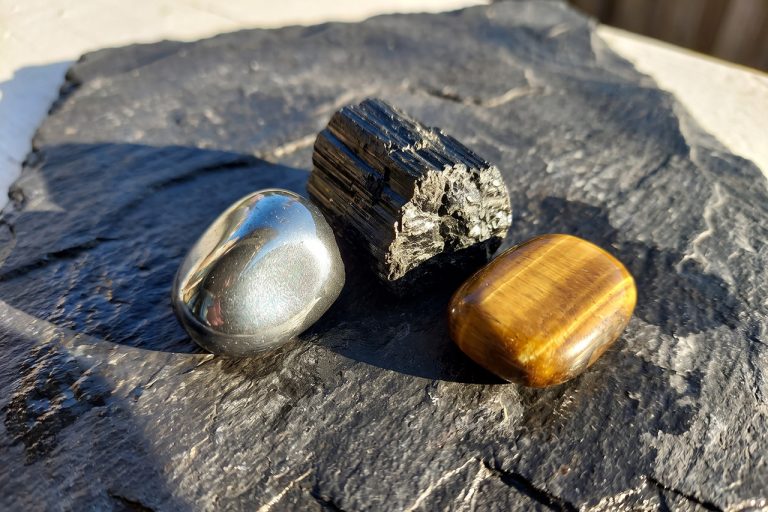
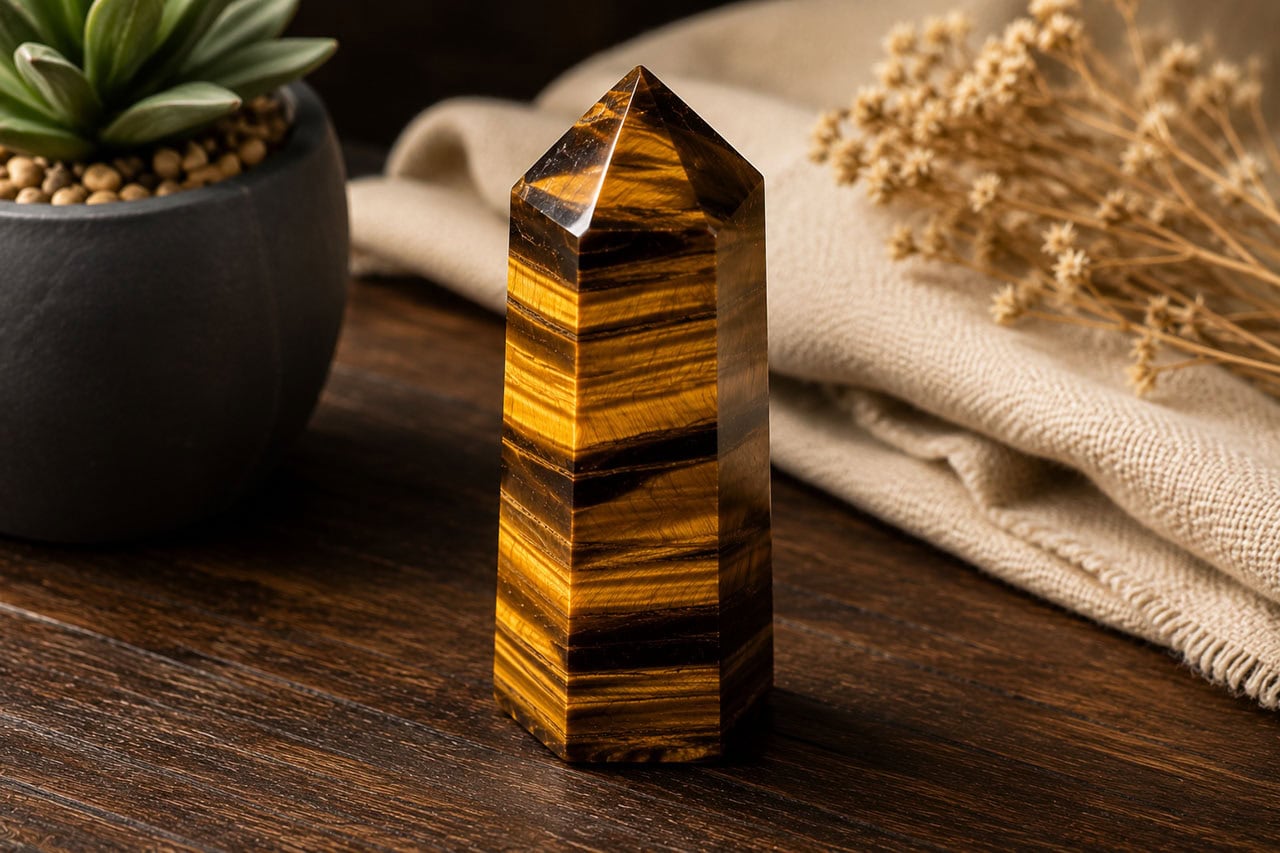
Turn a polished piece of tiger’s eye slowly in your fingers and a band of light travels across its face, keeping pace with your hand. Britannica calls the effect a vertical luminescent band like that of a cat’s eye, and describes the stone as having a rich yellow to brown colour and, when polished, a fine golden lustre.
There is an awkward stretch between deciding to do a hard thing and doing it, and it is where most of the abandoning happens, without anyone deciding to abandon anything. You check your phone, you reread the email, you notice you should have eaten, and the window shuts on its own. Crystal practice has a stone pointed straight at that stretch, and this is the one.
Why the placement is about timing
Practice does not assign this centre to the business of working out what you think. It describes the solar plexus in terms of will and drive, the part of you that carries out a decision once the deciding is over. Whether or not you take any of that literally, it is a specific claim about which stage of a problem the stone belongs to, and the stage it names is the last one.
That narrows things usefully. If you are still turning a choice over, tiger’s eye is not the stone the tradition points you at. If you have made the choice and you are standing in a corridor not going through the door, it is.
A placement can often be honoured passively. You wear the thing, it sits somewhere on you, and the arrangement holds all day whether you think about it or not. This one does not work like that. The solar plexus placement asks you to be present for it, which sounds like a drawback and is the point. A stone for the last stage has to be picked up at the last stage.
The practical question is not where tiger’s eye goes. It is what you do with it in the few minutes you have.
The few minutes before
Hold it and turn it.
There is no more to the informal version than that, and it is less trivial than it reads. The band moves as the stone moves, so watching it gives your eyes and your hands one small job with a visible result, and that is the specific thing that stops you reaching for a phone. Turn it slowly enough that the band crosses the face and does not flicker. Five or six passes take about a minute and a half.
Breathing out for longer than you breathe in while you do it is not part of the tradition and I am not going to pretend it is. It is just what makes those ninety seconds land.
The formal version, if you have the room for it, is to lie down and rest the stone on your upper belly for ten minutes before you go. Practice puts the centre there, so that is where the stone goes, and the instruction is to keep your attention on the weight of it and to let the speech you have prepared alone. Ten minutes is the length usually given, and the tradition makes no claim that twenty would be better.
Weight helps here, which is an argument for a bigger piece than a tumble. The tiger’s eye I keep is a polished tower about twelve centimetres tall, hand-held size, and it has a settled heft in the palm that a pocket stone cannot manage. A tumble in a coat is the version that is with you when you need it, so there is a real case for owning both. On how tiger’s eye gets used across an ordinary day, and what its price history has to do with that, how do you use tiger’s eye is the fuller account.
When it is the wrong stone to reach for
The tradition’s own framing rules out more than it lets in, and the ruling out is the useful half.
If the problem is that you do not know what you want, this placement has nothing for you, and the pause will feel hollow because you will spend it deciding. If the problem is the hour after a difficult conversation, and not the minutes before one, likewise. Practice has other stones and other centres for both of those, and reaching for the confident one when you wanted the quiet one is a fair way to end up disappointed in the whole business.
And a plain word about what the pause does. It does not make the meeting go well, and nothing in this practice claims a stone will. Ninety seconds of turning a stone buys you ninety seconds between yourself and the door, spent on something small and physical instead of on a screen. What you do with the interval is yours, and so is the question of whether that counts as the stone working.
If the optics are what you want next, the quartz and the fibres that produce the band are set out in the Crystalance Mineral Library.
Nothing here asks you to buy anything or to learn anything. It asks you to be holding a stone at the moment you would otherwise be holding a phone.