You never look inside a crystal pouch, and that decides what belongs in one: three or four tumbled stones you can tell apart by touch, carrying a single job between them. Keep it where your hand already goes.
There is a crystal pouch in a coat pocket somewhere in your house that has not been opened in a week. You know roughly what is in it. You could not name all four without tipping them out.
Nobody is being careless. The format is doing what the format does. An altar works on the eye, and so does a windowsill, a desk cluster or a bowl by the front door. Each of them reminds you it exists by being in your way. A pouch does none of that, and being the exception changes what belongs inside one.
A bag you cannot see into
Colour does most of the work in a crystal shop and none of it once the drawstring is pulled. That undoes the way a pouch is normally assembled, because a stone’s associations are something you read off it by looking.
What survives the closing of the bag is weight, size, surface and edge. Those are the properties your fingers can report on. A pouch is a tactile object with stones in it rather than a small portable display, and once you accept that, the choices in front of you change shape.
The bag also has to live somewhere your hand goes without being told. The pocket that already holds your keys. The inside pocket of the coat you wear daily. Not the tote you set down at the door, and not the bedside drawer, where pouches go to be forgotten with great sincerity.
Stones your hand can tell apart
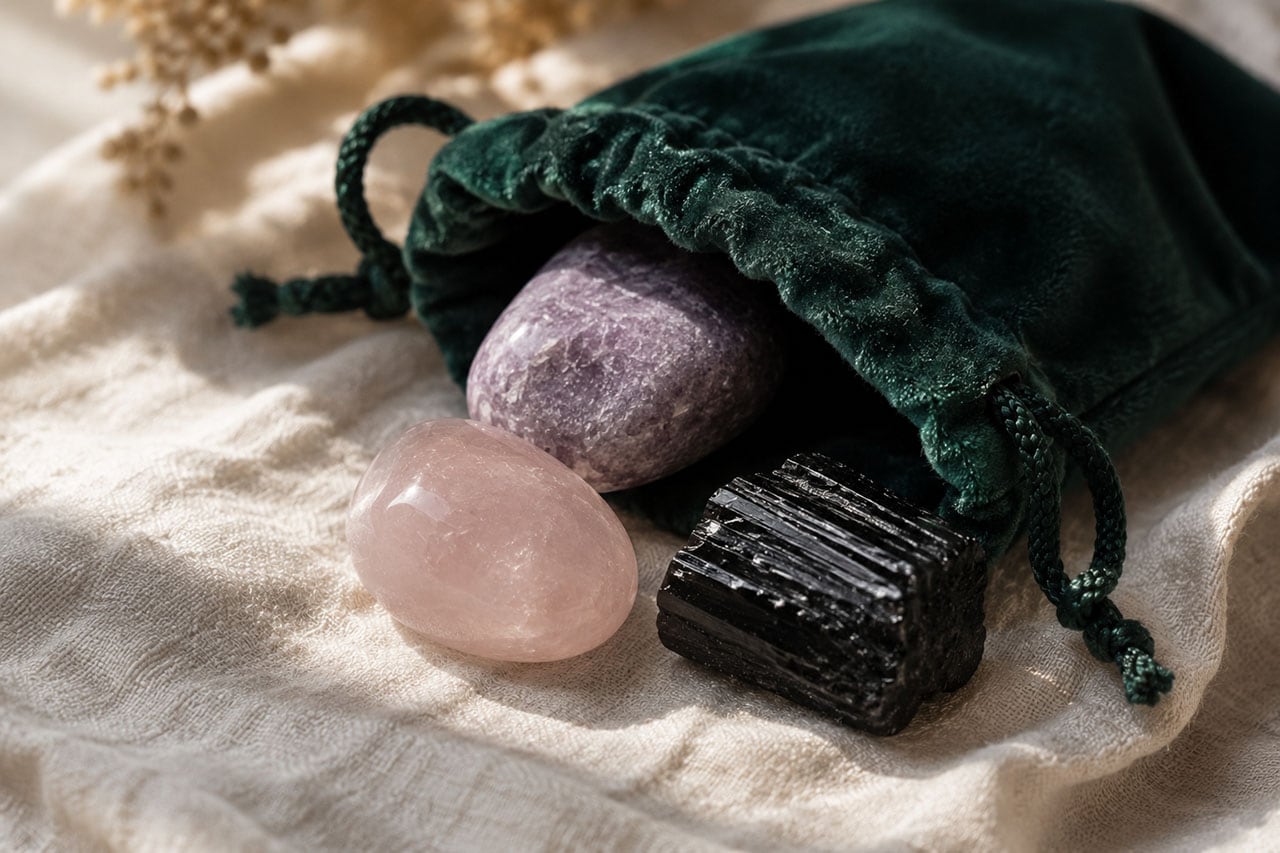
There are two identical purple velvet pouches in this house, one for crystals and one for tarot cards, and the crystal one takes tumbled or polished pieces only. We arrived at that rule the expensive way. Anything raw or clustered makes a mess of a bag quickly and scratches its neighbours, and the wider case for and against raw material is worked through in how to use raw crystals.
The awkward part follows straight from that rule. Tumbling is what makes stones feel the same. A rotary tumbler runs four stages of about seven days each, starting with coarse 60/90 silicon carbide grit, and rocktumbler.com describes the first stage without ceremony: your rocks are reduced in size. Four weeks of abrasion later, what you are holding was shaped by the barrel more than by the mineral, so a tumbled jasper and a tumbled amethyst arrive at very nearly the same object in the hand.
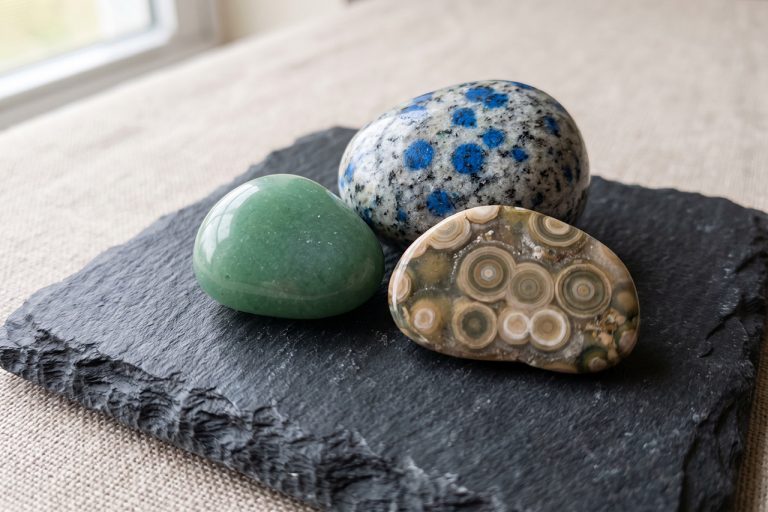
The tumbled-only rule therefore keeps the bag clean and costs you the ability to read the bag blind. Both halves are true, and the fix is small. Keep the number down to three or four, which is as many distinctions as I can hold by touch without opening the thing. Then break the sameness on purpose: make one piece noticeably larger than the rest, or work in a single drilled bead you can find with a thumbnail. One deviation is enough. You are not identifying every stone by feel, only working out which one you have got hold of.
Softness matters here for the ordinary reason. Quartz sits at 7 on the Mohs scale, the ten point ladder mineralogists use for scratch resistance. Amethyst, rose quartz, citrine, carnelian and agate are all quartz, so a pouch is usually a bag of sevens, and anything below 7 will pick up marks from the company it keeps. Selenite is a 2 and celestite is around 3, and both of them flake against a hard tumble rather than merely scuffing. Keep those for a shelf.
One pouch, one job
Build the pouch around one thing, because you cannot see inside it. Walk past a shelf and you have re-read it without meaning to. A closed bag says nothing on the way past, so whatever it is for has to be simple enough that you can recall it with your hand still in your pocket. Four stones for four separate purposes is four things to hold in mind on a Tuesday morning, and Tuesday mornings do not have room for four things.
You will also be told that stones chosen for different purposes fight each other inside the bag. There is nothing behind that idea and the tradition did not hand it down, so you can let it go without guilt. The one-job rule stands up perfectly well on its own.
Name the job in a single sentence before you pick anything. Help me stay level on the commute. Help me speak first in the meeting. If the sentence needs a comma, it is two jobs and it wants two pouches, and there is more on that framing in how to set intentions with crystals.
Why a pouch stops getting carried
Out of sight is the whole appeal and the whole problem. A stone on your desk asks nothing of your memory. A pouch asks for a small deliberate act every morning, and small deliberate acts are the first thing a rushed morning deletes.
Neither of the two fixes involves the stones. The first is to attach the pouch to something you already do without thinking, so that it moves pockets when your keys do. The second is to attach the noticing to a moment instead of to a whole day, the walk from the car or the two minutes before you open the laptop. A pouch used once at a fixed moment beats a pouch carried vaguely for a month.
If it has sat unopened for four weeks, the fair reading is that the job was not one that suits a pouch. Some things want to be looked at. Grief in particular tends to want a stone you can see, and putting it in a bag can be a quiet way of putting it away.
Build one this week
Start with the sentence, not the stones. Write the job down in one line and keep the line.
Pick the stone practice associates with that job and make it the largest piece in the bag, so it is the one your hand finds first. Add a second that does a different job rather than the same job again, since two stones for one purpose is one stone and a spare.
A third goes in only if you have a reason for it, and that one should be the odd shape or size. Three is a working pouch. Five is a collection you happen to be carrying.
The bag itself is chosen on whether it opens one-handed, because a drawstring you have to fight is a drawstring you stop pulling. Cleanse the closed pouch as a unit instead of stone by stone, which is what practice does with a bundle. Smoke or sound will do it, or a night somewhere dark.
Before you commit any stone to a bag, check it in the Crystalance Mineral Library, which spells out hardness entry by entry.
Three stones and one sentence, in the pocket you already use twenty times a day. If you want a fourth, make it the odd one.