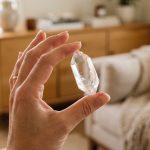

Aquarius has two rulers in circulation, Saturn and Uranus, and they point at different stones. The list you will usually be handed runs amethyst first, then garnet, aquamarine, labradorite, fluorite and hematite. That list belongs to the second of the two.
In the second century Ptolemy set out which planet governed which sign, and he put his reasons on the page beside the result. Cancer and Leo lie closest to our zenith and are the warmest of the twelve, so they went to the two great lights. Saturn is cold, and its orbit is the highest and furthest from those lights, so Saturn was handed the two signs sitting directly opposite them, Capricorn and Aquarius, which he calls cold and wintry, and whose opposition to the luminaries he took to be unfriendly.
That is an argument. Somebody can disagree with it in the terms it was made in.
The second ruler arrived without one. Uranus was found through a telescope in 1781 by William Herschel, who took it at first for a comet or a star, and astrology has since handed Aquarius to it. The reassignment carries no date and no attributed author.
Both rulers are in print today, often on the same chart, and they are not two versions of one idea. Saturn is limit and cold. Uranus, in the reading that came with it, is disruption. The stones follow whichever reading is being used, and almost every list on sale follows the newer one.
Why a winter sign went to the slowest planet
Ptolemy’s scheme is the oldest layer of this material that can be dated, and no later astrologer has withdrawn it. Saturn still holds Capricorn and Aquarius in the same textbooks that print Uranus alongside, which is why a modern chart often shows two rulers for the sign and no guidance on what to do about that.
Saturn’s Aquarius is a cold sign belonging to a slow, distant planet the tradition treats as unfriendly. Take that description on its own and the stones it suggests are dark and dense. The Capricorn list looks broadly like that, and Capricorn is Saturn’s other sign.
The Aquarius list looks nothing like it.
Even Cornelius Agrippa, printing his table of correspondences in 1533, gives Aquarius rock crystal. Colourless quartz. Whatever else it is, it is not purple, and it is not a stone anybody picked for what it does when you turn it under a lamp.
Three old lists, and one cell that comes with a citation
Three historical lists of sign stones survive in usable form, and a modern one stands against them. They agree almost nowhere.
Agrippa’s 1533 table gives Aquarius crystal. A Spanish treatise printed at Valladolid in 1604 by Morales gives amethyst. George Frederick Kunz, whose 1913 chapter is the ancestor of nearly every modern account, gives garnet. Current crystal practice gives amethyst.
Four compilers, four answers, and no two of them consulting each other. That is the condition of this whole subject: there was never a single tradition of sign stones to inherit, only a handful of separate lists made in separate centuries for separate reasons. Aquarius is the sign where that comes closest to not being true.
The Morales entry is the interesting one, and not because of the match. Kunz reproduces that list on page 347 of The Curious Lore of Precious Stones and cites it properly, to folios 15a and 15b, describing it as an old Spanish list that differs from the others he has given and probably representing Arab tradition. His own zodiacal list carries no citation at all, in a chapter that is otherwise densely footnoted. Set his signs beside his own tally of month stones in the previous chapter and every sign has been handed the stone of the month it begins in.
Counting the agreements needs a stated test, because two reasonable tests give two answers. Against the stone each of our twelve sign pages leads with, two of the thirty-six cells match: agate for Gemini, from Kunz, and amethyst for Aquarius, from Morales. Allow any stone further down our modern list instead of only the first, and the figure is nine. Aquarius holds one of the two and two of the nine, which is a larger share than most signs manage. The grid is not even complete, since Morales reaches Pisces and leaves the entry blank.
One qualification will not shake off. Amethyst is February’s birthstone, and Aquarius runs from about 20 January to about 18 February, so the modern list would have arrived at amethyst with or without a Spanish book. The best-documented agreement in the grid may still be two roads happening to meet.
What a second ruler did to the list
Uranus carries a reputation for the sudden and the unorthodox, and Aquarius acquired that reputation along with the planet. The sign became the outsider of the twelve, the one that does not do what the other eleven do. That is the Aquarius a crystal shop is selling to, and the stones on the shelf were picked to match it.
Labradorite is on the list for its flash, a blue and gold sheen that appears and vanishes as the stone turns, and fluorite for its colour zoning, bands of purple and green stacked inside one crystal. Amethyst carries the purple the sign has been associated with for far longer than Uranus has been a planet.
Aquamarine is harder to account for, and it is odd twice over. It reaches the sign on the water-bearer image, but Aquarius is an air sign, and the figure in the emblem is pouring the water instead of being it. Aquamarine is also March’s birthstone, which leaves it no calendar business anywhere near a sign that ends in the third week of February.
Garnet and hematite do the opposite job. Garnet arrives twice, from January in the birthstone calendar and from Kunz in the zodiacal one. Hematite is there as the grounding stone, in the sense crystal practice uses that word, meaning something reached for when everything else in a set is light and quick.
The six stones themselves
Only two of the six are mineral species. Amethyst is quartz coloured purple, Mohs 7. GIA gives it two sentences on its February birthstone page that belong together: some amethyst fades with prolonged exposure to strong light, and though the colour is stable with normal use, this is not a birthstone to wear to the beach every day. Aquamarine is the blue variety of beryl, Mohs 7.5 to 8. Garnet is a group, and almandine and pyrope, both at 7 to 7.5, are what sits behind most of the red material sold under the name.
Fluorite is one of the two species, calcium fluoride, and the softest thing here at Mohs 4, with perfect cleavage on four separate planes. It parts instead of chipping, and GIA puts fluorite among the heat-sensitive gems that should stay out of an ultrasonic cleaner. Hematite is the other species, iron oxide at Mohs 5 to 6. Drag a grey metallic hematite tumble across unglazed porcelain and the streak it leaves is cherry red, which catches people out every time.
Labradorite has the strangest paperwork of the six. The Handbook of Mineralogy has a page for it at Mohs 6 to 6.5, but it is not a valid species on the current International Mineralogical Association list, where only albite and anorthite survive across the whole plagioclase feldspar range. Everything between those two is a name for a composition. The flash a buyer is paying for is a real optical effect in a mineral that no longer has a name of its own.
Both readings of the sign are usable and they answer different questions. Saturn’s has a text behind it that a person can go and read, and it selects for weight and plainness, which is not what anybody is buying when they buy an Aquarius set. The modern list selects for the sign as it is understood now, and it does that well. What it cannot claim is descent.
Amethyst is indexed under quartz in the Crystalance Mineral Library, and aquamarine under beryl. The stone at the head of this list is the only one in the grid with a document behind it, and it is also the stone February would have supplied on its own. Whether the 1604 book earned its place there or arrived at the same square by a different road is not something the grid can settle.
Sources
- Ptolemy, Tetrabiblos I.17, Robbins translation, on the houses of the planets: penelope.uchicago.edu
- NASA, Uranus facts, on the 1781 discovery: science.nasa.gov
- Cornelius Agrippa, Three Books of Occult Philosophy, Book II ch. XIV, in the 1651 English translation of the 1533 original: archive.org
- George Frederick Kunz, The Curious Lore of Precious Stones, 1913, chs. IX and X: gutenberg.org
- GIA, February birthstone, on amethyst and light: gia.edu
- GIA, gems that should not go in an ultrasonic cleaner: 4cs.gia.edu
- Handbook of Mineralogy, labradorite: handbookofmineralogy.org