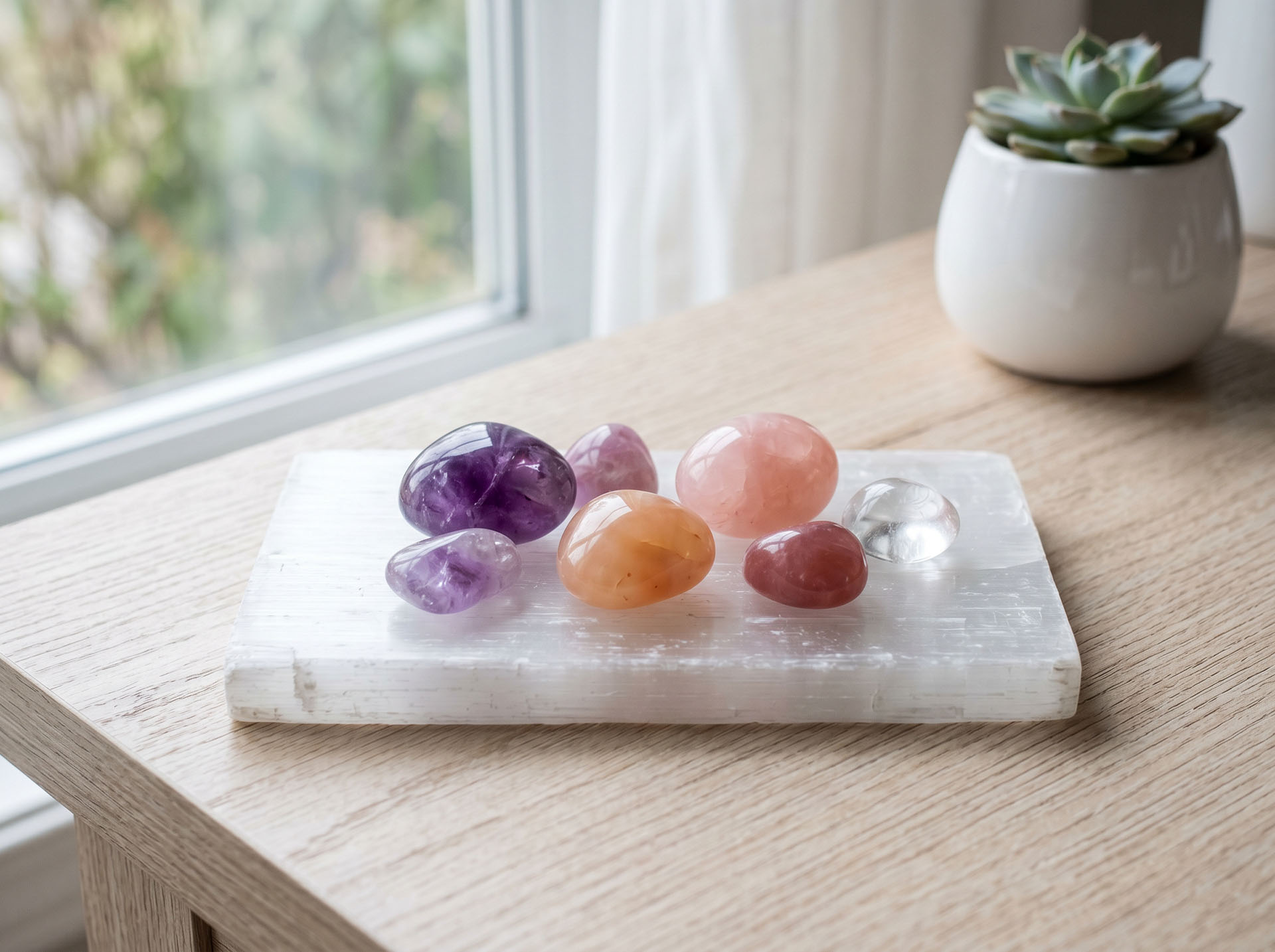
A few hours will do it, and overnight is the easy default. There is no real upper limit, because selenite is said to give off a steady clearing energy rather than fill up the way an absorbing stone does. The one thing you cannot do is get the selenite wet.
That last point is the strange thing about selenite, and it is worth sitting with before we talk about timing. This is the stone you use to clean all your other stones, and it is also the one stone in the collection you must never run under the tap. It is soft enough to scratch with a fingernail and soluble enough that water slowly dissolves it. So the tool you reach for to reset everything else is, itself, the most fragile thing on the shelf. Once you understand why that is, the question of how long to leave a stone on it mostly answers itself.
Why the time barely matters
Most cleansing methods have a natural clock. Running water is a quick rinse. Smoke is done when the smoke is done. Sunlight and moonlight run for hours because that is how long the stone sits out. Selenite is different because, in crystal practice, it is described as a stone that outputs rather than absorbs. Cleansing a crystal means resetting the energy it is said to have picked up from use, and the usual worry is that the cleansing tool eventually gets saturated. Selenite is the exception people reach for precisely because it is not supposed to saturate.
That changes what “how long” means. If nothing is filling up, there is nothing to overfill, so the duration is about thoroughness rather than a limit you can cross. A few hours is plenty for a light refresh, after a single meditation session or a stone you have only handled a little. Overnight, six to eight hours while you sleep, is the comfortable default and the reason so many people keep a selenite plate on the nightstand. A full day suits a stone that has been through something heavier, a piece you carried through a hard week or worked with intensively. Leave it longer than any of that and no harm is done. You are not going to over-cleanse a stone by forgetting it on the plate for a week.
So the real answer to the title question is a range, not a number, and the range is generous on purpose.
The one rule that actually matters: keep it dry
Selenite is a form of gypsum, calcium sulfate, and on the Mohs scale of scratch hardness it sits at about 2, which is soft enough to mark with a fingernail. More to the point, gypsum is soluble in water. Prolonged moisture makes it lose its shine, go dull, and eventually break down, and even a humid bathroom will wear on it over time. So the rule is simple and absolute: no water, ever, for the selenite itself.
That has a couple of practical knock-ons. When your selenite eventually feels like it needs its own refresh, and it will after a lot of use, you clean it the dry way. Moonlight on a windowsill is the usual choice, and a sound method like a singing bowl works too. Water and salt water are the two things to keep it away from.
The softness matters as much as the solubility. A selenite plate scratches easily, and a hard tumbled stone dragged across it will leave marks. It also runs the other way: in a shared pouch, a soft stone like selenite sheds fine grit against harder quartz-family tumbles and scuffs itself in the process, which is why loose selenite and a bag of tumbles do not travel well together. On a plate at home, none of this is a problem. Set the stones down gently and leave them be.
Setting it up so you barely think about it
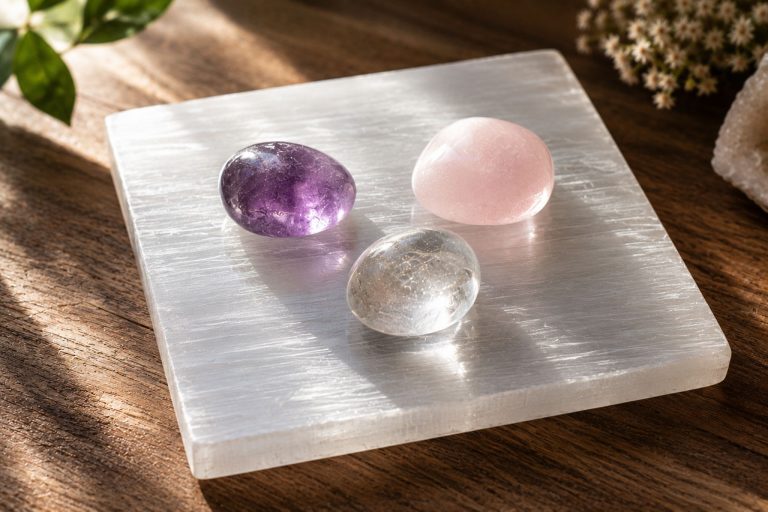
The appeal of selenite is that it asks almost nothing of you. A flat selenite plate with stones resting directly on it is the most efficient arrangement, since contact is where the method is strongest. A selenite wand or a rough chunk sitting among your stones still does the job from a few centimetres away, just a little less directly. A larger piece covers more ground, so one good plate can hold a whole handful of stones at once and have them ready by morning.
Almost anything can go on selenite safely. The exceptions are not really about the selenite at all but about the stones you are setting on it: keep your own soft or water-damaged pieces from grinding against the surface, and remember that a stone which should not get wet does not need to, because this method never involves water in the first place. If you want the fuller map of which stones like which methods, how to cleanse, charge, and activate crystals lays it out stone by stone, and crystal charging plates covers the plate form specifically.
Selenite is the stone that quietly looks after your other stones, which in a practice that can get fussy is worth a lot. For its full profile and the stones it pairs with, see the Crystalance Mineral Library. Leave your crystals on it for a few hours or overnight, keep the plate dry, and you can stop thinking about it. That is rather the point of it.
Sources
- Geology Science, Selenite: chemical formula CaSO4 dot 2H2O, Mohs hardness 2 to 2.5, soluble in water and dulled or dissolved by prolonged moisture. https://geologyscience.com/minerals/sulfate-minerals/selenite/