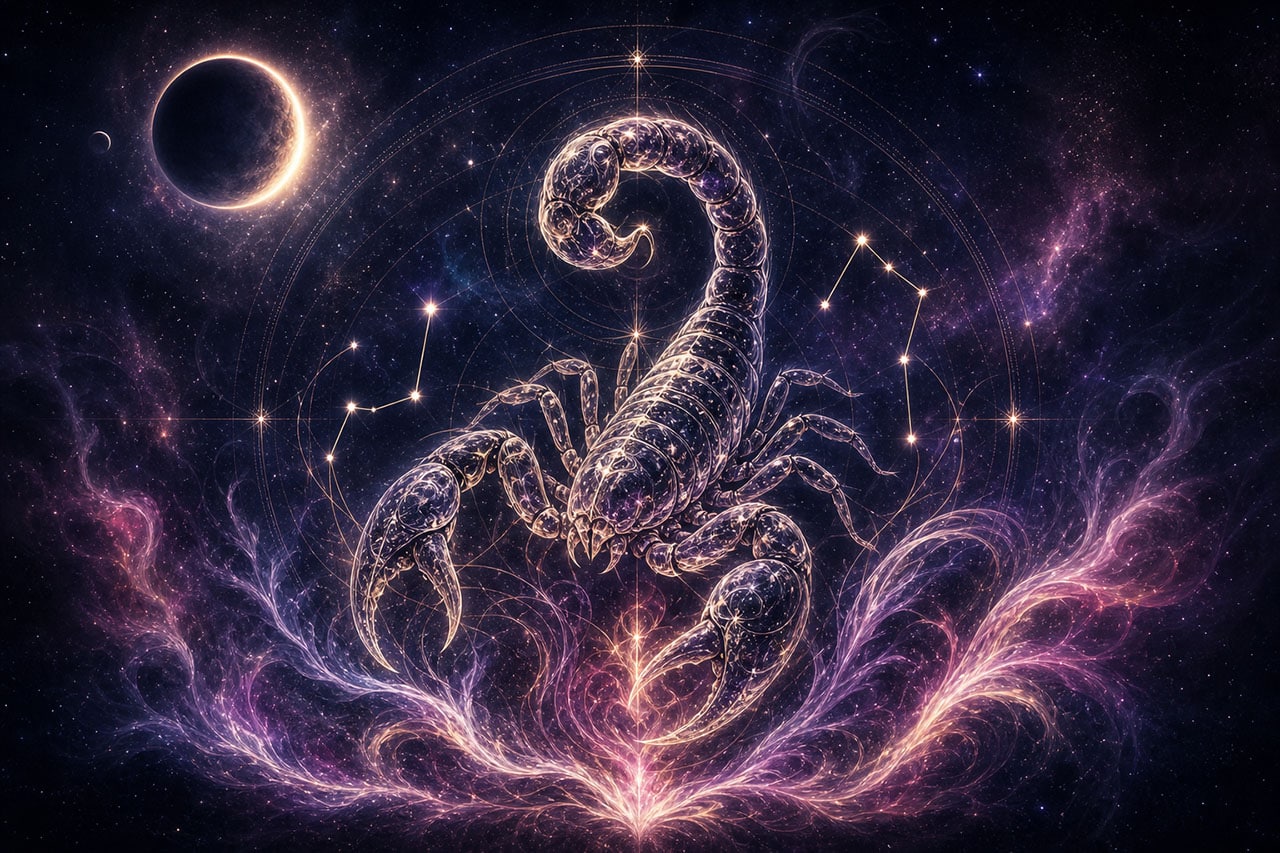
A thirteenth constellation, Ophiuchus, lies on the Sun’s path, and every few years a headline says it has unmade the sign. It has not, because a sign was never a constellation. The stones a shop gives, obsidian, malachite, labradorite, topaz, citrine and garnet, have even less claim on the sky than the sign does.
Between Scorpius and Sagittarius the ecliptic, the path the Sun appears to trace against the stars, runs through a thirteenth constellation. Ophiuchus, the serpent-bearer, sits with its lower half squarely in that path, and the National Optical-Infrared Astronomy Research Laboratory states the consequence flatly: the ecliptic passes through Ophiuchus, and the Sun, Moon and planets pass through it as seen from Earth. This is not a fringe claim or a recent discovery. It is where the Sun actually is for part of the year.
The Sun crosses in front of Scorpius for only about a week each year, and spends a longer stretch of its path in front of Ophiuchus. Every so often that arithmetic reaches the public as news that astronomers have added a sign, and every so often a lot of Scorpios spend an afternoon wondering whether they are now something else. They are not, and the reason is worth setting out properly, because it is more interesting than the scare it answers.
The thirteenth constellation, and who left it out
The story usually arrives as an astronomical intervention, and it was nothing of the kind. Nobody in a modern observatory changed anyone’s sign.
NASA published the arithmetic in 2016 and was widely reported as having created a thirteenth sign. Its own account, which now survives only on the agency’s Tumblr because the original pages return errors, is precise about who did the leaving out, and it was not NASA. Even by the Babylonians’ own reckoning, it says, there were thirteen constellations along the Sun’s path, and they picked one, Ophiuchus, to leave out. The same account gives the numbers without drama: the line from the Earth through the Sun points at Virgo for forty-five days and at Scorpius for only seven. And its closing line is the one to keep. They did not change any zodiac signs, it says. They just did the math.
The Babylonians had a reason to drop the thirteenth. Twelve equal parts map onto a twelve-month year in a way that thirteen unequal ones never will, and what they were building was a calendar instrument. It worked. What it was not, and never claimed to be, was a live map of which constellation is behind the Sun on a given morning.
Why it changes nothing
Two facts do all the work, and both are ordinary once stated.
The first is that the signs are not the constellations. A sign is an exact one-twelfth of the circle, thirty degrees, an equal division laid down as an abstraction over the ragged real constellations, which vary wildly in width. Scorpius is small and Virgo is broad, and the signs named after them get the same thirty degrees regardless. So counting how many days the Sun sits inside the boundary of a constellation is measuring a different thing from the sign, and a thirteenth constellation on the ecliptic no more adds a thirteenth sign than a long month adds a thirteenth hour to the clock.
The second is that the signs and the constellations have drifted apart, slowly and for a long time. The Western zodiac is pinned to the March equinox rather than to the stars, and the equinox creeps against the stars through precession, which the Aries page follows from its own end of the circle. The drift runs at roughly a degree every seventy years, which adds up to about a full sign since the zodiac was fixed. That is why the dates in a horoscope column and the dates the Sun is really in Scorpius no longer line up at all. None of it is an error. It is two conventions, a tropical one and a stellar one, doing two different jobs, and only one of them was ever about the stars.
Obsidian, and the stones that are not minerals
The stones on a Scorpio shelf are chosen with about as much regard for what they physically are as the sign has for the patch of sky behind it. Two of the six are not minerals at all, which makes the list a good place to be exact.
Obsidian is the headline stone. The US Geological Survey defines obsidian as dense volcanic glass, usually rhyolitic, formed where lava cools too fast for crystals to grow, so it has no lattice, no fixed composition, and no place on the International Mineralogical Association’s list of valid species. It is a rock. A raw piece settles the point in the hand better than the definition does, since a fist-sized fragment breaks in smooth curved shells rather than along any plane, there being no plane in it to follow, and the edges those fractures leave stay sharp enough that a specimen has to be lifted with some care, the same property that made the material worth working for hundreds of thousands of years before anyone drew a sign. Labradorite is the second non-mineral, in a quieter way. It has a Handbook of Mineralogy page but is absent from the IMA species list, because only two plagioclase feldspars, albite and anorthite, count as species, and the rest, labradorite among them, are names for compositions in the range between the two.
Citrine and garnet fill out the usual list, and both are on it for a look rather than a lineage. Most citrine sold is not natural yellow quartz but heat-treated amethyst, which GIA states plainly, since yellow quartz is rare in the ground. Garnet is a group rather than a single species, generally almandine or pyrope in the red material sold under the name. None of the six was assembled from its mineralogy, and that is the same move the sign is built on: a neat, equal label laid over something physical and ragged that it stopped matching a long time ago.
What the old lists gave Scorpio
The sign came off the sky about two thousand years ago, and the stone lists never lined up with anything even at the start.
Set the three surviving old assignments beside the modern one and Scorpio does as poorly as any sign. Agrippa, in 1533, gives amethyst. The Spanish list of 1604 gives garnet. Kunz, in 1913, gives beryl, in a zodiacal list he leaves unsourced inside a chapter that footnotes almost everything else. Three sources, three stones, and the obsidian a shop sells is a fourth that appears in none of them.
Garnet is the single place the old and the new touch. The 1604 list gives Scorpio garnet, garnet is on the modern Scorpio list, and that lands it among the nine attributions, out of thirty-six, that reach the right sign at all, which the Aquarius page counts out under both of its tests. It is not one of the two strongest, since those need the old and the modern list to lead with the same stone and obsidian leads here, and garnet had an easy second road in as the January birthstone besides, so even its one thread is more than accounted for.
Two of the remaining stones earn a line for what they are. Malachite is a real species, copper carbonate, soft at Mohs 3.5 to 4, and one GIA keeps out of an ultrasonic cleaner along with opal and turquoise. Topaz is the standing lesson that hardness is not durability, sitting at Mohs 8 and still carrying a cleavage plane a single knock can open. The Crystalance Mineral Library holds all of them under mineral names, which is why obsidian is described there as a rock and not a crystal, and why the stone at the head of this list has no mineral page of its own.
The one part of the Scorpio story that can be checked to the day is the Ophiuchus arithmetic, and it is the part that unsettles people most, which is a strange fate for a piece of long division. NASA’s own line on it is the one to end on. They did not change any zodiac signs. They just did the math.
Sources
- NOIRLab, the constellation Ophiuchus, on the ecliptic passing through it: noirlab.edu
- NASA, on the zodiac and Ophiuchus, “we just did the math”: tumblr.com/nasa
- US Geological Survey, Volcano Hazards Program glossary, on obsidian: usgs.gov
- George Frederick Kunz, The Curious Lore of Precious Stones, 1913, ch. X: gutenberg.org
- GIA, treated citrine: gia.edu
- GIA, gems that should not go in an ultrasonic cleaner: 4cs.gia.edu