Red stones get used for vitality and for starting something, and modern practice places them at the base of the spine. An Egyptian funerary instruction names a red stone too, and gives far more detail about what to do with it. That detail is the useful part.
Chapter 156 of the Book of the Dead asks for a knot amulet of red jasper, placed at the throat of the deceased, to give them the protection of Isis. University College London’s Digital Egypt has the rest of the procedure: the amulet is sprinkled with water of the ankh-imy plant and strung on a fibre of sycamore before it goes round the neck.
Set that beside anything you will be handed in a shop. A card telling you carnelian is for creativity has given you a stone and a noun. The Egyptian instruction gives you the material, the position on the body, the preparation and the thread, and then stops, because at that point there is nothing left to say.
Most of what makes a red stone useful now is in that gap.
What a complete instruction looks like
The Metropolitan Museum holds one of these knot amulets, made between 525 and 30 BCE. It is blocky and barely finished, because nobody was going to look at it. It went in between the bandages of a wrapped body.
The spell asks for red jasper. The object in the case is red glass. Somebody making an amulet for a purpose they took seriously enough to write a spell about substituted a manufactured material and kept the colour, so the colour was the half carrying the weight.
The material was flexible, then, and everything else was not. The stone had a fixed place on the body and a fixed preparation, both decided before the moment arrived rather than improvised in it. Compare that with how a red stone usually gets used now, which is that somebody picks one up when they feel they need it and puts it down again afterwards. The old instruction is not better because it is older. It is better because it is specific, and specificity is the thing you can borrow without believing anything you do not already believe.
Picking the stone
Start with the fact that the red family is not a family.
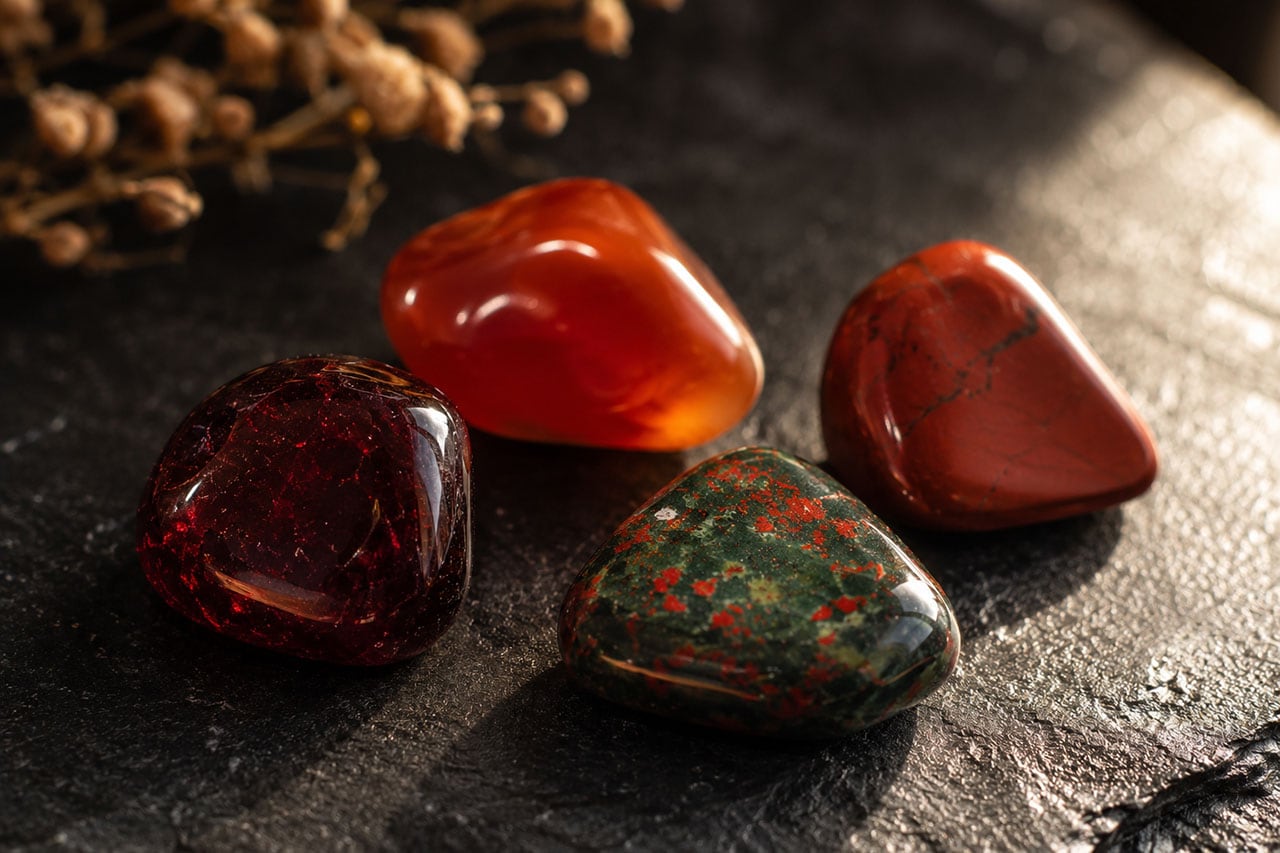
Red jasper and carnelian are both chalcedony, the same microcrystalline quartz, separated largely by how much foreign material got trapped inside as each formed. Garnet is not one mineral but a group, and GIA names five species in commercial use. Ruby is corundum, coloured by chromium, and unrelated to the others. Bloodstone, which appears on red lists constantly, is dark green with red flecks and is there for the flecks.
The refinements practice draws between them, jasper for endurance, carnelian for initiative, are laid over the colour rather than rising out of the minerals. As a way of choosing they still function perfectly well. They also mean you can pick on how a stone lives with you without worrying that you have selected the wrong shade of meaning.
On that practical question the differences are real and easy to state. Jasper and carnelian are cheap and take a knock, which is why they are the ones that end up in pockets and get handled daily; the light test that tells them apart, and what it says about how each one grew, is in carnelian vs red jasper. Garnet is durable too but usually arrives faceted and set, so it lives on a hand rather than in one. Ruby, at prices most people will pay, arrives as opaque raw material or as ruby in zoisite, and it looks nothing like the gemstone the name promises. Expect that rather than discover it.
Building the rest of it
The shape of the old instruction transfers cleanly, and nothing in it requires you to believe anything about Isis.
Fix the placement in advance. Decide where the stone goes, on the body, in a pocket, on a particular corner of a desk, and keep it there. Practice puts red at the root, and our guide to crystals for the root chakra covers the body positions in full, but a fixed spot of your own choosing does the same work. What matters is that it is decided and not renegotiated each time.
Fix the moment too. The Egyptian amulet had exactly one occasion. A red stone used before difficult conversations, and only then, becomes a signal; a red stone used whenever you happen to notice it becomes furniture. Pick the occasion narrowly and be a little strict about it.
Whatever preparation you settle on, use the same one every time. Rinse it, breathe on it, set it down and pick it up again. The Egyptian preparation involved a named plant water and a named fibre, and the point was not the botany. The point was that the sequence was the same on every occasion, which is what turns handling an object into a practice rather than a fidget.
And keep it plain. The instruction is four lines long. If yours is running to a page you have started decorating it, and the decoration is the first thing that will stop you bothering.
None of this asks the stone to do anything. It asks you to be as specific as the person who wrote that spell was, which is a low bar that almost nothing in modern crystal writing clears.
As for what to expect, a red stone will not make you braver and nobody should tell you otherwise. What a fixed object in a fixed place at a fixed moment does is mark the moment, and marking a moment before you walk into it is a real and ordinary thing to be able to do. If that sounds modest, it is, and it is also the part that holds up.
Where the red in each of these comes from, chemically, is a question the Crystalance Mineral Library answers stone by stone.