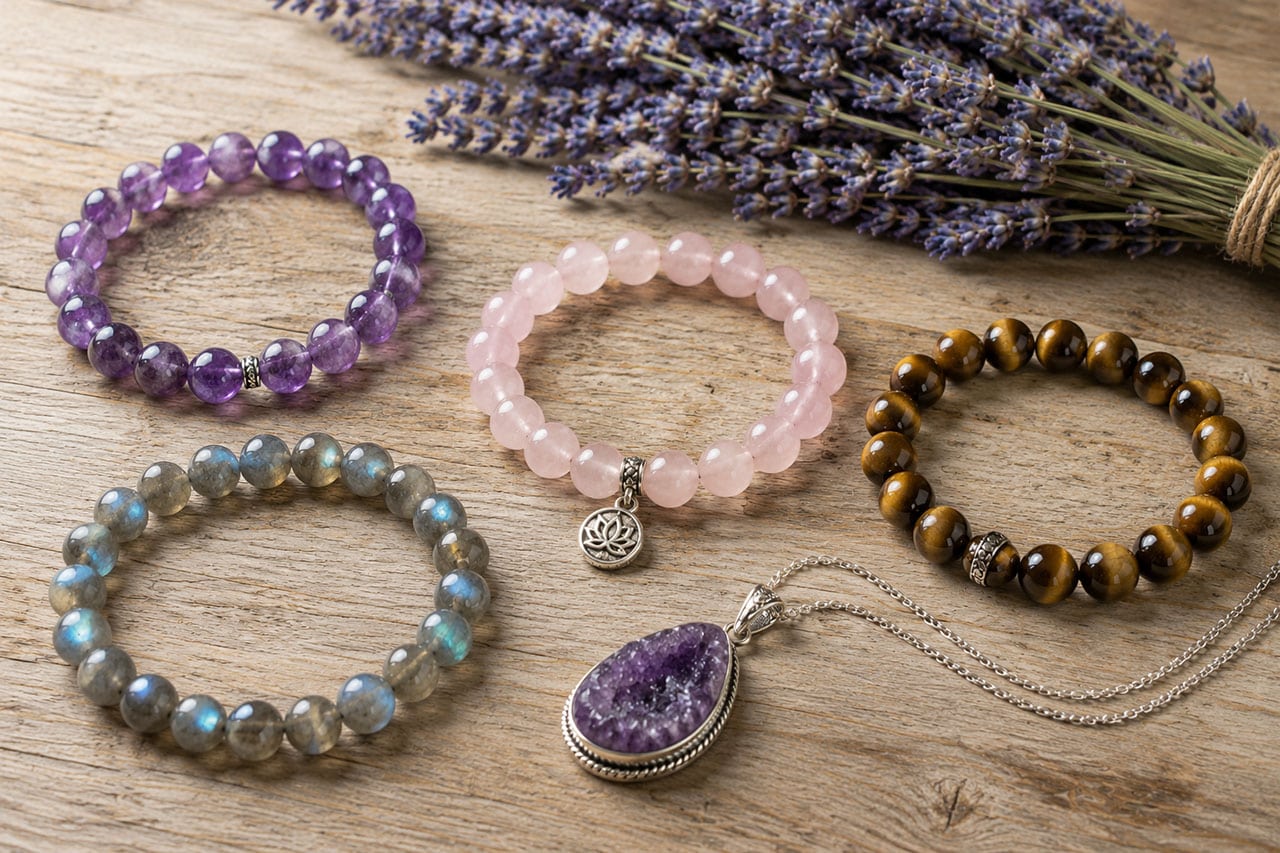
Yes. Wearing several crystals at once is fine almost every time. The idea that particular stones clash and cancel each other out is a recent internet rule, not older tradition. The two real limits are your attention and the hardness of whatever sits against whatever.
Stack a few bracelets on one wrist, tuck a pendant under your shirt, and somewhere a chart online will tell you two of them are at war. That chart is younger than most of the people reading it.
The rule that specific crystals fight or neutralise each other does not come down from any lineage or old book of stone-working. It was assembled recently, largely because a compatibility table is a tidy thing to publish and an easy thing to sell. Once you know that, the question gets more useful. Combining crystals is almost always fine, so the part worth your time is the short list of times it genuinely is not.
The clash rule is newer than it looks
Ask where the clash rule came from and you get silence, because it has no source to point back to. People have worn several stones at once for as long as they have worn stones, on the same cord, in the same pouch, sewn into the same hem. Crystal practice holds plenty of specific ideas about what a given stone is for, but “these two must never touch” is not one it inherited. It arrived with the search box.
What the tradition asks of you is smaller and harder. Know why you reached for a given stone today. That is where the real thinking lives, and no chart can do it for you.
Where your attention is the real limit
Here is the one form of the worry that holds up. If you are wearing a stone for a specific reason, say a piece of amethyst because you want its calm nearby, piling five more on top of it can make it harder to feel connected to any single one. The crystals are not interfering with each other. Your attention is. Split it six ways and each stone gets a sixth.
This matters most for focused work tied to the chakras, the energy centres of the body that crystal practice maps stones onto. Wearing one stone for one centre is a clear signal to yourself. Wearing a stone for every centre at once is closer to background noise. If a stone is doing a job for you, sometimes the useful move is to take the others off rather than add another.
Then there is the plainer version, the one people dress up in mystical language when it is really just social. Six bracelets read differently in a meeting than one does. That is a real consideration, and it is not a crystal question.
Where hardness is the real limit
The combination that can damage something is physical, not energetic. Crystals differ enormously in how hard they are, and a softer stone worn in constant contact with a harder one slowly loses. Mineralogists rank this on the Mohs scale, a one-to-ten ladder where each mineral scratches everything below it. Quartz sits at seven, and most of the stones people wear are quartz: amethyst, rose quartz, citrine, carnelian, tiger’s eye. They share that hardness and rub along beside each other without trouble.
The ones to watch are the soft stones. Selenite sits down at two, calcite at three, a banded fluorite tower like the rainbow one on my own shelf at four, all of them far below quartz at seven. Put any of them on the same wrist as a quartz bracelet and the quartz will win the argument over months, leaving fine scratches and dulled edges on the softer bead. The fix has nothing to do with energy. Keep soft stones on a different wrist, space them with plain beads, or wear them somewhere they are not grinding against harder company.
One honest note from my own stacking, because it cuts against the neat story. I have worn beaded bracelets in a pile for a long time and they have lasted well, with a single exception: two beads on a smoky quartz strand once broke clean in half while the cord held. One incident, cause unknown, against years of bracelets that were fine. I would not turn that into a law about beads, and neither should you. It is just the reminder that stones are physical objects and occasionally behave like them.
How to stack without overthinking it
Most of the day to day comes down to a couple of habits. Wear what you have a reason to wear, and let the rest be decoration if that is what it is, because most people stacking stones are doing it for how it looks or feels rather than for a calculated energetic recipe, and that is completely fine. Keep the soft stones out of direct contact with the hard ones. And pay attention to your own response, because if wearing a lot at once leaves you scattered, that is information worth acting on, and if it feels steadying, wear more.
There is something worth noticing in how much rule-making has grown up around a practice that used to be simple. People reach for stones when they want to feel a certain way, and the urge to systematise that into a chart says more about us than about the stones.
If you want to read up on any single stone before you start layering it with others, the Crystalance Mineral Library covers them one at a time, and if you are curious which pairings people reach for on purpose, the piece on what goes well with amethyst is a good place to start. The short version is the one you began with. Wearing several crystals at once is almost always fine, and the only pairing worth a second thought is a soft stone worn against a hard one.
Sources
- Mineralogical Society of America, Mohs Scale of Hardness: http://www.minsocam.org/msa/collectors_corner/article/mohs.htm