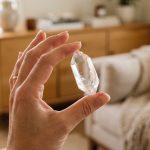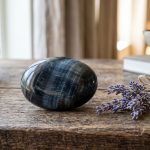

Celestite pairs with amethyst, selenite, blue lace agate and angelite, all quiet stones. But celestite is too soft to wear or carry, so every real pairing is a matter of where you set it down, not what you string on a bracelet.
Most combination questions are really about jewellery or a pocket. Celestite is the exception, and getting that straight changes the whole answer. This is a stone you place and leave, because it is far too soft and too fragile to live in a pouch or on a wrist. By the geological data it sits at only 3 to 3.5 on the Mohs scale of mineral hardness, with perfect cleavage, meaning it splits cleanly along flat internal planes at a knock. It is strontium sulphate, the pale blue crystals you usually meet lining the inside of a broken geode, and those little crystals chip and flake with very little provocation.
The pairing question for celestite, then, is not what you can wear it with. It is which quiet stones share the still corner you keep it in, and whether a set-down-only stone is even the thing you want. That is a real choice, and one worth making on purpose rather than discovering later when the geode has shed half its points into a drawer.
Why celestite is a stone you place, not wear
Our own working rule at the shelf makes the point cleanly. A fabric pouch carried with several stones takes tumbled or polished pieces only, and soft cleavable stones like celestite are exactly what you keep out of it, because they flake against the harder quartz tumbles and turn the inside of the bag to grit. Celestite fails every test that a carry stone has to pass. It is soft enough to scratch on almost anything, it cleaves if dropped, and its pale blue is best kept out of harsh light and away from water as ordinary care for a delicate display piece.
None of that is a mark against the stone. It is simply what celestite is, and it points to how you really use it. You give it a settled spot and you leave it there. That single fact quietly selects its partners for you, because a stone that lives in one place pairs by sharing that place, not by sharing a string.
The quiet company it keeps
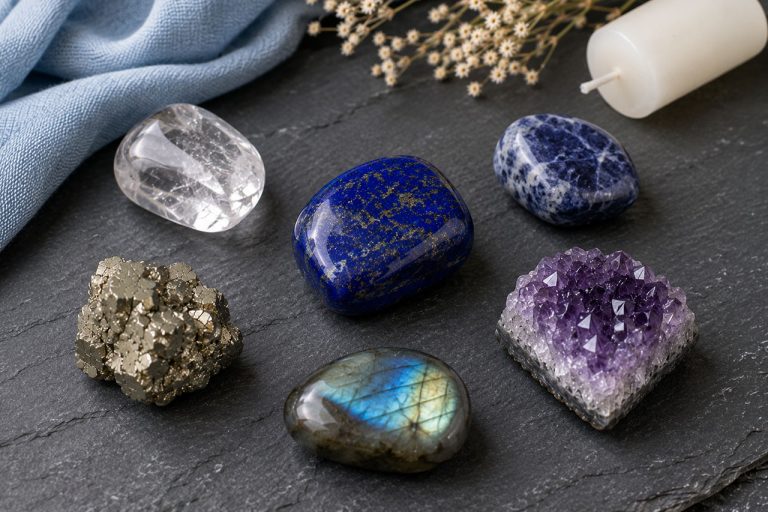
Set down and left alone, celestite keeps gentle company, and the tradition reads it as a soft, calming, spiritually oriented stone that does best beside others of the same temperament. Amethyst is the most natural of them, quieting and clarifying in practice, and a celestite and amethyst pairing on a bedside table is about as settled a setup as crystal work offers for sleep and winding down. Selenite suits it for a different reason, a clean, high, reset quality the tradition prizes for meditation spaces, though selenite is another soft stone, so the pair belongs on a shelf together rather than in a hand. Blue lace agate adds the same soothing blue with an association to gentle, patient communication, and angelite takes the pairing to its most peaceful, a soft companion for reflection or a hard stretch.
What celestite cannot survive is noise. Dense, protective stones like black tourmaline or obsidian, and hot activators like carnelian or red jasper, simply overrun it, and its quiet contribution gets lost rather than balanced. You can place it near them deliberately, but be clear that celestite will be the stone that disappears in that company. Its whole nature is to be the softest thing in the room, and it works best where the rest of the room agrees. For more on the stone’s own calming reputation, what celestite is good for covers it.
If you want the calm without the fragility
Here is where the real choice sits. If what draws you is celestite’s calm blue and you want to carry it or keep it somewhere it might get knocked, celestite is going to disappoint you, and no pairing fixes that. A gentler-handed stone will serve you better. Blue lace agate is a chalcedony, a quartz-family stone hard enough for daily wear, and it carries much of the same soothing blue character celestite does. Sodalite is tougher again and holds a similar calm-communication association. Either will take the pocket and the bracelet that celestite refuses.
Celestite earns its place when you want a still point rather than a carried one. A geode on a windowsill you sit near, a cluster in a meditation corner left undisturbed, paired with amethyst or selenite for a space you go to on purpose. Used that way it is one of the loveliest calm stones there is, and its fragility stops being a problem because you never ask it to do the thing it cannot. If sleep is the reason you are reaching for it, can you sleep with celestite goes into the placement in more detail, and the Crystalance Mineral Library has celestite’s full profile when you want the background.