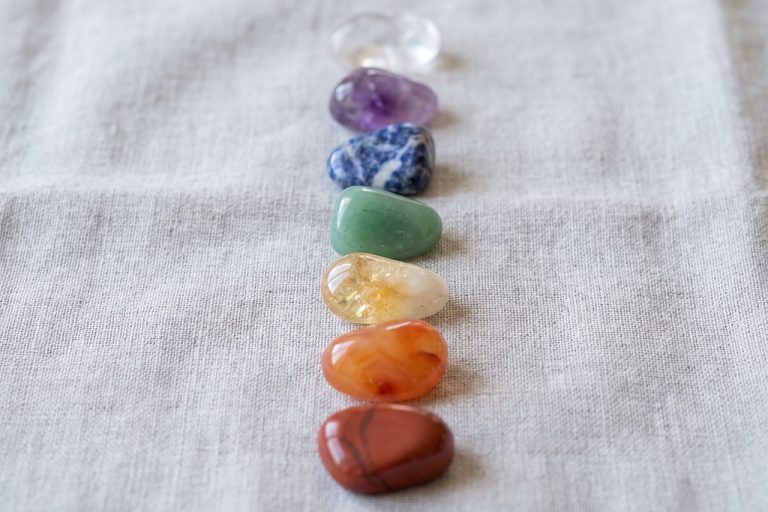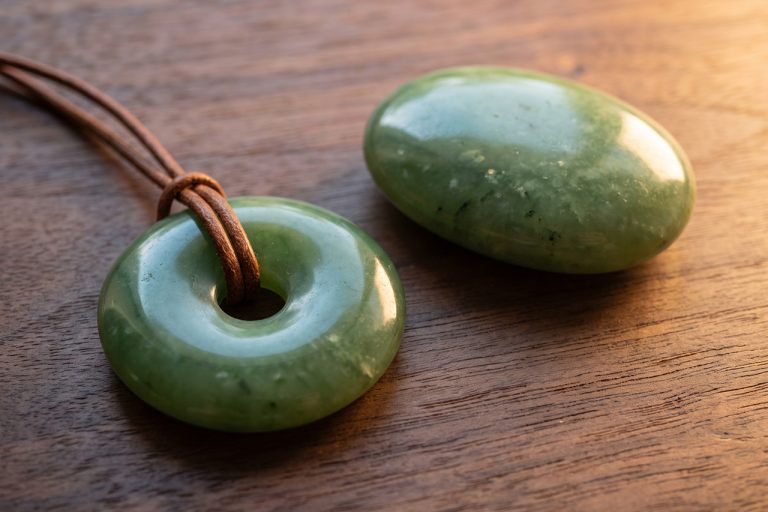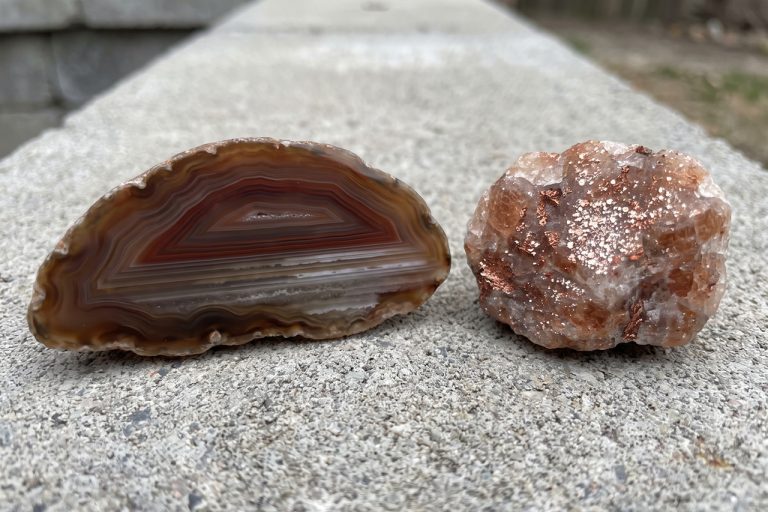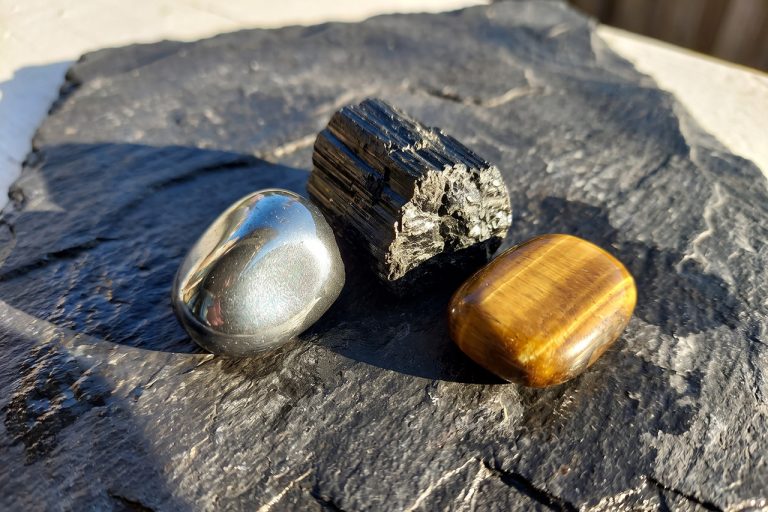
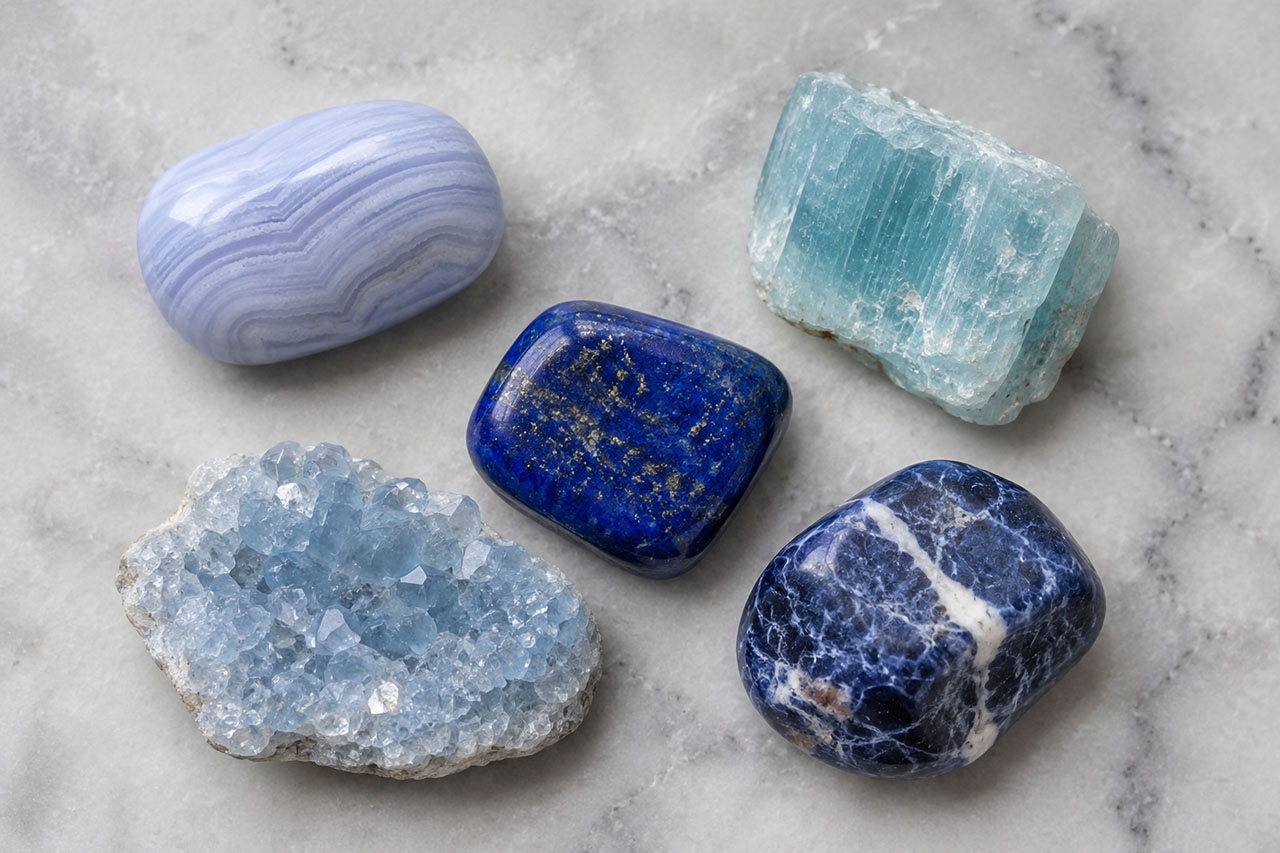
The throat centre is where crystal practice sends this whole family, reading it for calm, for clear thinking and for saying the difficult thing. The five stones behind that one reading are unrelated minerals, and they behave very differently in the hand.
The throat is a placement with a consequence built into it. Practitioners mean it fairly literally: the stone belongs near the throat, worn on a chain or a cord or a choker, or held there for a few quiet minutes before something hard. A stone for the root centre can sit on a table and still be doing its job. This one asks you to hang it round your neck.
That is fine if you own aquamarine. It is a slower conversation if you have fallen for angelite, because you are then being asked to suspend a stone softer than a copper coin over a tiled bathroom floor, daily, for a year.
Where each of them gets sent
Blue lace agate is where practitioners start when what is missing is calm. It is the soft end of the family in temperament, associated with easing the physical part of speaking anxiety, and it is the one most often handed to children and to people who find stronger stones overwhelming.
Lapis lazuli is the opposite end. Crystal practice reads it for truth and for self-knowledge, the harder kind, and for speech with some weight behind it. It has the longest documented history of any stone in the family, which is part of why it gets that job.
Aquamarine sits between the throat and the heart in the correspondence charts, and the practice reads it for the courage half rather than the calm half: saying the true thing, not merely saying it smoothly.
Sodalite is read as the analytical one. Where blue lace agate is about not being afraid, sodalite is about staying organised while the room is not, and practitioners reach for it around decisions rather than around performances.
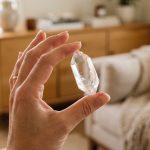
Angelite is the newcomer. It is a trade name for anhydrite, a pale blue calcium sulphate, and crystal practice reads it for serenity, for grief and for the quieter end of blue.
Five readings, and no way to tell from any of them how the stone will survive the year.
The widest hardness range on any shelf
Beryl, the mineral aquamarine belongs to, comes in at 7.5 to 8 on the Mohs scale with imperfect cleavage. Blue lace agate is chalcedony, a microcrystalline form of quartz, and behaves accordingly. Lazurite, the blue mineral that gives lapis its colour, measures 5 to 5.5. Anhydrite is 3 to 3.5, which puts it below a copper coin and a little above a fingernail.
That is a spread of nearly five points inside one colour, and because the Mohs scale is not linear the real distance between the ends is much wider than the numbers make it sound. No other correspondence group on a crystal shelf spreads like that. The reds cluster in the quartz family. The greens mostly do. Blue is where the tradition happens to have collected a beryl, a chalcedony, a feldspathoid and two sulphates and given them one job.
Lapis needs a qualification there, and it is a distinction this site has got wrong before. Hardness is a fact about a mineral. Lapis lazuli is a rock, an aggregate of lazurite with calcite and pyrite mixed through it, so the piece in your hand is only as tough as its softest and its loosest component. A lapis pendant with a lot of white calcite in it is not a 5.5 object, whatever the lazurite figure says.
Anhydrite is where it gets serious, and the reason is not hardness on its own but cleavage. Cleavage means the mineral parts along a flat plane when it is struck, the way a pane of glass does not. The Handbook of Mineralogy gives anhydrite perfect cleavage on one form and nearly perfect on another, yielding pseudocubic fragments, with brittle tenacity and an uneven to splintery fracture. A dropped piece is therefore as likely to come apart into blocks along a plane as it is to chip. GIA’s laboratory, writing up a faceted anhydrite in 2023, reached the obvious conclusion: the material “is not well suited for use in jewelry due to its low hardness of 3.5 on the Mohs scale and its perfect cleavage in one direction”.
Which one gets the chain
If you want a blue stone against your throat all day, on a chain, through doors and seat belts and the bottom of a bag, that is aquamarine or blue lace agate. Not because they are better stones or better readings, but because they will still look like themselves in March. A stone you are afraid to wear is not doing the job the tradition assigned it.
For the soft half, invert the arrangement. Give angelite, celestite and a calcite-heavy lapis a fixed place instead of a chain, a shelf by the desk or the corner of a bedside table, and go to them instead of carrying them to you. A desert rose on our own shelf is about twenty centimetres across, dinner-plate sized, and it is startlingly light the first time you pick it up. Objects like that are made to be visited.
While we are here, the care rule attached to angelite is aimed at the wrong hazard. The warning you will meet says water turns anhydrite into gypsum. The reaction is real but the conditions are not domestic ones: the experimental work that converted anhydrite to gypsum quickly did it to fractured rock under differential stress in the crust, while months of sieved powder sitting under water mostly did not convert at all. Anhydrite does dissolve in water, more slowly than gypsum does, so a piece living in a steamy bathroom will dull at the surface over years. That is the real size of the risk, and it is much smaller than a drop onto tiles.
Choose the reading you want, then check that the stone can survive the way you mean to use it. If it cannot, move the stone rather than giving up on it. Where each of these minerals sits in its own family, and what puts the blue into it, is set out stone by stone in the Crystalance Mineral Library.
Sources
- Handbook of Mineralogy, Anhydrite, Mineral Data Publishing, for hardness 3 to 3.5, for cleavage perfect on {010} and nearly perfect on {100} yielding pseudocubic fragments, for brittle tenacity and uneven to splintery fracture, and for the name from the Greek for without water: handbookofmineralogy.org
- Handbook of Mineralogy, Beryl, Mineral Data Publishing, for hardness 7.5 to 8, imperfect cleavage on {0001} and brittle tenacity: handbookofmineralogy.org
- Handbook of Mineralogy, Lazurite, Mineral Data Publishing, for hardness 5 to 5.5, imperfect cleavage on {110}, brittle tenacity, and the name from the Persian lazhward, for blue: handbookofmineralogy.org
- Almeida, M. E. and Renfro, N., “Purple Anhydrite”, Lab Notes, Gems & Gemology 59(1), Spring 2023, p. 72, for anhydrite not being well suited for use in jewellery owing to its low hardness of 3.5 and its perfect cleavage in one direction: gia.edu
- Heeb, J., Healy, D., Timms, N. E. and Gomez-Rivas, E., “Rapid hydration and weakening of anhydrite under stress: implications for natural hydration in the Earth’s crust and mantle”, Solid Earth 14, 2023, pp. 985 to 1003, for hydration to gypsum in a few hours under non-hydrostatic stress with fracturing and grain-size reduction, and for the earlier months-long experiments on sieved anhydrite powder under water having failed to produce hydration products or showing relatively slow rates: se.copernicus.org
- Notholt, A. J. G. and Highley, D. E., Gypsum and Anhydrite, Mineral Dossier No. 13, Institute of Geological Sciences, London: HMSO, 1975, p. 2, for anhydrite having no water of crystallisation, dissolving in water more slowly than gypsum, and eventually hydrating to it, a process accelerated by fine grinding: nora.nerc.ac.uk
- MIN-002, Crystalance Personal Experience Library: a desert rose specimen about 20 cm across, dinner-plate sized, and surprisingly light for its visual size.