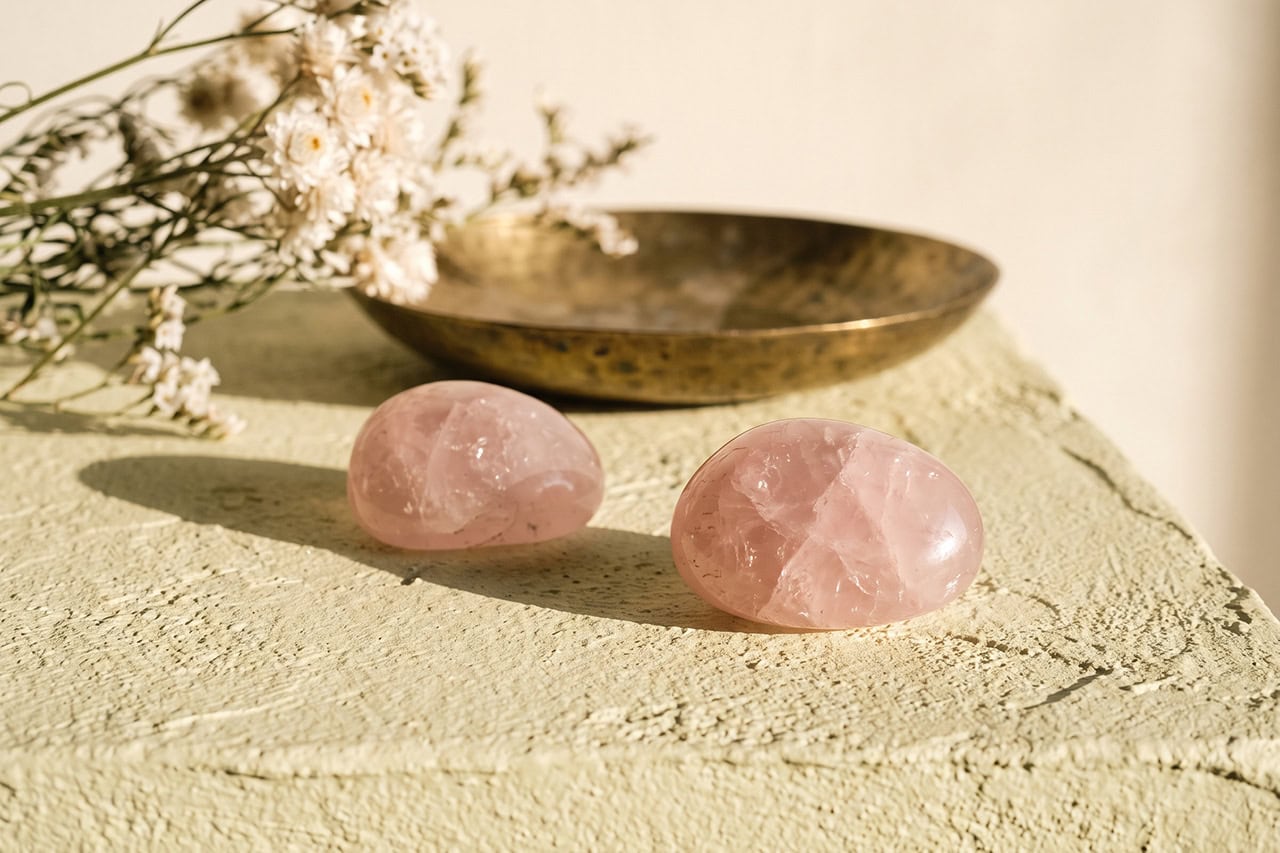
Rose quartz. Not because it is the strongest of them, but because it is the only one on the standard list you can pick up without first deciding what is wrong with you.
You have met that list. Rose quartz opens the heart, rhodonite heals old wounds, and garnet is for passion that has gone quiet. Then rhodochrosite, for the childhood underneath the self-criticism. Then green aventurine, for the low self-worth that makes a person settle for less than they wanted.
Four of those five entries do not describe a stone at all. They describe a reader. Before the list will help you, you have to work out which reader you are, and it wants the answer quickly.
The question the list asks first
Rhodonite is the clearest case, because its condition is the easiest to state. To choose it you have to have decided, standing in a shop or scrolling on a phone, that you are carrying an injury from a previous relationship, and that this injury is the thing in your way. That may well be true. It is also the kind of conclusion that tends to arrive slowly, with help, over months, and usually with somebody else in the room.
The list wants it in about eleven seconds, from a woman holding a jute pouch, before she has taken her coat off.
Rhodochrosite asks for considerably more. To pick it you have to have located the origin of your self-criticism in your childhood, which is a piece of work some people spend years on and never quite finish. Garnet asks you to conclude that your desire has faded. Green aventurine asks you to agree, in advance and in a shop, that you settle for less than you want because you do not believe you deserve more.
There is nothing unreasonable about thinking any of those things about yourself. Deciding them at a counter, on the strength of a card the size of a stamp, in order to complete a purchase, is a different act.
And the practical joke inside the list is that its heaviest assignment goes to the flimsiest object. The Handbook of Mineralogy gives rhodochrosite a hardness of 3.5 to 4, with perfect rhombohedral cleavage and brittle tenacity, which in plain terms means the stone sold for the longest and slowest inner work is the one most likely to split if you drop it on a tiled floor.
What answering it costs
Garnet is the sharpest case, because the diagnosis it asks for is unusually easy to say yes to. Someone a few years into a relationship can be talked into believing the passion has gone quiet, because the alternative is claiming out loud that it has not, and that is not a sentence people volunteer about their own lives.
You pick up the garnet, and the picking-up has confirmed something. Not loudly, and not in words you would defend if challenged, but you have now walked out of a shop having agreed with a proposition about your relationship that you were not thinking about twenty minutes earlier. Some version of it will still be in your head on the drive home.
That is the cost, and there is nothing mystical in it. It is the ordinary way a question changes the person it is put to. A symptom checker at two in the morning does the same thing, and you finish it slightly worse than you started, having said yes to a run of questions written to be said yes to.
A list that sorts stones by what has gone wrong with you is a symptom checker with prices on it. The difference is that you can close a symptom checker. It is much harder to walk away from one when the outcome is a small pink object you were looking forward to.
I want to be careful here, because none of this is an argument that the stones are a bad idea, or that people who buy them are being fooled. The five are all real minerals with long associations and people get real use out of every one. What I am objecting to is the order of operations.
Is there a best one, then?
Rose quartz, and here is the whole of the reason.
It is the only entry on the list that arrives without a precondition. It does not require you to have identified a wound, dated your self-criticism, audited your desire, or conceded that you settle. You can pick it up while knowing nothing about yourself at all, and that is the ordinary state to be in about a relationship, including one that is going well.
That is not a mystical claim and I am not going to dress it up as one. It is a claim about the moment of choosing, and the moment of choosing is the part of this a person controls.
There is a second advantage, and it shows up later. Your reading of your own situation will change, sometimes several times in a year, and readings of that kind turn out wrong often enough. A rhodonite bought as a wounded person becomes slightly awkward to keep holding once you decide you were mostly just tired and short of daylight. The rose quartz survives the revision, because it was never premised on the diagnosis in the first place.
I would go one step further than that, and this is the unpopular half. If something on that list has already told you something about yourself that you did not walk in believing, put it down and come back another day. The stone is not the problem. Forming views about your own inner life in a room designed to sell you things is a poor way to arrive at them, and that goes for me writing this as much as it goes for the shop.
What to do at the shelf instead
That leaves green aventurine, whose entry is the gentlest on the list and the sharpest at the same time. It is offered to people who settle. Read that back as a description of a customer and it is a small cruelty, delivered in a soft voice, on a laminated card.
The move is simple and slightly boring. When you catch yourself deciding which of the five descriptions fits you, stop, and notice that a list has asked you a question. You do not have to answer it. The question is not diagnostic, it was not written by anyone who has met you, and answering it is not one of the steps involved in acquiring a stone.
Then take the pink one, because you can, and because nothing has to be true about you first.
What you do afterwards is a separate matter and a longer one, and if the thing underneath the question is a level of worry that is running your week, what crystals help with anxiety and calm will be more use than any of the five.
The Crystalance Mineral Library has profiles for all of them when you want the detail. There is also a small ring in the Victoria and Albert Museum, catalogue number 848-1871, possibly Italian, fifteenth century, which the museum calls likely to have been a love token representing everlasting love, or perhaps a betrothal ring. It is plain engraved silver with two bezels: on one, two hands clasped; on the other, two hands holding a heart between them.
Sources
- Handbook of Mineralogy, rhodochrosite: rruff.info
- Handbook of Mineralogy, quartz: rruff.info
- Victoria and Albert Museum, fede ring, museum number 848-1871: collections.vam.ac.uk