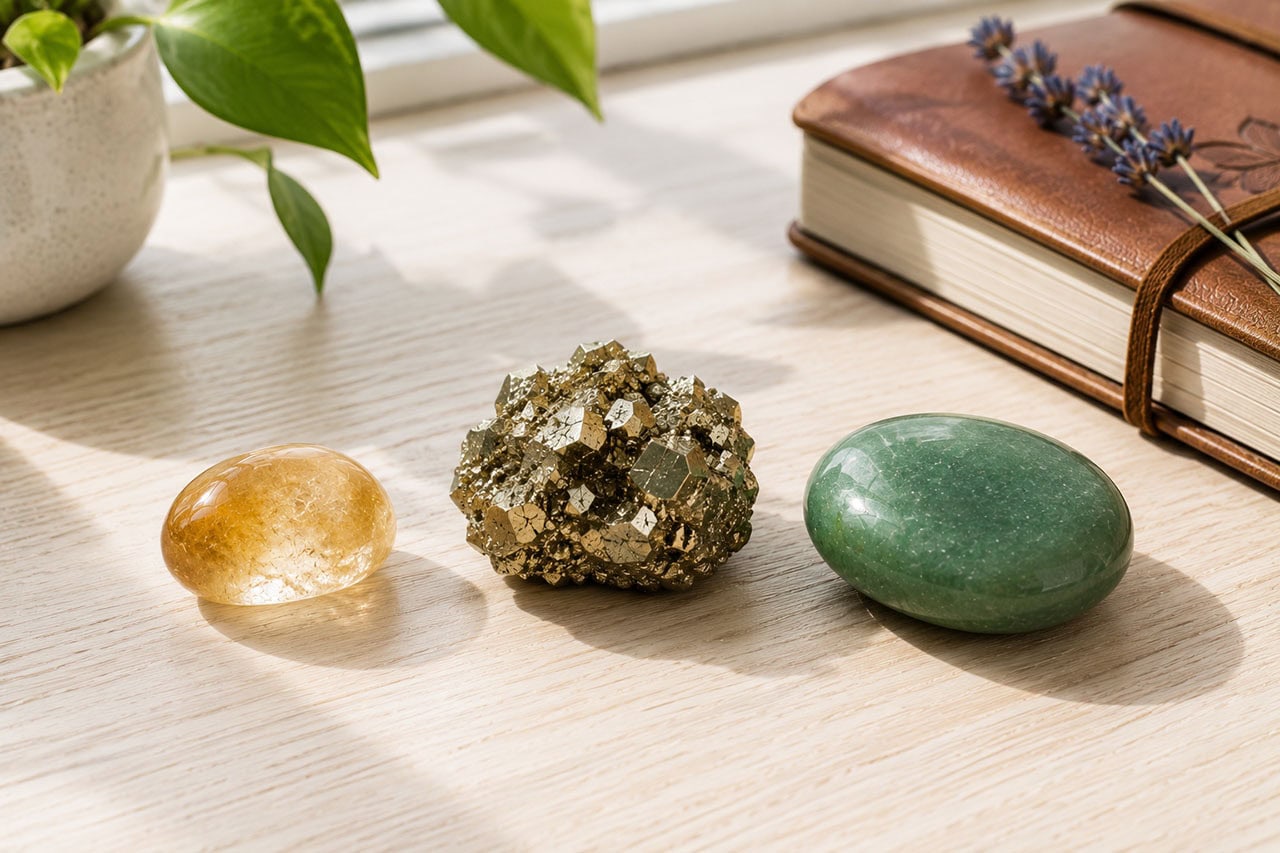
The standard wealth crystals are citrine, pyrite, and green aventurine, each associated in modern crystal practice with abundance, financial luck, and material prosperity. Money magnet bracelets typically combine these stones. The associations are belief-based traditions, not literal wealth generation.
Search “crystal for money” and you will land in a corner of the internet where confident claims and unstated mechanisms sit side by side. Crystals for prosperity. Crystals for cash flow. Bracelets that “magnetise” wealth. There is a real practice underneath this, with real traditions and real intentions, but the marketing has gotten a long way ahead of what the stones can actually do.
The honest version is simpler. A small handful of crystals are associated with wealth, abundance, and money in contemporary crystal practice. The associations are stable across most modern sources. What the stones do is a separate question worth answering honestly.
Here is the working list, what each one is associated with, and what holding them is actually doing.
The Standard Wealth Stones
Three stones carry most of the wealth-and-money associations in contemporary crystal practice.
Citrine. The yellow quartz variety, often called the “merchant’s stone” in modern crystal circles. Associated with abundance, prosperity, financial confidence, and what practitioners call manifesting cash flow. Citrine has the longest-standing wealth association in modern Western crystal practice, and almost every money-related crystal recommendation includes it.
Pyrite. Iron sulphide (FeS₂), nicknamed “fool’s gold” for its bright metallic gold appearance. The colour association alone is enough to anchor pyrite as a wealth stone in most modern practice. Used specifically for attracting money, building financial confidence, and (in some traditions) manifesting prosperity through deliberate intention work.
Green aventurine. Quartz coloured green by mica or hematite inclusions. The green carries the colour-symbol association with growth, money, and abundance (the same logical thread that gives the dollar bill its colour in crystal symbolism). Often described as the “gambler’s stone” for its luck-and-opportunity associations.
These three are the wealth-crystal core. Most money-related bracelets, kits, and recommendations are built around some combination of them, sometimes with citrine and pyrite paired specifically because their colour and folk-association overlap reinforces the intention.
How These Stones Are Believed to Work
In contemporary practice, the standard claim is that crystals “attract” or “magnetise” the energy of whatever they are associated with, money included. Each of the three wealth stones has its own emphasis.
Citrine is described as expansive. It broadens the practitioner’s confidence and openness around money, removes psychological blocks around receiving, and supports a general feeling of financial wellbeing.
Pyrite is described as protective and grounding. It shields against bad financial decisions and builds the kind of steady confidence that supports long-term financial work.
Green aventurine is described as luck-oriented. It draws favourable circumstances and opens opportunities, particularly in active money-making contexts (entrepreneurship, sales, negotiations).
Honestly, the framing here borrows heavily from the law-of-attraction style of intention setting. The claim is not that the stone itself generates money, but that holding the stone with focused intention shifts something in the practitioner’s awareness, behaviour, or openness that then has downstream effects on financial outcomes. The stone is the anchor. The work is the work.
How People Actually Use Them
A few practical patterns.
Carrying or wearing. Small tumbled citrine, pyrite, or aventurine pieces are commonly carried in a pocket or purse, or worn as bracelets. The “money magnet bracelet” is typically a beaded bracelet combining citrine and pyrite, sometimes with green aventurine added. There is no universal rule about which hand to wear it on. Some traditions specify the left wrist for receiving and the right wrist for sending, but the practice varies by source.
Placing. A piece of pyrite or citrine kept in a workspace, near a cash register, or on a desk where financial decisions get made is a common placement pattern. The stone serves as a visual cue and intention reminder.
With intention. The most consistent advice across mainstream crystal practice is to combine the stone with a clear intention. Holding citrine while writing a financial goal, placing pyrite on a contract or business plan, or wearing aventurine before a negotiation are all variations on the same pattern: pair the stone with a specific moment of decision-making.
Pairing. Citrine and pyrite are the most commonly paired wealth stones because their colour and association overlap reinforces the intention. Green aventurine adds the opportunity-and-luck thread. For more on combining crystals safely, see can you wear multiple crystals at once.
Does Any of This Actually Make Money?
Worth being direct about this. No, crystals do not generate money. There is no measurable mechanism by which a stone in your pocket changes your bank balance.
What crystals can do is serve as anchors for the intentions, decisions, and behaviours that actually produce financial outcomes. A pyrite piece on your desk doesn’t bring in clients. The same pyrite piece, combined with your decision to focus on revenue work, can be useful as a reminder that helps the focus stick. The stone is the cue. You are the variable.
The wealth crystals are most useful as part of an active practice (intentional money work, focused effort, deliberate decisions) and least useful as a passive substitute for that practice. A money magnet bracelet alone, worn without any corresponding change in behaviour, is jewellery. The same bracelet worn as a daily intentional reminder during a period of focused financial work is something else.
If you find that working with citrine, pyrite, or green aventurine helps you stay focused on your financial goals, the stones are doing what they are supposed to do. The mechanism is psychological and intentional rather than supernatural. Both can be true.
For more on individual wealth-associated crystals, see the Crystalance Mineral Library for citrine, pyrite, and green aventurine specifically. The stones are practical tools for intentional practice, not shortcuts. Money still comes from work. Crystals can support the focus that makes the work consistent.