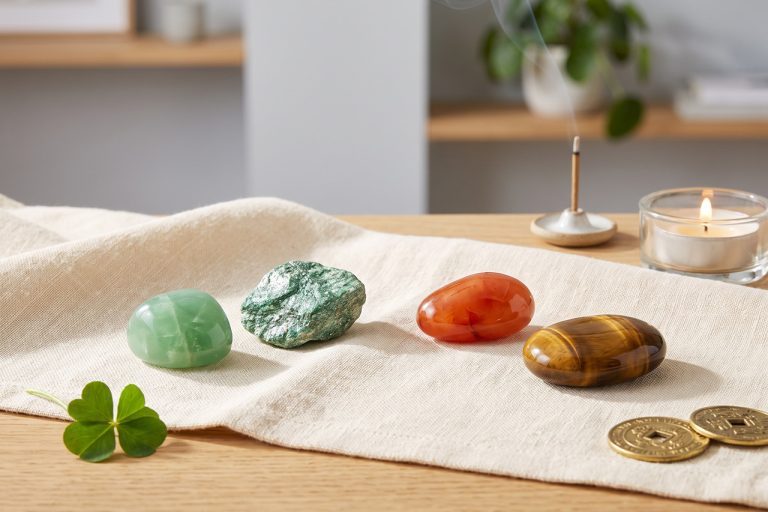
Blue lace agate, sodalite, aquamarine and amazonite for clear speech, carnelian for nerve. Each of those is aimed at your insides. The older tradition answered the same question with stones aimed at the people listening.
Pliny stops in the middle of his account of jasper to say this: “In passing, it gives me pleasure to refute here, as elsewhere, the falsehoods of the Magi, who tell us that this stone is helpful to public speakers.” Then he moves straight on to the next variety.
He was not sceptical about stones in general; book 37 of the Natural History is full of claims he reports without breaking stride. He singled that one out. And the other speaking claim in the same book, the one he lets pass with only his usual raised eyebrow, is pointed somewhere completely different.
Who the old stones were working on
Camillo Leonardi assembled the Speculum lapidum in 1502 out of everything the lapidary tradition had accumulated. His entries for speaking are startlingly specific about their target.
Chelidonius, the swallow stone, comes in red and black. The red kind, in Leonardi’s entry, “makes its bearers eloquent and pleasing”. The black kind brings undertaken business to its desired end, quells anger, and makes the bearer pleasing and calm. And then this: dominorum iras mitigat. It softens the anger of lords. Three words, in 1502, for the thing you are worried about on Thursday.
Galactides makes a man victorious in lawsuits, shrewd, lovable and eloquent. Chalcedony, carried pierced and threaded on bristles from a donkey, makes you the victor in civil cases and contests. Fourteen centuries before that, Pliny relays a claim from Zachalias of Babylon about haematitis, and relays it with a visible sneer, saying Zachalias “is not content to credit it with curing diseases of the eyes and liver, but places it even in the hands of petitioners to the king, allows it to interfere in lawsuits and trials”.
Read those as a set. A lord whose anger softens. A court that finds for you. A judge. A king receiving a petition. Somebody who finds you lovable, or beloved, or pleasing. A twelfth-century French prose version of Marbode’s verse lapidary puts it most directly of all, in its entry on the red chelidonius: “He who carries this stone will be a good orator and will be much beloved. One must carry it wrapped in linen cloth and suspended under the left arm.”
Beloved by whom? Not by himself.
These entries get quoted badly, so here are two warnings before you go looking. Not one of them is single-purpose: Leonardi’s swallow stone also treats fevers, jaundice and epilepsy, and Leonardi skips the full list of agate’s virtues altogether, telling the reader he is leaving them out for brevity. Nor was the old tradition uniformly combative. His carnelian entry says that, worn at the neck or on the finger, it checks quarrels and inflamed tempers, which is peacemaking rather than victory.
The modern list points the other way
Each item on the contemporary list names something happening inside the speaker: clearer expression, more confidence, a steadier and less rushed voice. The audience is not in the sentence.
That is a real change of address, and it happened recently, because the list itself is recent. Sodalite could not have appeared in any medieval lapidary under that name, since it did not have one. Thomas Thomson analysed it and named it in a paper read to the Royal Society of Edinburgh in 1811, and even then he recorded that the mineral had at first been taken for feldspar, which it closely resembles.
What did not change much is the material. Blue lace agate is a banded chalcedony, the same family as the stone Leonardi sent into court on donkey bristles. The substance stayed put. The person it was supposed to affect moved from the far side of the room to the inside of your chest.
What that leaves you with
The study behind the popular writing on pre-performance rituals was by Brooks and colleagues, published in 2016, and it was retracted in 2024. Stuart Vyse, writing up the notice in Skeptical Inquirer, reports that the authors’ own review found participants had been dropped from an earlier version of the data in a way that changed the outcome of two studies, and that a third contained runs of heart-rate readings unlikely to have occurred naturally.
What survives is smaller and more careful. Hobson and colleagues, in 2017, gave forty-eight undergraduates a ten-step hand and arm sequence and had them perform it once a day for four days, then once more in the laboratory. A specific brain response to making mistakes was reduced afterwards. The authors then list three limits themselves: the participants did not report feeling less anxious, their performance did not improve, and the slow deliberate movements alone, rather than the ritual, might have produced the effect.
Notice what was tested there. Not a gesture at the door. Four days of repetition, then the thing itself. If you want an object involved in your preparation, that is the shape the one surviving study used, and it is not the shape you get sold. Hold the stone for a minute at the same point in each rehearsal, across the days before, so that by the time you stand up the object is the least novel thing in the room.
Do not expect it to change how you feel. The study that found a change in the brain did not find one in how people felt, and it said so.
If you want a stone anyway, blue lace agate is the pale banded chalcedony with fine white lines through it, and sodalite is the deeper blue streaked with white. Carnelian is the warm orange one that the practice assigns to nerve rather than to words, and we have written separately about what carnelian is used for. The Crystalance Mineral Library has what each one is made of. That is the part that has not moved in five hundred years.
The rest of it has. A medieval reader asking this question wanted the judge to like him. He would find it strange that the question is now about how the speaker will feel, and stranger still that the person he was trying to persuade has dropped out of it altogether.
Sources
- Pliny the Elder, Natural History book 37, Rackham translation
- Camillo Leonardi, Speculum lapidum, 1502, Universite Rennes 2 CETM transcription
- Marbode of Rennes, twelfth-century French prose lapidary, tr. Martha Hale Shackford, 1913
- Thomas Thomson, “A Chemical Analysis of Sodalite, a new Mineral from Greenland”, Transactions of the Royal Society of Edinburgh 6, read 1811
- Retraction notice for Brooks et al., “Don’t stop believing”, Organizational Behavior and Human Decision Processes 185, 2024
- Stuart Vyse, “Maybe Do Stop Believing in Rituals”, Skeptical Inquirer
- Hobson et al., “Rituals decrease the neural response to performance failure”, PeerJ 5, e3363, 2017