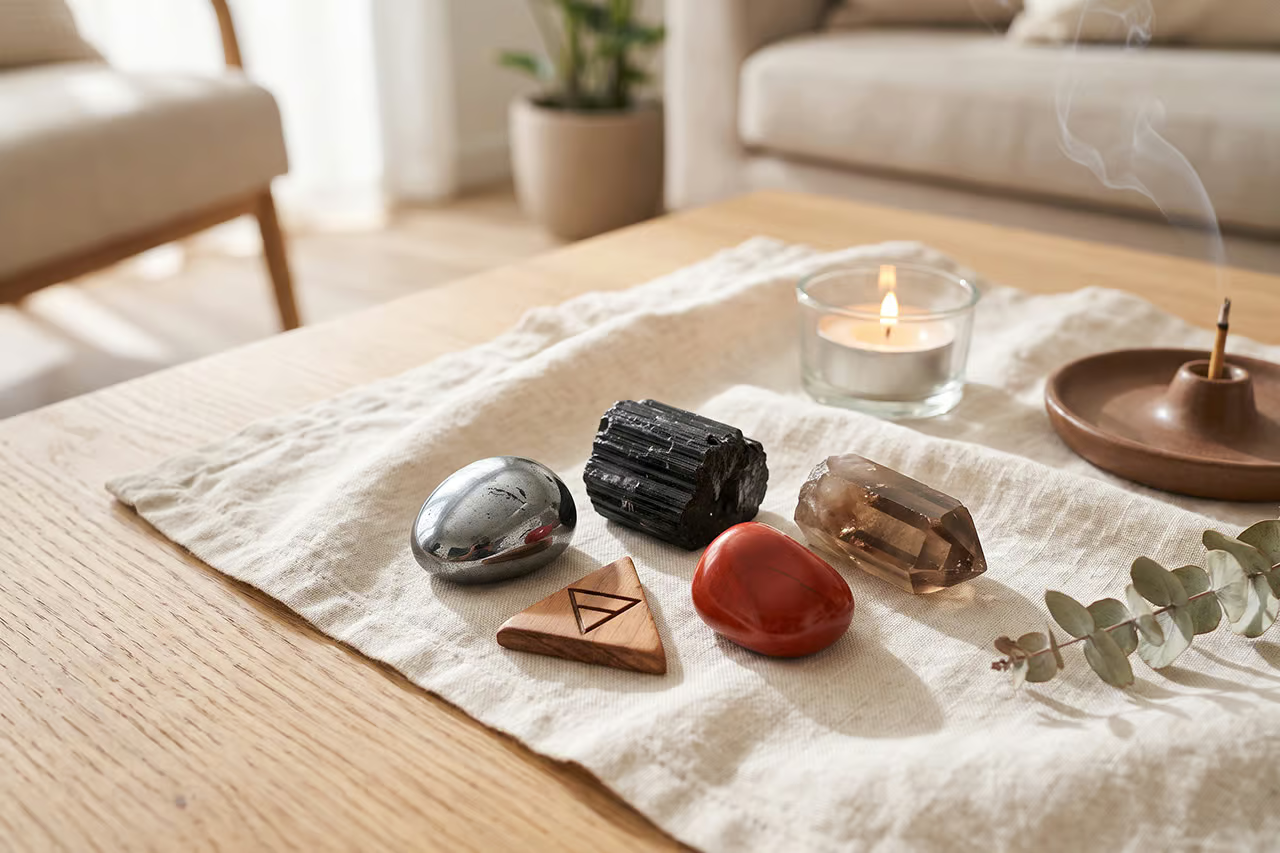
Hematite, black tourmaline, red jasper and smoky quartz are the four that crystal practice names most often for grounding. The property that sorts them is weight, and weight is the one thing on this shelf you can check for yourself.
Pick up a hematite tumble. Pick up a quartz tumble the same size in your other hand. Your hands will have settled it before you have read either label.
An association you can test is a rare thing here. A chart will tell you that a stone belongs at the throat, or that it is for luck, and there is nothing you can do at the counter to check either one. Weight is different. Crystal practice says down and it says heavy, and heavy is a claim your own body settles standing at a table.
Grounding, in the practice’s own language, means feeling planted and present rather than scattered, and a grounding stone is one the tradition treats as steadying when things are coming at you faster than you can place them. That is the request, and it needs saying, because the word gets stretched over a very wide range of unease. What the tradition offers against it is not a theory. It is an object, low down, that has some heft to it.
Why hematite heads the list
Crystal practice puts hematite at the head of its grounding list, and the reason is not alphabetical.
The Handbook of Mineralogy gives hematite a measured density of 5.26. Quartz comes in at 2.65, dropping to between 2.59 and 2.63 when it is massive rather than well formed. That puts hematite at close to twice the density of quartz, so a hematite tumble and a quartz tumble of the same size are not in the same weight class, and you notice the difference the instant you take both.
The rest of the list is more ordinary than its reputation. Schorl, the black tourmaline sold as a grounding stone, measures 3.18 to 3.22, so it is about a fifth heavier than quartz and nothing like hematite. Red jasper and smoky quartz are quartz, which means they weigh what a pebble weighs.
None of that makes the other three wrong. It explains why hematite leads and the others follow, and it tells you what you are getting. Red jasper and smoky quartz bring colour and association to the job; hematite brings a physical fact. If you have tried a grounding stone and felt nothing whatever, and it was a smoky quartz tumble, the flat honest possibility is that you were holding something that weighs the same as a stone off a beach.
There is a second-order point in that for anyone assembling a set. Size is doing more work here than species. A large piece of ordinary jasper outweighs a small piece of hematite, so a shop that only stocks tiny hematite is a shop where the jasper is the better buy, and that is not the trade-off a label draws your attention to.
Downward is a direction, not a spot
Crystal practice is unusually specific about this one. It normally names a position, a centre at the throat or in the middle of the chest. For grounding it names a direction instead, and the direction is down.
That means the placement can be got wrong in a way most of them cannot. A stone held in cupped hands at chest height while you sit upright in a chair is being held about as far from the tradition’s own instruction as a stone can be, and it is an easy mistake to fall into, because holding something in front of you is what holding something looks like.
Put it where your body already meets the ground instead. Under the sole of a bare foot while you sit is the plainest version, and if a stone underfoot is uncomfortable, and for a raw piece it will be, rest it on the floor against the arch instead. Under a thigh on a hard chair works too. Nothing needs to touch skin for this, so a stone inside a sock or sitting on top of a shoe is doing the same job.
Then leave it there and do something ordinary. This is not a stone that asks for a session. Ten minutes at a desk with a hematite tumble under one foot is the whole practice, and the reason it survives an ordinary week is that it costs nothing and interrupts nothing. On the fuller range of placements for hematite specifically, and there are more of them than this article needs, where do you put hematite on your body is the proper account.
Buying one without a shop to stand in
Buying online takes the four-second test away from you, so here is what to do instead.
Buy by weight, not by dimensions. A seller who lists grams is telling you the one thing that decides this purchase; a listing with a photograph and a measurement in centimetres is asking you to guess at it. The size I reach for fills a closed hand and no more, and where two pieces cost the same I take the heavier one without thinking about it further.
Buy the tumbled version rather than the raw one, and this is the one place I would spend a little more. A raw piece that goes under a foot or under a leg has edges on it. A tumbled one does not, and that is the whole argument.
None of which makes weight the mechanism, and crystal practice has never claimed it was. It puts red jasper on this list for its colour, and the colour is doing the work there rather than the weight. All I am claiming is that of everything the tradition says about these four, the weight is the part you can confirm standing up. If a red jasper pebble is the one you reach for, the number in the section above is not an argument against it.
And expect the association to be an association. Nothing here promises you a state, and a heavy stone under your foot is a heavy stone under your foot. What a weight at the low end of your body gives you is something to notice, and noticing it is the whole of what I am claiming for it. Hematite’s chemistry, its varieties and the reason a steel-grey stone leaves a red mark have a page of their own in the Crystalance Mineral Library.
You may not have to buy anything at all. If there is a stone somewhere in the house that surprises your hand for its size, that is the one, whatever the label on it happened to say.