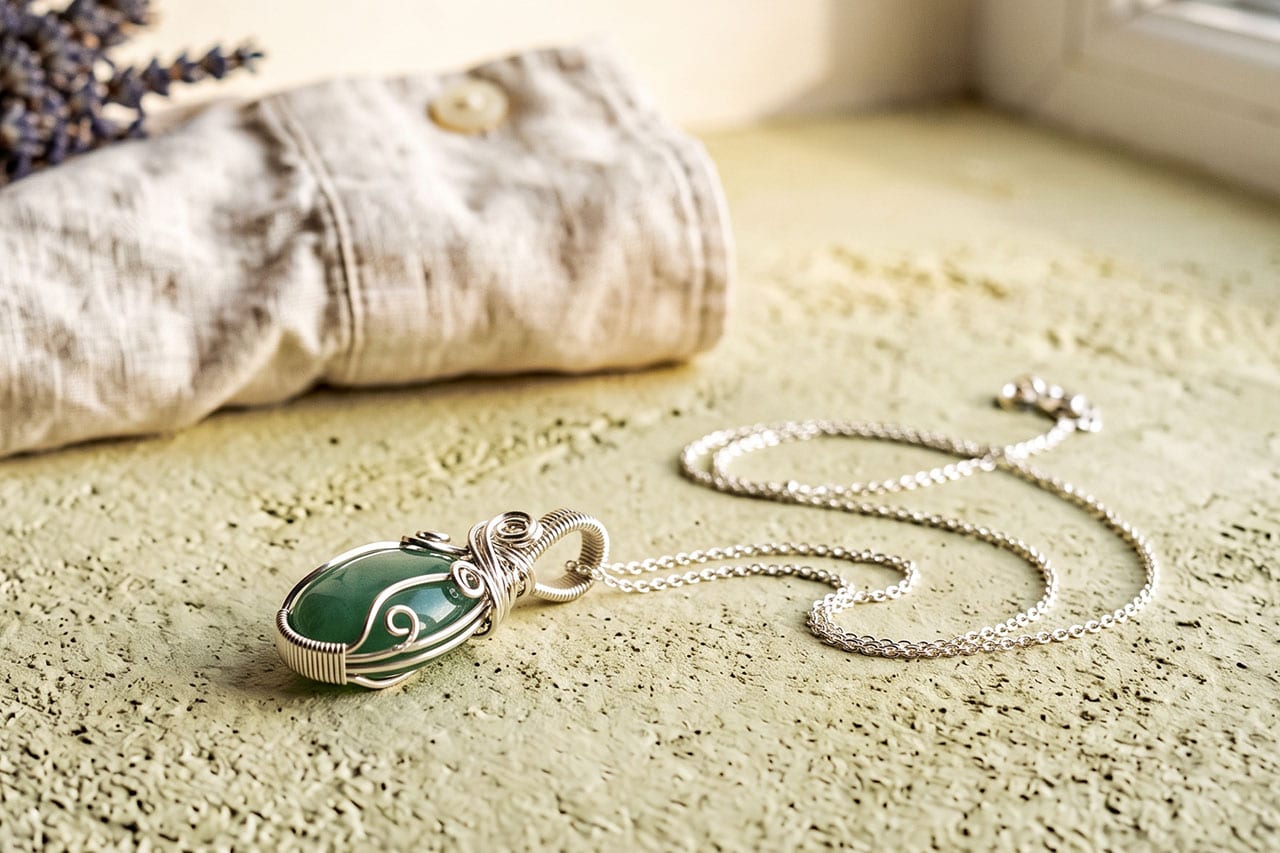
A crystal pendant keeps one stone in contact with you all day without asking you to remember it. Chest height is what does the work: the stone is visible in a mirror and it sits where a hand goes when someone is thinking.
There is one stone here small enough to hang on a cord, a few grams of moldavite, and it is the only piece in the collection that has ever been worn rather than looked at. Everything else stays on a shelf and gets picked up on purpose.
That gap is bigger than it sounds. A stone on a shelf is something you visit, and a stone in a pocket is something you have to remember is there. A pendant is neither. It is the one crystal format that puts the object into the path of a gesture people already make, and the rest of this is about how that works and which part of the thing wears out.
Why chest height works
Crystal practice puts the pendant over the heart, and in the tradition’s own terms that is a chakra placement. A chakra, in the Hindu and Tantric Buddhist practices the word comes from, is a centre of psychic energy in the body, and Britannica notes that six major ones are placed roughly along the spinal cord with a seventh just above the crown of the skull. Modern Western crystal work assigns the one in the middle of the chest to love and grief, so stones with those associations are worn there. Rose quartz and rhodonite both get worn this way for that reason.
Underneath the tradition there is a plainer reason the format works, and the two do not conflict. Chest height is where hands go. If you rest a hand on your sternum during a difficult phone call, or fold your arms so the fingers land just below the collarbone, a pendant on a mid-length chain lands in that gesture without your having to invent a new one.
Chain length is the one adjustment that matters, and it is a positioning decision rather than a style one. A choker-length chain puts the stone at the throat, which practice associates with speaking and being heard. A collarbone-length chain sits just above the heart position, and a mid-chest length puts it where practice wants it. Go longer than that and the stone drops toward the solar plexus and into the zone where it swings, catches on a seatbelt and gets tucked inside a shirt. If you want it touching skin rather than fabric, wear it under the shirt on purpose, which also stops it knocking against buttons all day.
The other half of the practice is what happens when you put it on. Fastening a clasp is a fixed moment in the morning, which makes it an easy place to attach an intention. Name one thing while you do it. Stay patient today. Say the thing in the meeting. It takes five seconds, and it is the difference between wearing a pendant and wearing a necklace.
What gives way first
Not the stone, in most cases. A pendant hangs free and rarely meets anything harder than a shirt, which is why softer and more cleavable material is usable in a pendant that would be a poor idea in a ring.
What fails is the assembly, and it fails in a predictable order.
Wire-wrapped raw pieces come loose. A wrap holds the stone by friction and geometry rather than by a setting, and knocks shift it. Check a wrapped piece every couple of months by holding the stone and twisting it gently against the wire, and re-tighten or re-wrap before it moves freely. Stones do come out of wraps.
Bails are next. The bail is the small loop the chain passes through, and on inexpensive pieces it is often a glued cap on the top of the stone rather than a metal fitting through a drilled hole. Glue lets go. If you are choosing between two similar pendants, the one with a drilled hole or a wire wrap through it will outlast the one with a cap stuck on the crown.
Then the clasp. A spring ring opened and closed twice a day works loose long before a chain wears through, and it is a cheap thing to replace at a jeweller once you notice it catching. Lobster clasps hold up better than spring rings for daily wear, and that matters when you buy the chain rather than after the pendant has gone.
The cord is the exception to all of this, because a cord fails visibly. It frays where it passes through the bail and you can see it coming. If costume metal bothers your skin, a cord also sidesteps the question entirely and costs almost nothing to replace.
Water is the last one, and it depends on the stone rather than the format. Wearing a pendant in the shower is fine for quartz and the hard opaque stones and a bad idea for the soft or soluble ones. There is a list in which crystals should not be put in water, and the short version is that if you do not know, take it off.
Choosing one you will keep wearing
Choose for the wearing, not for the stone, because the stone is the part that is easy to get right.
Pick something you like looking at, since you will see it in a mirror every morning and a pendant you find slightly ugly comes off within the week. Pick a weight you will not notice, because a heavy pendant is one that gets taken off at a desk and left there. If you are new to this and have no pull toward a particular stone, clear quartz is the standard first choice in practice, on the tradition’s view that it works with any intention rather than a specific one.
The format also opens up material that jewellery otherwise rules out. Geology.com recommends amazonite for earrings, pendants and pins rather than rings and bracelets, on the grounds that those formats meet less abrasion and impact, and the same reasoning applies across the softer stones. A pendant is where you get to wear the one you like.
Wear one at a time. Layering three pendants is a look rather than more practice, and it makes the reach-for-it-while-thinking part useless, because a hand arriving at three stones no longer knows which one it came for.
For the harder questions, including which fragile stones can be worn and where crystal rings fit, what is a crystal pendant for goes at the jewellery side properly. And if you want to look a stone up before hanging it round your neck for a year, the Crystalance Mineral Library gives each mineral its own entry with the hardness and habit on it.
The pendant you still have in five years will be the one whose clasp you replaced twice and never thought about again.
Sources
- Britannica, Chakra (psychic-energy centres in certain forms of Hinduism and Tantric Buddhism; six major centres roughly along the spinal cord and a seventh just above the crown of the skull)
- Geology.com, Amazonite (microcline feldspar, Mohs 6 to 6.5, two directions of perfect cleavage; best used in earrings, pendants and pins, which meet less abrasion and impact than a ring or a bracelet)