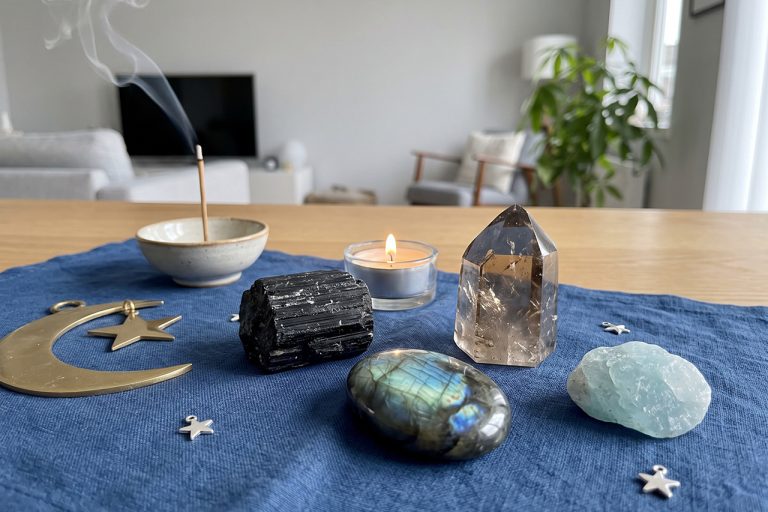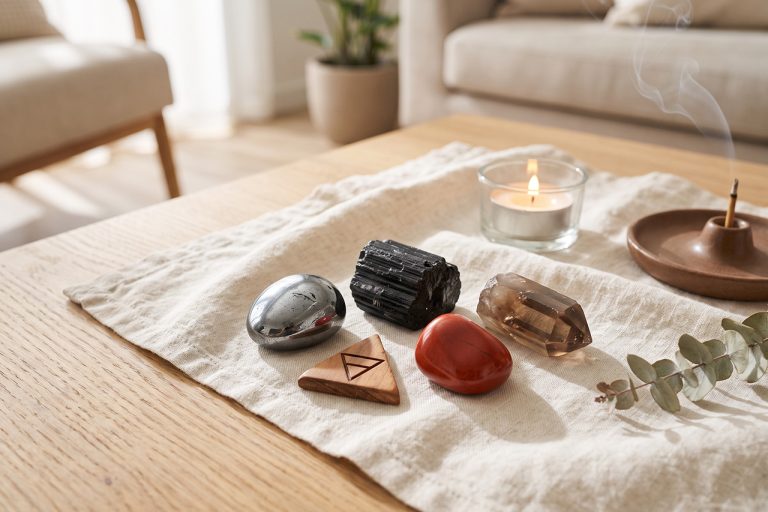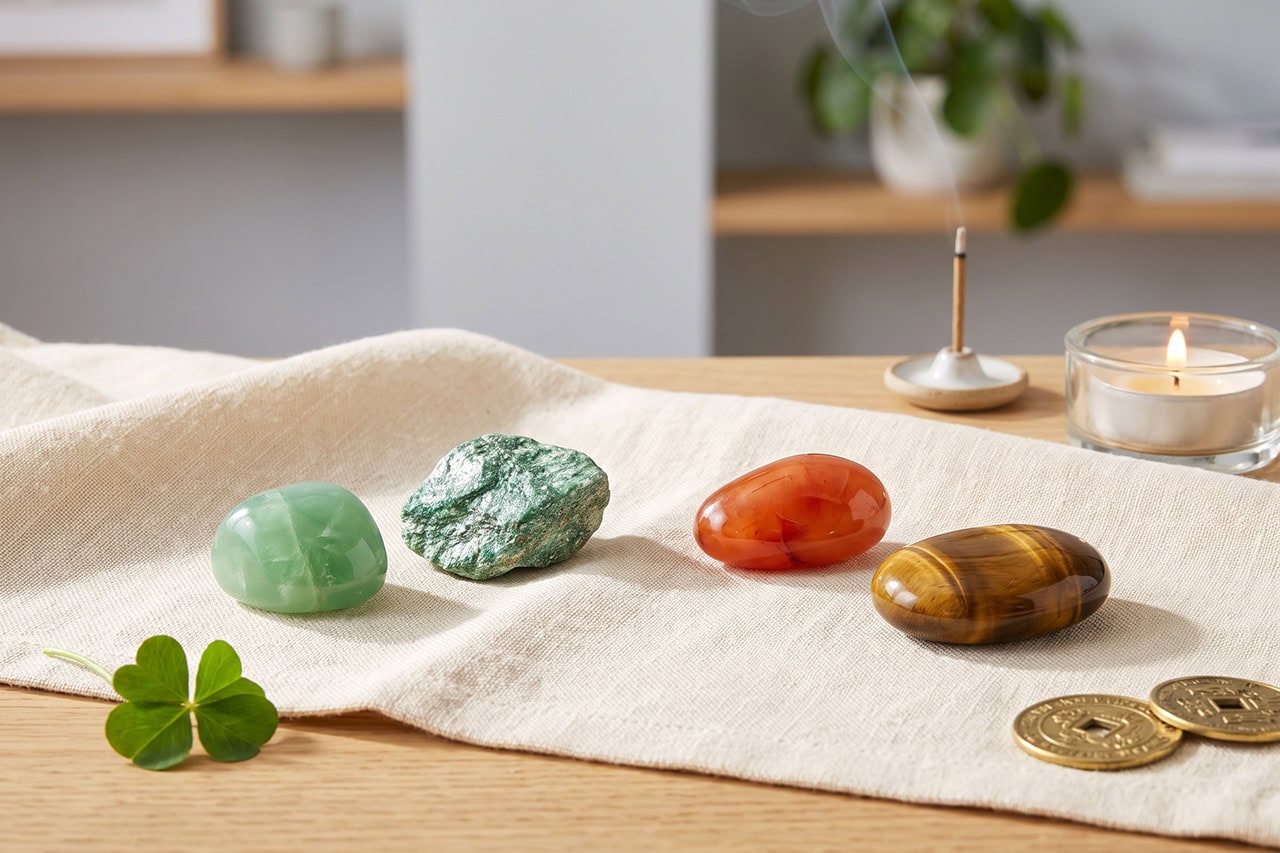
Ask for a confidence stone and you will be offered tiger’s eye or carnelian, with citrine, sunstone, pyrite and bronzite behind them. All six are routed through the solar plexus, the energy centre modern charts associate with personal power.
Walk into a crystal shop with a hard week ahead and there is a whole section waiting for you. Warm colours, gold and orange, and a consistent story attached: these are the stones of will and self-belief, and they belong at the solar plexus, roughly where your ribs meet.
The version that gets practised is smaller and more sensible than the chart makes it sound. Somebody puts a stone in a coat pocket on the morning of an interview, touches it once on the train, and forgets about it until afterwards. That is the whole ritual, it costs nothing, and plenty of people who would not call themselves spiritual do it.
Before buying a second one, though, read the text that centre comes from, and find out what happened the one time anybody measured a carried object.
The shelf, and the reasoning behind it
A shopkeeper asked for a confidence stone tends to reach for tiger’s eye first. Crystal practice reads it for courage under pressure and for holding your nerve in a situation you did not choose, and it is the default answer for a job interview or a difficult conversation.
Carnelian gets a different flavour of the same job. Where tiger’s eye is about steadiness, carnelian is read for initiative: starting the thing, making the call, going first. Practitioners hand it to people who know what they want to do and have not begun.
Citrine is read for openness rather than nerve, the confidence of expecting something to go well rather than bracing for it not to. Sunstone gets warmth and visibility, being seen without flinching. Pyrite gets a harder, more armoured reading. Bronzite, a rarer entry on the list, gets courtesy and self-possession, the version of confidence that does not need to raise its voice.
Those are five or six different psychological states, and the tradition routes all of them through the same place on the body. The chain is short: stone, colour, centre, quality. Warm colour lands a stone at the solar plexus almost automatically, which is how a chatoyant brown quartz, a reddish chalcedony and a yellow quartz end up as neighbours.
Every step of that is a report about what crystal practice holds, and the last step is the one worth pulling on. Where does personal power come from?
What Woodroffe printed
The Serpent Power is where most of this reached English readers. Sir John Woodroffe, writing as Arthur Avalon, published it in 1919: a translation of the sixteenth-century Sanskrit text the Sat-cakra-nirupana, together with its commentaries. The seven-centre chart on the wall of your local shop descends from that book and from the theosophical writing that grew up alongside it.
Start with what is not in it. The text Woodroffe was translating does not assign qualities to the centres at all. He says so directly: “In the description of the Cakras given in this work, no mention is made of the moral and other qualities and things (Vrtti) which are associated with the Lotuses in other books, such as the Adhyatmaviveka.” He then prints the list from that other book anyway.
Then look at what the list says. The navel lotus, manipura, has ten petals and ten qualities attached, and Woodroffe’s own English gloss reads: “Shame, treachery, jealousy, desire, supineness, sadness, worldliness, ignorance, aversion (or disgust), fear.”
Ten of ten are faults. Shame and fear are among them, and nothing resembling confidence, self-esteem or personal power appears in that list or in the verses describing the centre.
Then the sentence immediately before it, which is what makes the list make sense: “Thus the bad Vrttis of the lower Cakras pass away in the Yogi who raises Kundali above them.” Woodroffe adds that the qualities of the two lower centres are all bad, those of the heart mixed, those of the Lalana centre predominantly good and those of the Soma centre wholly so, “thus indicative of an advance as we proceed from the lower to the higher centres.”
The third centre in the source, then, is not a reservoir. It is a stage, carrying a set of things a practitioner is working to move past, and shame and fear are two of them. The chart on the shop wall reads that stage as a store, which is a different thing entirely.
Woodroffe is not attacking anybody here, and neither is this article. He wrote that the question of the reality and value of this yoga was not one his book was concerned with; he was setting out what the texts say. The centre is named for a gem, as it happens. The Gautamiya-Tantra, which he quotes, says it “is called Manipura because it is lustrous like a gem.”
The one experiment about a carried object
The research on whether a carried object helps performance is thin, and the best-known piece of it has a design nobody expects.
In the studies behind Lysann Damisch’s 2010 work, one experiment concerned a lucky charm, and it did not hand anybody a charm. Only people who already owned one were invited, they were asked to bring it, the experimenter took it away to photograph it, and it came back to half of them. What moved was the participants’ rating of their own likely success, from 5.10 to 6.64 on a nine-point scale, and their score on a memory task, by about half a standard deviation.
What did not move is the part to hold on to. Their mood did not differ significantly. Nor did their sense of the task’s importance, nor their own estimate of how well they had just done. In an earlier golf experiment in the same thesis the point is made flatly: participants did not notice the difference in their own performance. And in a three-arm golf study, the lucky label beat the control, 6.42 against 4.75, while the unlucky label did nothing at all, 4.79 against the same control. The effect was all on the upside, and the people it happened to could not feel it.
The follow-up matters too. Two larger preregistered replications went after the golf-ball version and did not find it. In their authors’ words, “the effect of superstition on performance is elusive: Participants told they had a lucky ball performed almost identically to controls.”
Put the two halves together and they point the same way. The source text treats the third centre as something you pass through. The one measurement anybody made ran through what the person already believed about their own chances, and it did not survive a bigger test. Neither describes a stone as a supply of anything.
Leave it at home once
Here is the useful thing to take from that removal experiment, and it costs nothing.
Leave it at home once, on purpose. Pick an ordinary occasion, not the interview, and go without the stone you have been carrying, and notice what you do instead. Damisch found out what a charm was worth by taking it away from people, and you can run the same test on yourself for the price of one slightly uncomfortable Tuesday.
You will get one of two answers, and both are useful. Either the day goes exactly as it would have done, in which case the stone is a pleasant object rather than a load-bearing one and you can stop worrying about losing it. Or you find yourself reaching for the pocket, in which case you have learned something real about what the ritual is doing, and you can build on it deliberately rather than by accident.
And take the source’s version of that centre as good news. Shame and fear are on the list because the text treats them as things a practitioner moves past, which is a kinder account of a hard week than a chart promising a reservoir of power you are apparently failing to draw on. As for what tiger’s eye, carnelian and citrine are as objects, chatoyant quartz, iron-stained chalcedony and yellow quartz among them, that is the Crystalance Mineral Library.
Sources
- Avalon, A. (Sir John Woodroffe), The Serpent Power: Being the Sat-cakra-nirupana and Paduka-pancaka, first published 1919; read in the Dover reprint of the seventh edition and cross-checked against the fourth edition, Ganesh & Co., Madras, 1950, which shares its pagination. For the statement at p. 138 that the text translated makes no mention of the Vrttis; for the ten Vrttis of Manipura and Woodroffe’s gloss at p. 139; for “Thus the bad Vrttis of the lower Cakras pass away in the Yogi who raises Kundali above them” and the progression through the higher centres at p. 140; for the Gautamiya-Tantra on the name at p. 370; and for the preface to the third edition on the book’s scope: archive.org
- Damisch, L., Keep your fingers crossed! The influence of superstition on subsequent task performance and its mediating mechanisms, doctoral dissertation, Universität zu Köln, for the lucky-charm study in which only existing owners were recruited and the charm was removed and returned to half of them, for self-efficacy of 6.64 against 5.10 and the memory-task difference of about half a standard deviation, for mood, perceived task importance and self-rated performance not differing significantly, for the three-arm golf study returning 6.42 for the lucky ball and 4.79 for the unlucky against a control of 4.75, and for participants not noticing the difference in their own performance in an earlier golf study. The published 2010 article in Psychological Science is paywalled and was not consulted; the figures above come from the dissertation: kups.ub.uni-koeln.de
- Calin-Jageman, R. J. and Caldwell, T. L., “Replication of the Superstition and Performance Study by Damisch, Stoberock, and Mussweiler (2010)”, Social Psychology 45(3), 2014, pp. 239 to 245, for two high-powered preregistered replications of the lucky golf ball experiment, and for the finding that the effect is elusive and that participants told they had a lucky ball performed almost identically to controls. Quoted from the published abstract: doi.org