
Adamite
Arsenate
Yellow, green, violet, pink, colorless, white
Vitreous to adamantine
3.5
4.32 - 4.48
Orthorhombic
Mexico (Ojuela Mine), Greece (Laurion), Chile, Namibia (Tsumeb)
Uncommon to rare in fine specimens
Zn₂(AsO₄)(OH)

In 1824 a French mineralogist named Gilbert-Joseph Adam picked up some specimens at the Veta Negra Mine in Chañarcillo, in the Atacama Desert of Chile. They sat, as specimens do. Forty years later Charles Friedel got round to analysing them, found a zinc-rich mineral that was not olivenite, and published the description in 1866. He named it adamite, after the man who had supplied the material.
That is worth getting right, because a lot of pages say Adam discovered and identified it himself. He did not. He collected it. Friedel did the chemistry, four decades later, in Paris, from a drawer.
Adamite is a basic zinc arsenate. Two zinc atoms, one arsenate group, one hydroxyl. It forms as a secondary mineral in the oxidised zone of hydrothermal deposits that carry both zinc and arsenic, which is a narrow enough set of conditions to explain why the good localities are few and famous. Ojuela in Mexico. Lavrion in Greece. Tsumeb in Namibia. Each one an old, heavily worked ore body where the upper levels sat and weathered for a long time before anyone dug them.
The arsenate part of that formula is not a technicality, and it is the reason this page reads differently from most crystal pages about most minerals. Arsenic is a structural component here, not a trace impurity. It is roughly a quarter of the mineral by weight, bound into the crystal lattice, chemically stable while the specimen is dry and intact. That last clause is doing a lot of work. Everything in the care and usage sections below follows from it, and quite a lot of what circulates online about adamite does not.
What draws people to it is the colour. Cuprian adamite from Ojuela is an electric yellow-green that photographs almost badly, in the sense that pictures of it look edited when they are not. Cobaltian material runs pink to violet. Plain adamite is honey-yellow and, in good crystals, glassy and sharp. The rosettes and radiating fans it forms on limonite matrix are among the more photogenic things in secondary mineralogy.


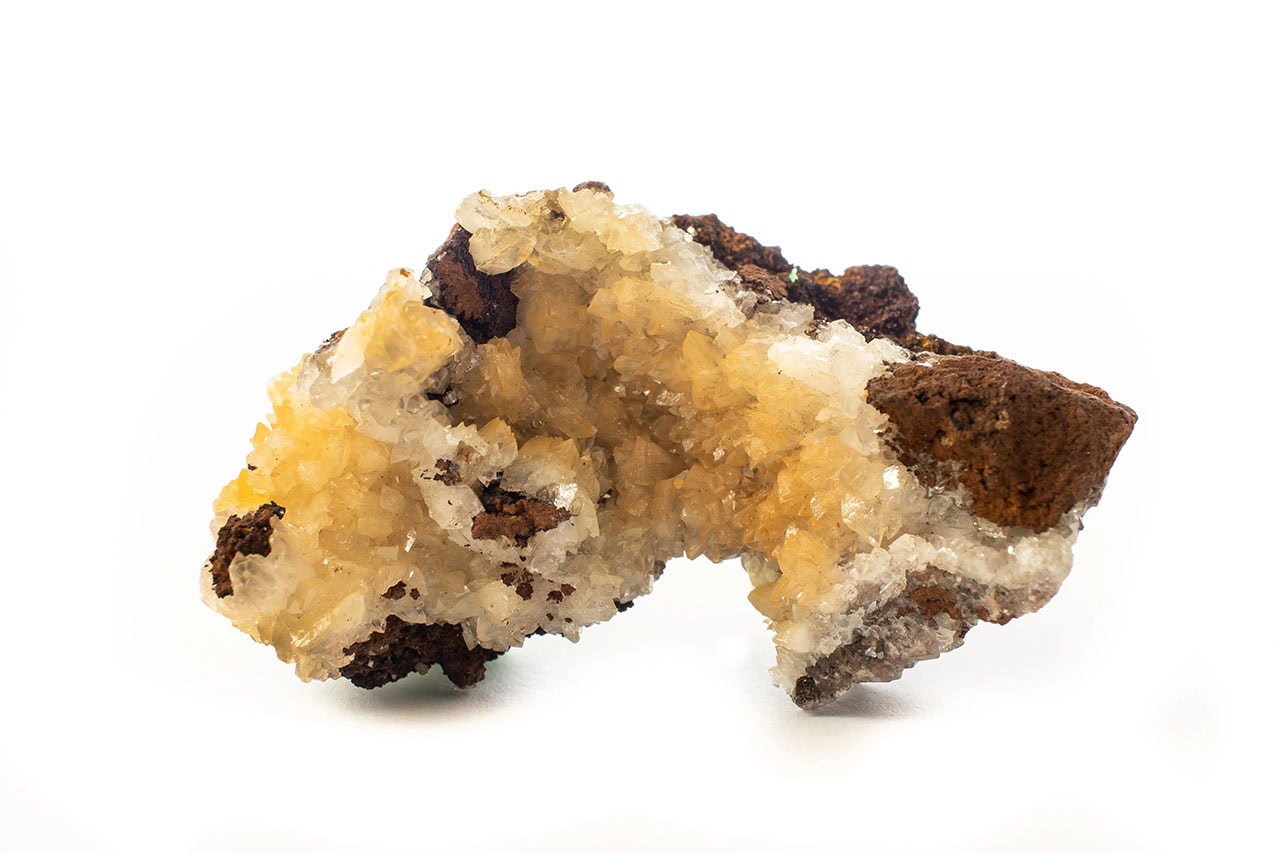
TABLE OF CONTENTS
Properties & Qualities
Physical Properties
Adamite reveals itself as nature's chameleon, shifting through a spectrum of colors that would seem impossible for a single mineral species. In its purest form, adamite crystallizes as colorless or pale yellow wedge-shaped crystals, but trace elements transform it into something far more dramatic.
Copper creates the famous electric green variety that has made Ojuela specimens legendary. Cobalt produces rare pink to violet hues that command premium prices. Iron can shift the color toward brownish yellows.
The crystals themselves possess an almost supernatural brilliance. Their luster ranges from vitreous (glassy) to adamantine (diamond-like), creating a play of light that seems to pulse from within. Under ultraviolet light, many specimens burst into brilliant green or yellow-green fluorescence—a phenomenon so striking that UV lamps have become standard equipment at adamite localities.
Touch reveals another surprise. Despite their glassy appearance, adamite crystals feel remarkably dense, their high specific gravity making even small specimens feel substantial. Yet they're surprisingly soft, barely harder than calcite, requiring careful handling to preserve their lustrous faces.
In humid conditions, adamite can develop a subtle iridescent film as surface alteration begins. Some collectors actually prize these rainbow-touched specimens, seeing beauty in the mineral's slow transformation.
Metaphysical properties
Within energy healing circles, adamite has earned recognition as what practitioners call a "high-frequency joy stone." Its reported vibrational signature resonates primarily with the solar plexus chakra—the energy center associated with personal power and will—while simultaneously activating the heart chakra.
This dual activation has made adamite particularly valued among crystal workers who describe experiencing both grounding and elevation when working with the stone. Some report that holding adamite creates a sensation of warmth spreading from the solar plexus, accompanied by a lifting feeling around the heart.
Modern metaphysical texts often reference adamite's fluorescent properties as evidence of its ability to "transmute" energy. The theory suggests that just as the mineral transforms UV light into visible light, it can allegedly transform dense emotional or spiritual energies into higher frequencies. While scientifically unverified, this belief has become central to adamite's metaphysical reputation.
Historical evidence for traditional use remains sparse, though anecdotal accounts from Mexican mining communities suggest miners would keep small specimens as talismans for finding ore—perhaps a practical appreciation for a mineral that literally glows under the right conditions.
Meaning & Symbolism
Physical meaning
In symbolic interpretation, adamite represents the principle of inner radiance manifesting outward. Its formation in oxidation zones—where primary minerals weather and transform—mirrors the human journey of turning challenges into growth.
The mineral's association with creativity and productivity stems partly from its solar plexus connection. Practitioners often describe adamite as dissolving the barriers between inspiration and action, making it popular among artists and entrepreneurs who report enhanced creative flow when keeping specimens in their workspace.
The high zinc content has led some alternative health practitioners to view adamite as symbolically connected to physical vitality, as zinc plays crucial roles in immune function and cellular repair. However, it's critical to note that adamite's arsenic content makes it unsuitable for any direct physical application.
Its tendency to fluoresce has been interpreted as representing hidden potential—abilities or talents that emerge under the right conditions, much like the mineral's hidden colors revealed under UV light.
Spiritual meaning
Adamite's spiritual symbolism centers on authentic self-expression and the courage to shine one's inner light. Many practitioners describe it as a "permission stone," helping release fears around being seen or judged for one's spiritual gifts.
The mineral's formation process—requiring specific conditions of oxidation, temperature, and mineral availability—parallels the spiritual concept of divine timing. Just as adamite cannot form until conditions align perfectly, spiritual practitioners see it as a reminder that spiritual unfoldment happens in its own time.
Contemporary spiritual teachers often recommend adamite for those experiencing what they term "spiritual dimming"—when life challenges or societal pressures cause someone to hide their spiritual nature. The stone's literal ability to glow in darkness becomes a powerful metaphor for maintaining spiritual luminosity even in difficult times.
Some practitioners report that meditating with adamite enhances communication with what they describe as higher guidance or one's "higher self," though such experiences remain highly subjective and personal.
Healing Benefits
Physical healing
Traditional and alternative healing practices attribute various physical benefits to adamite, though it's crucial to emphasize these are based on energetic and folk traditions, not medical science. Given adamite's arsenic content, it should never be used in elixirs, placed directly on skin for extended periods, or ingested in any form.
Energy healers often place specimens near (not on) the body, claiming benefits for the endocrine system. Some practitioners specifically mention the thyroid and adrenal glands, suggesting adamite's energy helps balance hormone production. These claims appear to stem from the stone's association with the solar plexus chakra, which some healing modalities link to metabolic function.
Historical accounts from mining regions mention keeping adamite specimens in living spaces to combat fatigue and promote vitality. Whether this arose from the psychological boost of viewing beautiful crystals or attributed energetic properties remains unclear.
Some crystal therapists recommend adamite for those dealing with Seasonal Affective Disorder (SAD), citing its bright appearance and fluorescent properties. While no clinical evidence supports this use, the psychological impact of working with light-associated objects during dark seasons shouldn't be dismissed.
Emotional healing
Adamite's reputation in emotional healing centers on its reported ability to restore joy and enthusiasm after periods of depression or emotional depletion. Practitioners describe its energy as gently dissolving emotional blockages, particularly those related to self-expression and authentic joy.
Many users report that working with adamite helps identify patterns of self-sabotage that dim one's natural enthusiasm. The stone's bright, optimistic appearance seems to translate into its energetic signature, with people frequently describing increased lightness and possibility.
Crystal therapists often recommend adamite for inner child work, suggesting it helps reconnect with states of wonder and playfulness that may have been suppressed. Some report breakthrough moments of remembering what brought them joy before life's responsibilities took precedence.
The mineral is also associated with releasing what practitioners call "inherited emotional patterns". Family or cultural programming that suppresses individual expression. While these concepts lack scientific validation, many find the framework helpful for personal growth work.
Spiritual healing
In spiritual healing contexts, adamite is considered particularly effective for what energy workers term "light body repair." This concept refers to healing disruptions in the subtle energy field allegedly caused by trauma, negative thought patterns, or challenging life experiences.
Practitioners often use adamite in sessions focused on clearing ancestral patterns, particularly those involving suppression of intuitive or creative gifts. The theory suggests that traumas experienced by ancestors can create energetic imprints that affect descendants. A concept that intersects interestingly with emerging epigenetic research, though the energetic interpretation remains unproven.
Some healers report that adamite helps "re-ignite" dormant spiritual abilities, comparing its action to relighting a pilot light that has been extinguished. They describe placing it on or near the solar plexus during healing sessions to restore what they call "spiritual sovereignty. The ability to trust and act on one's spiritual insights.
The stone's formation in oxidation zones has been interpreted metaphysically as representing the transformation of spiritual wounds into wisdom, making it popular for shadow work and integration practices.
Use & Care
How to use
- Meditation enhancement: Hold a small tumbled piece during meditation to amplify inner vision and connect with joy frequencies. Focus on the solar plexus area while visualizing golden light expanding.
- Creative workspace: Place a specimen on your desk or in creative spaces to stimulate innovation and maintain energetic flow. Position where you'll see it regularly for visual inspiration.
- Jewelry application: Wear in pendants or rings (ensure proper sealing due to arsenic content) near the heart or solar plexus for continuous energetic support throughout the day.
- Crystal grid centerpiece: Use as the central stone in grids focused on manifestation, joy, or breaking through creative blocks. Surround with clear quartz points facing outward.
- Bedroom placement: Keep a specimen on bedside table for dream enhancement and morning vitality. Ensure room is well-ventilated due to arsenic content.
- Chakra layouts: During energy healing sessions, place over solar plexus (with barrier cloth) for confidence and personal power work. Limit to 15-20 minute sessions.
- Visualization tool: Gaze into the crystal structure during visualization exercises to enhance clarity of intention and strengthen manifestation work.
- Sacred space anchor: Display larger specimens on altars or in meditation rooms to maintain high vibrational frequency in the space.
- Phototherapy: Some practitioners use adamite under UV light during meditation, though eye protection is essential.
How to cleanse
- Moonlight bathing: Place under full moon overnight for gentle energetic cleansing. Particularly effective for emotional healing work.
- Sound cleansing: Use singing bowls, bells, or tuning forks to clear energy through vibrational resonance. Circle the sound tool around the specimen.
- Sage smudging: Pass briefly through sage or palo santo smoke. Ensure excellent ventilation and don't oversaturate with smoke.
- Selenite charging: Rest on a selenite plate or wand for 4-6 hours to neutralize and purify accumulated energies.
- Visualization clearing: Hold the stone while imagining brilliant white light flowing through it, carrying away any stagnant energy.
- Brown rice burial: Nestle in a bowl of organic brown rice for 24 hours. The rice allegedly absorbs negative energy (dispose of rice afterward).
- Reiki cleansing: Use Reiki symbols (especially Sei He Ki) to clear and purify the stone's energetic field.
- Breath work: Hold near mouth and use conscious breathing to blow away old energy, imagining it dispersing like smoke.
- Never use water: Avoid all water-based cleansing due to arsenic content and potential structural damage.
How to charge
- Morning sun exposure: Place in gentle morning sunlight for 5-10 minutes maximum to activate solar properties without color fading.
- Crystal cluster charging: Rest on clear quartz or amethyst cluster overnight to amplify and restore energetic potential.
- Earth burial method: Wrap in natural cloth and bury in clean, dry soil for 24-48 hours for deep earth recharging.
- Pyramid charging: Place inside a copper or crystal pyramid structure for 3-7 days for concentrated energy amplification.
- Intentional programming: Hold while clearly stating specific intentions, visualizing the energy anchoring into the crystal structure.
- Sound frequency charging: Use 528 Hz tuning forks or recordings to charge with the "love frequency."
- Breath work activation: Practice pranayama while holding the stone, breathing your intentions into its matrix.
- Grid charging: Place within an activated crystal grid specifically designed for charging for 3-7 days.
- Lunar charging: Expose to new moon energy for new beginnings or full moon for maximum power.
Combining with other stones
- Clear Quartz:Amplifies adamite's joyful frequency while adding clarity and focus to its energy. Creates powerful manifestation combination.
- Citrine:Natural partnership for abundance work, combining adamite's creative spark with citrine's prosperity vibration.
- Moldavite:Accelerates spiritual transformation while adamite keeps you grounded in joy rather than overwhelm.
- Rose Quartz:Balances heart-centered compassion with solar plexus confidence for authentic self-love.
- Pyrite:Grounds adamite's high frequency into practical success and material manifestation.
- Celestite:Enhances connection to angelic guidance while maintaining earthly joy and enthusiasm.
- Sunstone:Doubles the solar energy for maximum vitality, leadership, and positive outlook.
- Green Aventurine:Combines heart healing with emotional uplift for complete heart chakra activation.
- Carnelian:Adds creative fire and sexual vitality to adamite's joyful expression.
Identification
Can be mistaken for
- Olivenite:Similar apple-green color in copper-bearing specimens, but olivenite has different crystal structure (monoclinic vs orthorhombic) and forms more prismatic crystals.
- Smithsonite:Can show similar colors and botryoidal forms, but smithsonite is zinc carbonate with different luster and no fluorescence.
- Hemimorphite:Blue-green varieties might resemble adamite, but hemimorphite has different crystal terminations and no UV fluorescence.
- Prehnite:Green varieties can look similar, but prehnite has lower specific gravity and different crystal habit.
- Austinite:Another arsenate that can be visually similar, but forms in different crystal system (orthorhombic but different space group).
- Conichalcite:Green copper calcium arsenate that resembles cuprian adamite, but has different crystal structure and calcium content.
- Legrandite:Yellow varieties can be confused with yellow adamite, but legrandite has different crystal angles and habit.
How to spot a fake
- UV light test:Genuine adamite typically fluoresces bright green or yellow-green under short-wave UV. No fluorescence suggests possible fake.
- Weight assessment:Real adamite feels notably heavy for its size due to 4.3+ specific gravity. Lightweight specimens are suspect.
- Crystal structure examination:Look for characteristic wedge-shaped orthorhombic crystals. Perfect crystals with wrong shape indicate synthetic.
- Price evaluation:Extremely cheap "adamite" especially from non-traditional localities, likely indicates mislabeled smithsonite or dyed calcite.
- Source verification:Genuine adamite comes from specific localities. Question specimens from unusual or undocumented locations.
- Hardness test:Real adamite scratches easily with steel knife (3.5 Mohs). Test inconspicuous area only.
- Color distribution:Natural specimens show subtle color variations and zoning. Perfectly uniform color suggests dyeing.
- Seller credentials:Purchase from established dealers who specialize in arsenates and can provide locality information.
- Surface examination:Look for natural crystal faces and growth patterns. Molded or carved pieces are obvious fakes.