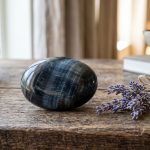

Turquoise is the one to buy. Zircon and tanzanite are also on the current December list, added in 1952 and 2002. Turquoise is the softest of the three, and it is soft and porous enough to take a mark from the person wearing it.
Buy a turquoise and sooner or later somebody will tell you to watch it. The stone is supposed to answer back, dulling when its owner is unwell or being deceived and brightening when things are right. The advice has proved unusually durable, and it survives for a reason that has nothing to do with prophecy. Turquoise does change on a hand.
The original version of the belief promised something blunter. From the thirteenth century on, GIA writes, turquoise was believed to protect the wearer from falling, especially off horses, and to break into several pieces at the approach of disaster. A stone that shatters at the moment of danger is not a stone anybody sits and monitors. Somewhere between that claim and the modern one, the mechanism changed from a single dramatic event to a continuous readout, and the readout is the part that turns out to be real.
What people had to work with
Anyone who wanted to notice that had a very long run at it. Writing for the Metropolitan Museum of Art in 2018, Deborah Schorsch traces Egyptian turquoise back to fragments found in tombs in the el-Qaa region of Sinai, dated to around 5000 BC, which she offers as perhaps the earliest evidence of mining there by local inhabitants. The two important ancient mines, Wadi Maghara and Serabit el-Khadim, left tools, workings, habitation sites and inscriptions recording royal expeditions across the third and second millennia BC. At Serabit el-Khadim a Middle Kingdom temple was dedicated to Hathor, who Schorsch notes sometimes appears in texts under epithets naming her the lady or the mistress of turquoise.
Among the earliest worked pieces are turquoise beads on bracelets taken from the arm of an unidentified woman buried in the tomb of the first-dynasty king Djer at Abydos, now in the Egyptian Museum in Cairo. Seven thousand years, counting from those el-Qaa fragments, is a long time for a soft stone to spend against skin. Whatever a turquoise does on a wearer was there to be watched for the whole of it.
George Frederick Kunz, writing in 1913, gave the ordinary explanation in half a sentence: turquoise “is affected to a certain extent by the secretions of the skin”. He was not offering it as a debunking. He was accounting for how the idea got started, and he noticed something that undercuts the idea anyway, which is that the same power was reported for the ruby and the diamond, stones with none of turquoise’s sensitivity to their wearers.
None of that makes it a foolish thing to have believed. A soft blue stone worn daily against skin does visibly alter, and a person who noticed and drew a conclusion was reasoning from evidence with the instruments available. The conclusion was wrong. The observation was correct, and it is still correct.
Why turquoise changes on a hand
Turquoise is not one crystal. GIA describes it as an aggregate of microscopic crystals forming a solid mass, and the packing of those crystals decides everything downstream: closely packed material is less porous and takes a waxy polish, looser material is more porous and polishes dull. What the stone is made of, a compound of hydrated copper and aluminium phosphate laid down by water moving through rock, is why it arrives full of small spaces at all.
Whatever a porous material sits against, it takes some of it up. GIA puts turquoise at 5 to 6 on the Mohs scale, well down among gem materials, and says the birthstone can be damaged by acids and discoloured by certain chemicals, cosmetics and even skin oils or perspiration. Hand cream and scent and sweat all qualify, and so do the oils that come off skin in ordinary use. A turquoise worn for twenty years is a record of twenty years of being worn, and there is no way back to the colour it started with.
The same porosity settles how well a piece survives being worn. GIA notes that texture affects durability as well as appearance, gives fair to good toughness for the finer-textured material, and says outright that coarse-textured turquoise might have poor toughness too. The loose material is both the one that takes up the most and the one most likely to break.
One piece of standing advice can go. GIA says turquoise is generally stable to light, so the habit of keeping a turquoise out of daylight has nothing behind it in that source. Heat is a different matter, and GIA warns that high heat causes discoloration and breakage. What marks a turquoise is contact with the person wearing it, not the window it sits beside.
Treatment complicates all of this, because much of the turquoise sold has been worked on before it reaches a shelf and a treated stone will not behave the way an untreated one does. That is a separate subject with its own article in turquoise vs howlite, and what turquoise is asked to do once you have a genuine piece is set out in what turquoise is good for.
Where zircon and tanzanite come in
Neither of December’s other two stones has much in common with turquoise beyond the colour, and neither has been on the list anything like as long.
Zircon’s claim on attention is geological rather than decorative. Blue zircon is heat treated to get there, and GIA says so on its December page. The larger fact sits outside jewellery altogether. In 2001 Wilde, Valley, Peck and Graham reported in Nature the discovery, among detrital zircons from the Jack Hills of Western Australia, of a grain “with an age as old as 4,404 ± 8 Myr”, about 130 million years older than anything previously identified on Earth. The oldest dated piece of this planet is a zircon crystal, and it is neither blue nor in a ring.
Zircon also has a peculiarity that reads oddly beside turquoise. It often carries radioactive elements as impurities, and GIA says these break down its crystal structure over geological time, in extreme cases leaving material that is practically amorphous. What is unusual is that the damage is not permanent: heating a zircon to high temperatures reverses some of it, and GIA describes high-temperature heat treatment as repairing the damaged structure. Whatever else zircon is, it is a stone with a way back.
Tanzanite is the opposite case, young enough that its finding is inside living memory. Blue stones out of Tanzania were identified as the mineral zoisite in 1962, and GIA dates the location of the primary source, the Merelani Hills, to 1967. The account on its history pages, which GIA introduces as the most common story of the tanzanite mining boom rather than as settled fact, has a Masai tribesman finding violet-to-blue crystals weathering out of the ground and alerting a local fortune hunter, Manuel d’Souza, who registered four claims. Tiffany took the stone on as main distributor, named it after the country and ran a publicity campaign in 1968.
Turquoise has also been mined in the Nishapur district of Iran for more than a thousand years, on GIA’s account, at the far end of a run that began in Sinai. The care advice comes down to keeping turquoise away from what comes off a hand, and that is a harder thing to do than keeping it out of the sun. Where turquoise, zircon and tanzanite sit among the minerals is set out in the Crystalance Mineral Library.
People have asked turquoise for a warning since at least the thirteenth century, and the question was never as strange as it sounds, because the stone was visibly doing something. It was recording what had already happened to it.
Sources
- GIA, December birthstones, on the thirteenth-century belief, turquoise hardness and care, zircon heat treatment and the Merelani Hills: gia.edu
- GIA, turquoise description, on texture, porosity and composition: gia.edu
- GIA, tanzanite history and lore, on the 1967 account and the Tiffany campaign: gia.edu
- Schorsch, Deborah, “Turquoise in Ancient Egypt,” The Metropolitan Museum of Art, April 2018, on the Sinai mines, the el-Qaa fragments, the Djer bracelets and the Hathor epithets: metmuseum.org
- Kunz, George Frederick, The Curious Lore of Precious Stones (1913), chapter II, on the secretions of the skin: gutenberg.org
- GIA, zircon description, on radiation damage to the crystal structure and its reversal by heat: gia.edu
- Wilde, Simon A., John W. Valley, William H. Peck and Colin M. Graham, “Evidence from detrital zircons for the existence of continental crust and oceans on the Earth 4.4 Gyr ago,” Nature 409, 2001, pp. 175 to 178: nature.com