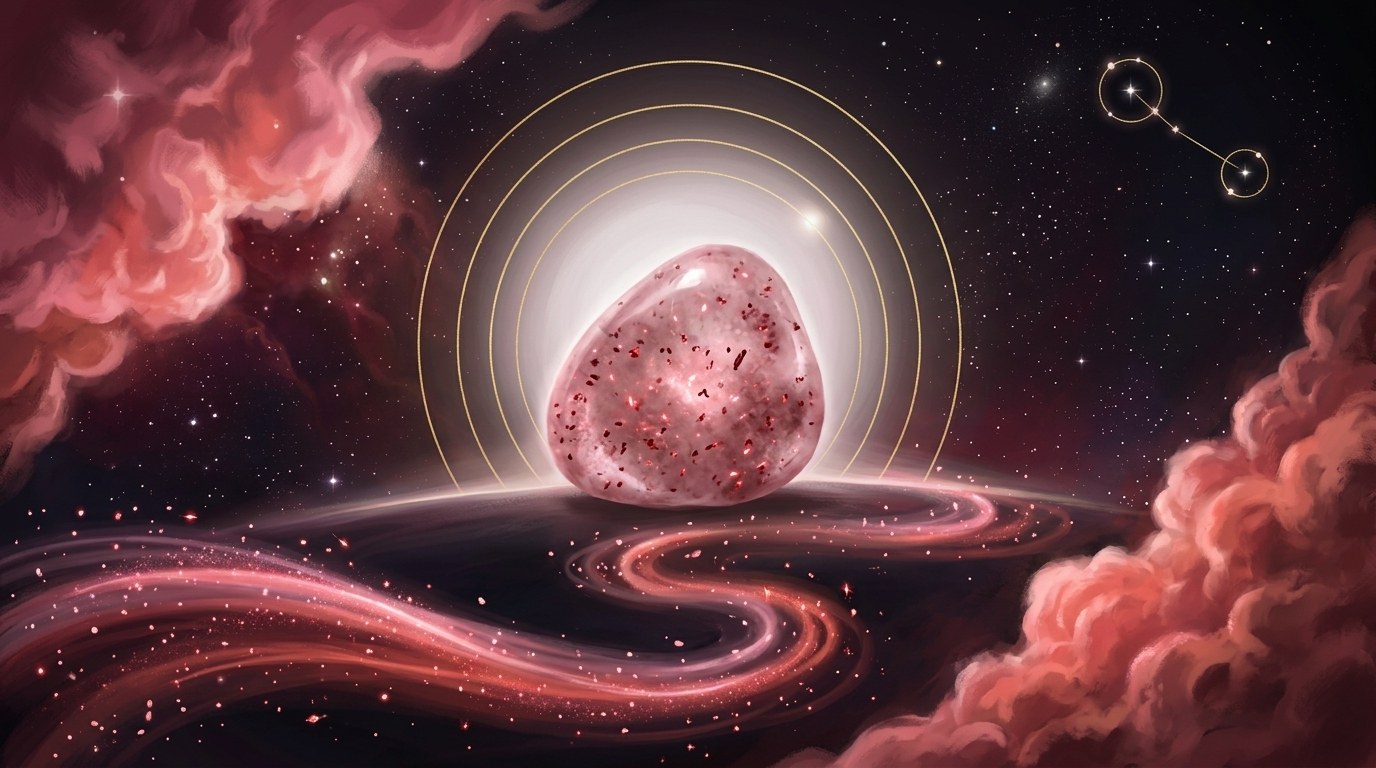
Gratitude is the job strawberry quartz gets in crystal practice, and a settled heart rather than a hungry one. The stone is two minerals, though, and the same tradition already hands each of them a different assignment.
Take the practice reading first, since it is what brings people here. Practitioners file strawberry quartz under the heart chakra, meaning the energy centre associated in this tradition with love and feeling, and then narrow it down. Rose quartz is asked for warmth toward yourself, the receiving end of things. Strawberry quartz gets asked for appreciation of what is already there: the relationship you have rather than the one you want, the week you had rather than the one you planned. Somebody short of self-kindness is pointed at rose quartz. Somebody who has plenty and cannot feel it is pointed here.
That reading is coherent and it is useful, and it belongs to the practice rather than to the stone. But run it against the practice’s own filing system and something odd falls out.
Strawberry quartz is quartz with red mineral inclusions, and the red is usually hematite. Crystal practice has firm views about both of those, and it arrived at them separately, long before anybody had a pink included quartz to sell.
What the tradition already says about the two halves
Hematite, in this tradition, is the grounding stone. Practitioners reach for it when somebody is scattered or up in their own head, and the associations round it are steadiness and weight. It is not a heart stone in anybody’s system. It is about as far from the heart’s territory as the practice’s own map goes.
Quartz, meanwhile, is what practitioners call an amplifier: a stone held to strengthen whatever else is present rather than to contribute a quality of its own. That is the whole of its assigned job in most pairings. It carries other people’s signal.
Put those two claims side by side and the tradition has described strawberry quartz without meaning to. A grounding mineral, dispersed through an amplifier. Read by the practice’s own rules, the piece in your hand should be a grounding stone with the volume turned up.
Instead it is sold and read as a heart stone. The heart chakra’s colours are pink and green, this stone is pink, and pink is what anybody sees before they see anything else.
There is no outside authority to appeal to here, and a practice is entitled to file its own stones however it likes. The useful consequence is smaller than a verdict: if you are working with this piece, two readings are available to you, and only one of them is printed on the label.
What the red things are
Hobart King, a graduate gemmologist writing for Geology.com, defines strawberry quartz as a marketing term “used for specimens of pink to red quartz or quartzite that receive their color from eye-visible mineral inclusions.” He names four candidates for the red and ranks none of them: hematite platelets, lepidolite flakes, alurgite and piemontite. He also names two localities the material comes from, Chihuahua in Mexico and the Thunder Bay district in Ontario.
Hematite is the one that keeps turning up when included quartz is put under an instrument. A 2023 note in Gems & Gemology, working on a different trade material, the stuff sold as rabbit hair quartz, reports: “The fibrous red inclusions in sample R1 with peaks at 246, 295, 412, 612, and 1319 cm-1 are hematite.” The yellow inclusions in another of their samples came back as goethite, a close relative. One note on two samples is not a rule about every pink quartz on the shelf, but it tells you what the red things in this family tend to be.
Hematite is iron oxide, the red in red jasper and in a great deal of red sandstone, and a relative of rust rather than the same substance, since rust is mostly hydrated iron oxyhydroxides. The Handbook of Mineralogy gives its streak as cherry-red or reddish brown and its hardness as 5 to 6, with habits running complex rhombohedral, sometimes thin tabular, sometimes micaceous or platy. The entry also lists it as opaque but transparent on thin edges, which is how a mineral that reads steel grey in a lump reads bright red where it is thin enough for light to get through.
One thing none of that will settle for you is whether a given stone is natural. King says the commonest imitation is “made by melting glass and mixing in particles of hematite or another red material”, and his next sentence is the one to read: “When made skillfully, imitation strawberry quartz can have a very attractive color and a convincing scatter of inclusions.” The trade has been dressing quartz up under this name for decades, too. A Gems & Gemology Gem News item from the autumn of 1996 records a Californian dealer showing surface-coated quartz crystals at Tucson in colours imitating amethyst, citrine, prasiolite and red strawberry quartz, the coatings carrying gold, bismuth, lead, chromium, titanium and smaller amounts of calcium, potassium and iron. A convincing scatter is exactly what an eye test would be looking at, so an eye test cannot do this job and chasing it turns a pleasant object into an anxiety.
Working it as a pair
Stop treating your piece as one stone with one job and start treating it as two things that arrived together, then ask which of the two you came for. Wanting the gratitude reading means working with the pink, which is to say asking hematite to do something the tradition does not otherwise ask of it. That is a reasonable thing to want, as long as you know it is what you are asking. Steadiness is the easier case, because the material is already grounding by the practice’s own account and nobody has to give you permission to use it that way.
Some pieces make the choice easier than others. A stone with heavy, obvious flecking is visibly a hematite stone; one where the red has dispersed into an even blush reads pink first and mineral second. Neither is better. They point in different directions, and you can pick the one that points where you are going.
The one thing to keep off it is an expectation borrowed wholesale from rose quartz. Those two are different objects with different contents, whatever the shelf they share suggests. For how they sit alongside each other and what else goes with them, what goes well with rose quartz covers the pairings. Hematite and quartz each have a page in the Crystalance Mineral Library.
Sources
- King, H.M., “Strawberry Quartz”, Geology.com, for strawberry quartz as a novelty gem and marketing term for pink to red quartz or quartzite coloured by eye-visible mineral inclusions, for the four named inclusion minerals hematite, lepidolite, alurgite and piemontite with none of them ranked, for the Chihuahua and Thunder Bay localities, for the most common imitation being made by melting glass and mixing in particles of hematite or another red material, and for the sentence immediately following it, that a skilfully made imitation can have a very attractive colour and a convincing scatter of inclusions: geology.com
- Zhang, Q., Rui, S., Li, X. and Zheng, J., “Special Hair-Like Inclusions in Quartz”, Gems & Gemology Gem News International 59:2, 2023, for the Raman identification of the fibrous red inclusions in sample R1 as hematite at 246, 295, 412, 612 and 1319 wavenumbers and of the yellow inclusions in sample Y2 as goethite at 305, 394 and 694, in material sold as rabbit hair quartz rather than as strawberry quartz: gia.edu
- Handbook of Mineralogy, hematite, for the streak given as cherry-red or reddish brown, the hardness of 5 to 6, the complex rhombohedral, thin tabular, micaceous and platy habits, and for the entry recording hematite as opaque but transparent on thin edges: handbookofmineralogy.org
- Gems & Gemology Gem News, Fall 1996, pp. 214 to 222, edited by Mary L. Johnson and John I. Koivula, for the coated quartz crystals shown at Tucson in 1996 by Rock Currier of Jewel Tunnel Imports imitating amethyst, citrine, prasiolite and red strawberry quartz, and for the coatings containing gold, bismuth, lead, chromium, titanium and lesser amounts of calcium, potassium and iron as determined by EDXRF spectroscopy: gia.edu