Yes, palo santo (Bursera graveolens) is traditionally used for protection in several South American Indigenous traditions, particularly among Quechua peoples in Peru and Ecuador. The aromatic wood, when burned, produces a warm citrusy smoke used for purification, clearing, and protective ritual. Modern crystal and spiritual practice has adopted palo santo widely, often without acknowledging its Indigenous source or the conservation concerns around current harvesting. The respectful version uses it with awareness of both. Here is the working guide.
The “does palo santo protect?” question gets asked in several forms (can palo santo be used for protection, is palo santo good for protection) all pointing at the same practice. The honest answer needs to cover the protective use, the cultural context, and the sourcing question. Here is the working version.
What Palo Santo Actually Is
Palo santo translates from Spanish as “holy wood” or “sacred wood.” It refers specifically to Bursera graveolens, a tree in the same Bursera family as the copal-producing trees of Mesoamerica. Palo santo grows in dry tropical forests across South America (Ecuador, Peru, Bolivia) and parts of Central America (Mexico, Costa Rica, Guatemala).
The wood is aromatic on its own (the heartwood contains aromatic resinous compounds) and produces a distinctive warm, slightly citrusy, slightly woody smoke when burned. The aroma is different from copal (which is the resin of a related tree, producing a sweeter and more incense-like smoke) and from sage (which is a herbaceous plant with a more herbal aroma).
Palo santo has been used for thousands of years in Andean Indigenous traditions, particularly among Quechua-speaking peoples, for ceremonial purification, healing rituals, and protective practice. The Catholic missionaries who arrived in South America in the 16th century recognised its sacred status (and gave it the name “palo santo,” which has stuck even in Indigenous use today).
Is Palo Santo Good for Protection
In the source traditions, yes. Palo santo has a specific protective role in Quechua and other Andean ceremonial practices, used to clear difficult energy from spaces, from objects, and from people. The protective use is one of palo santo’s primary traditional applications.
In modern crystal and spiritual practice, palo santo is one of the most widely-used smoke-cleansing materials, often paired with crystals for protective intention work. The protective claim is the same as for white sage, copal, or other smoke-cleansing materials: the smoke is said to clear negative or stagnant energy and create a protected space.
The honest version is the same as for other smoke practices. The energetic-protection mechanism is belief-based. The aromatic and ritual experience is real. The practice of moving through a space with smoke and directing protective intention is meaningful as practice regardless of any measurable energetic shift.
Can Palo Santo Be Used for Protection
Yes, with two layers of awareness.
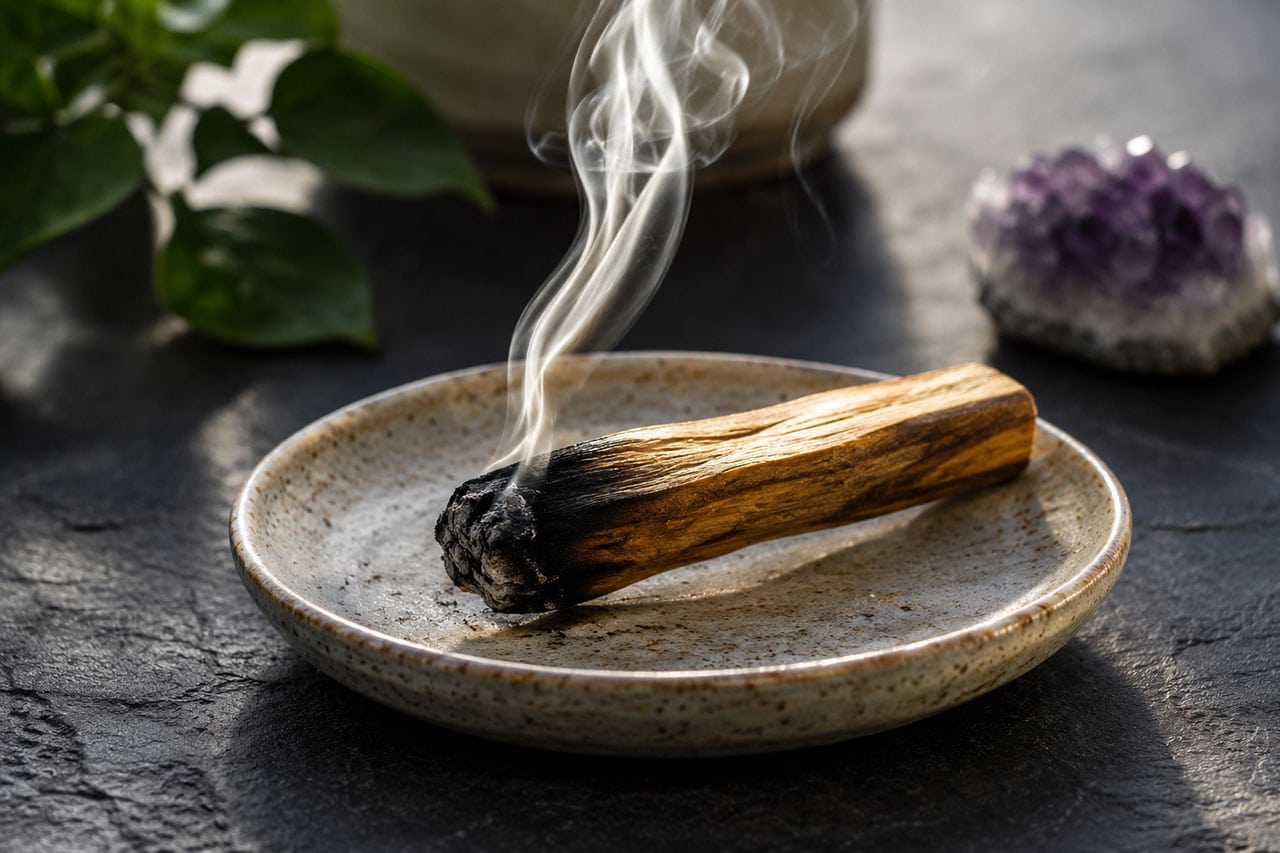
The practical layer. Palo santo smoke is the ritual medium. The practitioner lights a small stick (or piece) of palo santo, lets the flame catch and then blow it out so the wood smoulders, and uses the smoke for the protective practice. Move the smouldering stick around the space (room, doorway, body, object) with the intention of clearing and protecting. Extinguish on a heat-safe surface when finished.
The awareness layer. Palo santo is sacred in specific living traditions and is currently the subject of both conservation and cultural-source concerns. Using palo santo as a generic “protection wood” disconnected from its source traditions and supply-chain reality is the version that draws appropriation critique. Using it with awareness of both is the version that holds up.
A Working Palo Santo Practice for Protection
A simple working sequence.
Set the intention. Briefly state what protection means for this particular use. “I clear this space of difficult energy and protect it for the work I am doing here.” Specificity helps.
Light the wood. Hold a small palo santo stick or piece in a flame until the wood catches. Let it burn for 10 to 20 seconds, then blow out the flame, leaving the wood smouldering.
Use the smoke. For a space, walk around the perimeter and pause at corners and entryways. For an object (crystal, ritual tool), pass the object briefly through the smoke. For a person, gently waft the smoke around the body. The intention guides the directing.
Extinguish. Set the smouldering stick on a heat-safe surface (ceramic dish, abalone shell with sand, dedicated incense holder) and let it self-extinguish. Palo santo typically stops smouldering within a minute or two when no longer fanned. Confirm the stick is fully out before leaving the space.
Reuse. A single palo santo stick can be relit and used many times. The same stick can serve weeks or months of regular practice.
The Conservation Question
A critical practical note. Palo santo (Bursera graveolens specifically) is not currently listed as endangered, but multiple South American organisations and Indigenous communities have raised concerns about unsustainable harvesting practices in some commercial supply chains.
The traditional Indigenous practice is to harvest only naturally-fallen palo santo wood (wood from trees that have died and fallen on their own, after a curing period of years). This ensures the trees are not damaged and the wood develops the full aromatic compounds the tradition values. Sustainable commercial suppliers follow this practice.
Some commercial harvesting practices, however, cut living trees for the wood. This both damages the trees and produces wood with less developed aromatic qualities (the resin compounds develop during the fallen-tree curing period). Living-tree harvested palo santo is also less effective as the ceremonial substance the tradition values.
A responsible buyer asks the seller about sourcing. A seller who can speak to fallen-wood harvesting, can name the supplier or region, or is transparent about Indigenous community involvement is sourcing more responsibly. A seller who has no specific answer is sourcing from an unspecified pool that likely includes living-tree harvest.
This is the same buyer-due-diligence pattern that applies to crystals generally. See how to buy crystals without getting ripped off for the broader logic.
On Respectful Use
Palo santo, like copal and white sage, is a sacred material from living Indigenous traditions adopted into modern Western spiritual practice. The respectful version is similar across these materials.
Source carefully. Prefer suppliers who indicate sustainable fallen-wood harvest and ideally Indigenous-community involvement.
Acknowledge the source tradition. The brief recognition that you are using something with deep Andean Indigenous roots is the start of respectful engagement. The acknowledgement need not be elaborate.
Avoid claiming to perform specific Indigenous ceremonies without invitation. Using palo santo smoke for personal practice is one thing. Claiming to perform Quechua or other specific ceremonial protocols is another.
For more on this conversation generally, see are abalone shells sacred and what is copal incense and how to use it.
Palo Santo Compared to Other Protection Practices
For practitioners who want to do protective ritual but are uncertain about cultural-source questions around palo santo, several alternatives exist.
Crystal protection. Black tourmaline, smoky quartz, obsidian, and hematite are all stones associated with protection in modern crystal practice. See how to use different stones for healing work.
Sound protection. Bells, singing bowls, or chanted tones used with protective intention. See how to cleanse crystals with words and sound.
Other aromatic practices. Frankincense and myrrh (Middle Eastern resins with their own long traditions), rosemary or other locally-meaningful herbs, beeswax candle lighting, and similar practices from one’s own cultural background are all alternatives that avoid the cultural-source question that palo santo raises.
Verbal and breath protection. Stated protective intentions, breath work, or other practices that require no external material. The simplest and most universally accessible form of protection ritual.
The Honest Frame
Palo santo does protect, in the practice tradition’s framing. The aromatic smoke serves as ritual medium for protective intention. The mechanism is belief-based; the practice is real. The cultural-source and conservation considerations are part of using it honestly. Both can coexist with active practice when held with awareness.
For more on the underlying cleansing-and-protection framework, see how to set intentions with crystals. For more on individual stones used in protective practice, see the Crystalance Mineral Library. Palo santo is one of the more meaningful protective ritual substances available in modern practice when used with care. The smoke does its ritual work. The practitioner does the work of using it responsibly.