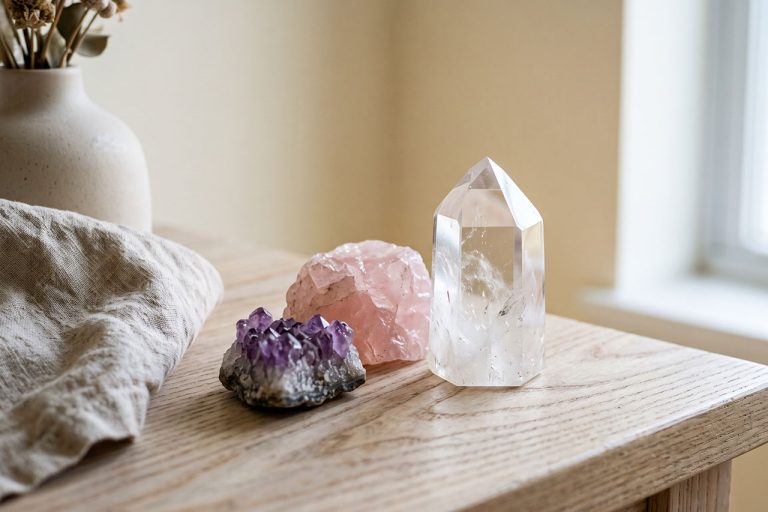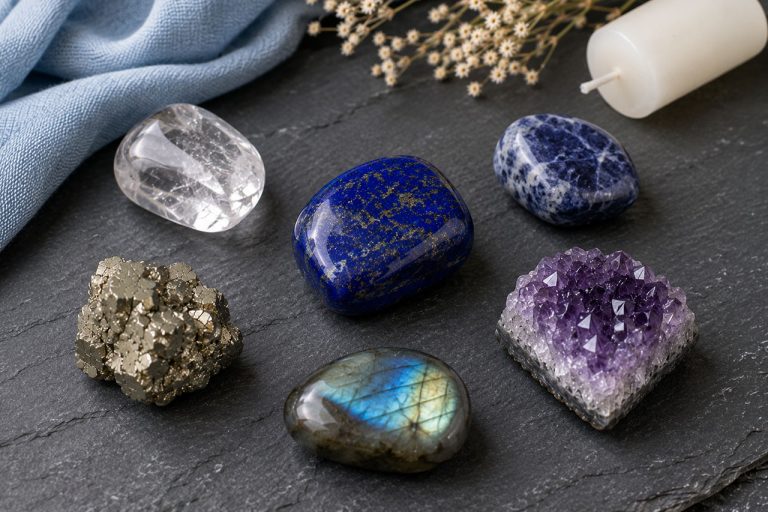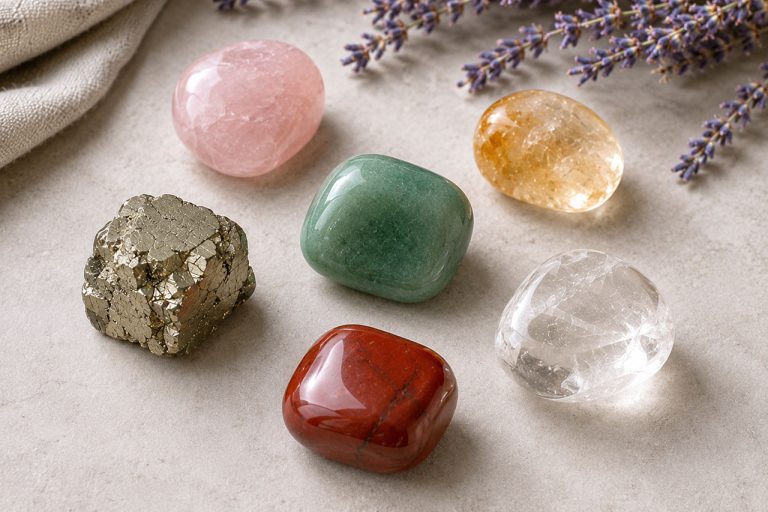
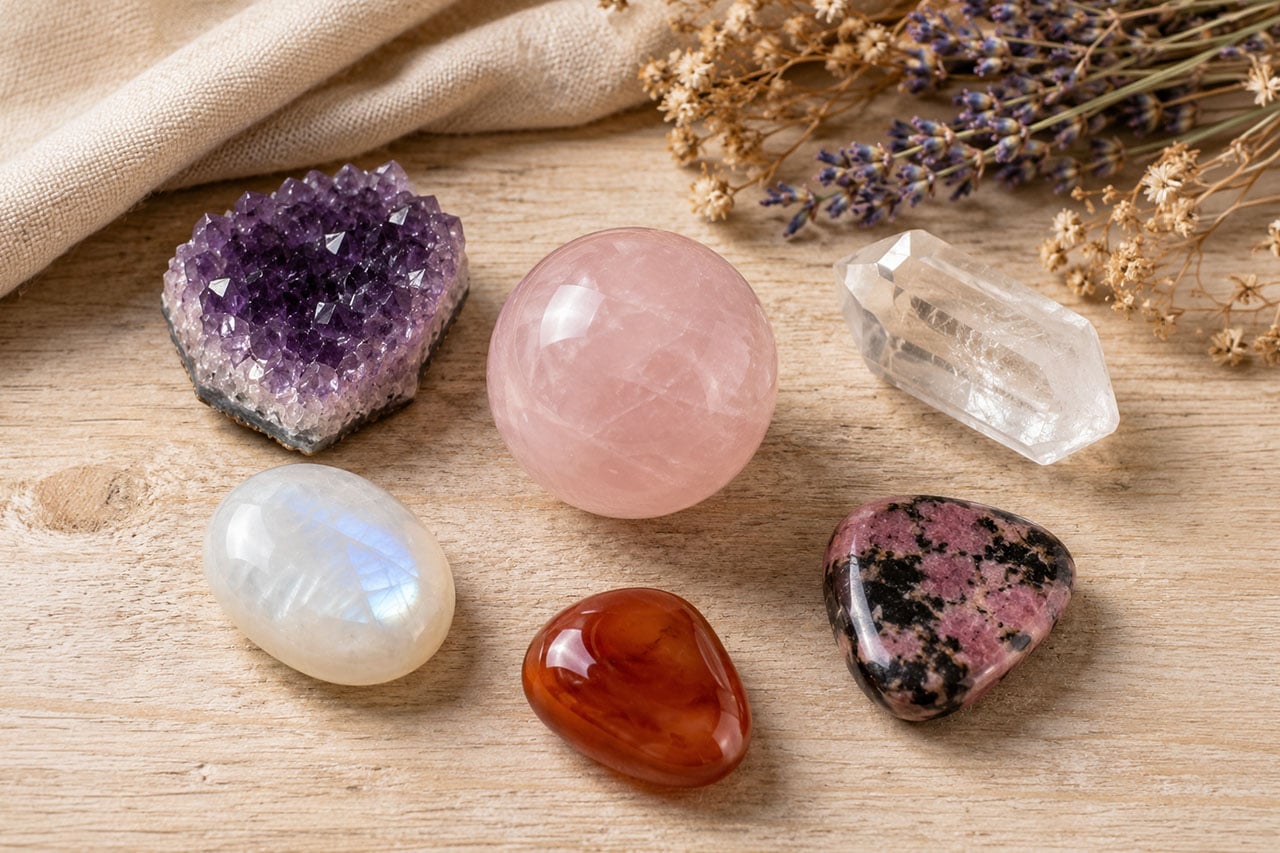
Rose quartz pairs well with amethyst for calm, clear quartz to strengthen it, moonstone for softness and rhodonite for deeper emotional work. It is a gentle, forgiving stone, and its best pairings are the ones that give that gentleness some shape.
Rose quartz is the stone almost everyone owns and hardly anyone chose. It is pink, it is tied to love, and it arrives as a gift or a shop-counter impulse and settles into the collection. The most common thing people say about it afterwards is that they are not sure they feel much from it, and that is one to take seriously, because it is true and it is not a flaw. Rose quartz is the mildest of the popular stones. That mildness is exactly why its pairings carry more weight than most: a partner does not decorate rose quartz, it gives a quiet stone enough definition to notice.
The raw piece on my own shelf is an exception that proves the rule. It is unpolished and unusually saturated, vivid enough to read across a room, which is rare, because raw rose quartz is normally paler and polishing does the work of bringing the colour up. Most rose quartz you will meet is softer and quieter than that, in colour and in character both. The useful question, then, is less what rose quartz goes with and more what you want it to become once it has company.
Match the partner to what you are working on
Rose quartz covers a lot of emotional ground, and the pairing is how you narrow it. Practice reads it broadly as the stone of the heart, which stretches across self-kindness, romantic love, grief and plain everyday warmth, so the partner you add is really you telling the stone which of those you mean.
For calm the standard partner is amethyst, treated in the tradition as quieting and clarifying, and the pair turns up everywhere for sleep, worry and the low-self-worth kind of week. It is the combination people leave on the nightstand, and it is a fair place to begin. Moonstone takes rose quartz somewhere softer and more intuitive, an emotionally intelligent gentleness that sits naturally alongside it, which is why the two come up so often in relationship work. Carnelian pushes the other way, adding warmth and forward motion, so the pair suits confidence tangled together with feeling, the creative or relational kind rather than the plain get-it-done kind.
When you want it to register
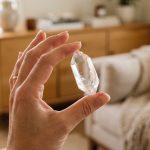
If rose quartz on its own feels like nothing, there are two honest fixes, and both are pairings. The first is volume. Clear quartz is treated in practice as an amplifier, a stone that strengthens whatever sits beside it without adding a character of its own, so next to rose quartz it turns up the warmth the rose quartz already carries rather than changing it. For the many people who find plain rose quartz too faint to feel, this is the simplest thing to try before deciding the stone does nothing.
The second fix is depth rather than volume. Rhodonite shares rose quartz’s heart-centred focus but the tradition points it at the harder material, the old hurt and the slow rebuilding of self-worth. Where rose quartz offers a general softness, rhodonite works on something specific, and together they make a more thorough emotional pairing than either alone. That is the combination for a genuine piece of work rather than a mood. And if neither volume nor depth is what you are after, that is a fair answer too. Rose quartz asks so little that the fair move is sometimes to reach for a stone with more to say.
Living with rose quartz
Physically rose quartz is one of the easiest stones to keep. It is a form of quartz, so it sits at 7 on the Mohs scale of mineral hardness by the Mineralogical Society of America, hard enough to take daily handling without scratching, and it is happy worn, placed or held. The caution you will see everywhere is that rose quartz fades in sunlight, and it is repeated with far more confidence than the evidence supports. The pink in ordinary rose quartz, the cloudy massive material almost everyone owns, comes from microscopic mineral fibres rather than a fragile colour, as Goreva, Ma and Rossman established in American Mineralogist, and that kind of colour holds up well to light. The fading reports attach mostly to the rare transparent crystalline rose quartz, whose colour GIA notes can fade in light and then be restored by irradiation. Your piece is almost certainly the massive kind. Keeping it out of hard, sustained afternoon sun is a sensible precaution, but do not expect it to bleach on a windowsill.
However you use it, the combinations follow the same easy character as the stone. The bedroom is the classic home for rose quartz, and a rose quartz and amethyst pairing on the nightstand is about as widely used a setup as crystal practice has. Worn, it sits comfortably with moonstone or rhodonite, both similarly soft, none of them fighting each other on the wrist.
Rose quartz is one of the few stones that genuinely suits almost anyone at almost any stage, and that is the real reason it ends up everywhere. If you are not sure where to start pairing, start here, and if amethyst is the calm you keep coming back to, what goes well with amethyst picks it up from that side. The Crystalance Mineral Library has the full rose quartz profile when you want it.