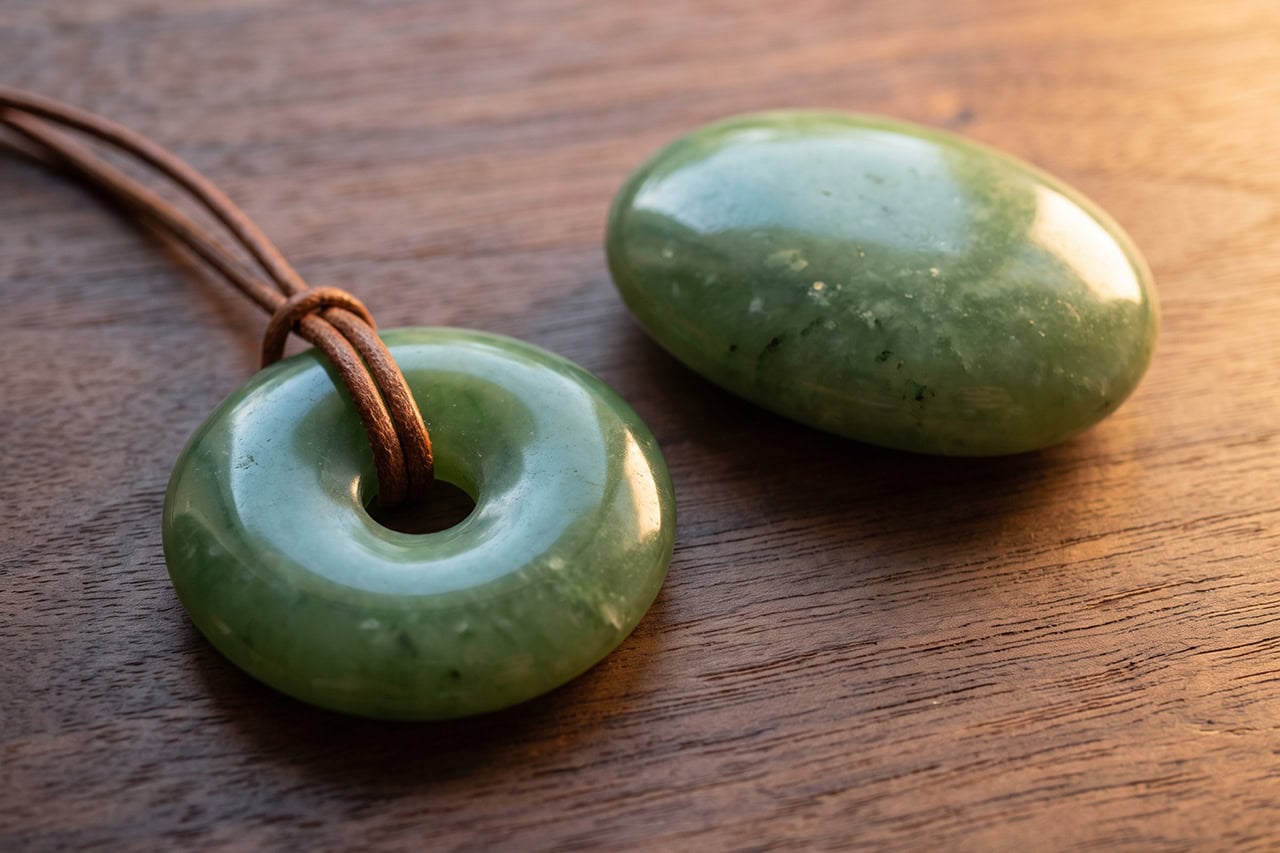
Yes. Crystal practice puts jade at the heart chakra, the energy centre associated with love and emotion, and works with it for steadiness and patience. The tradition that made jade famous was making a different kind of claim about it, and that difference changes what yours is for.
A student asked Confucius why gentlemen prize jade and think so little of soapstone. Was it simply that jade is scarce and soapstone is everywhere?
The answer, as the Book of Rites records it, does not defend jade’s price. It compares. Jade is soft, smooth and glossy, the way benevolence is. It is angular without being sharp enough to cut, the way righteousness is. Its flaws do not conceal its beauty and its beauty does not conceal its flaws, which is what loyalty looks like. Struck, it gives a note that is clear and prolonged and then stops abruptly, and that is music. Hung in beads as though about to fall to the ground, it looks like propriety, or as Legge glosses it, the humility in propriety.
Eleven of these, in the chapter called Pin Yi, and it is a strange list to find at the root of a healing reputation.
What the classic account is doing
James Legge’s translation names eleven and the Chinese carries the same eleven: benevolence, intelligence, righteousness, propriety, music, loyalty, good faith, heaven, earth, virtue, and the path of truth and duty. The last four are not personal qualities at all. Heaven and earth do not belong on a list of things a stone might do for you, and their presence is the first sign that the list is not that kind of list. Other early texts run the same exercise and reach different totals, nine in the Guanzi and seven in the Xunzi, so the number belongs to the version rather than to the mineral.
The thing they share is the grammar. In Legge’s translation every entry arrives as a comparison, and the direction never reverses. The passage sets its own terms in the line that governs the list, that “anciently superior men found the likeness of all excellent qualities in jade”, and after that each quality turns up as like this and like that. Men are doing the finding. Jade is what they are looking at. There is no sentence anywhere in which the stone acts on a person, and the chapter carries no word for healing, curing, protecting, luck or long life.
It closes on the man rather than the mineral, saying that this is why the superior man esteems it so highly. Esteem is something a person does.
A model and a medicine are two different objects. You hold a model up against yourself and find yourself wanting. You take a medicine and wait. The Pin Yi passage is entirely the first sort, and modern crystal healing is built almost entirely on the second.
That does not settle whether Chinese tradition as a whole made medical claims for jade, and the passage should not be stretched that far. The 1911 Encyclopaedia Britannica says in passing that the Chinese believe in jade’s medicinal value and regard it as the symbol of virtue. Both things at once, in one sentence. What the Pin Yi chapter establishes is narrower and firmer: this particular statement of what jade is for contains no medicine in it anywhere.
Jade is a kidney word
The English name did not travel from China. It came the other way across the Atlantic, and it arrived with a medical claim already attached.
Britannica lays the chain out in two sentences. Jade reaches English through French, from l’ejade, from Spanish ijada, the loins, from Latin ilia, the part of the body between the hips and the groin. The stone was known to the Spanish conquerors of Mexico and Peru as piedra de ijada, which Britannica glosses as colic stone. Then: “The reputed value of the stone in renal diseases is also suggested by the term nephrite (so named by A. G. Werner from Gr. νεφρός, kidney), and by its old name lapis nephriticus.”
Merriam-Webster gives nephrite the same origin in one line, from Greek nephros, “from its formerly being worn as a remedy for kidney diseases.” Note what both sources are doing. Britannica says reputed. Merriam-Webster says formerly. Neither is endorsing anything; both are reporting what people held.
The two names your jade answers to therefore carry two different propositions. One compares it to eleven things and asks nothing of it. The other names it after an organ and expects a result, and the organ is not the heart.
Try the exercise the passage describes
The Pin Yi list is not a catalogue of jade’s powers. It is a person looking hard at a physical object and naming what each of its properties resembles, and that turns out to be a method rather than a set of conclusions. It also works better with a stone in your hand than with anything written down.
Take the piece you own. Not jade in general, that particular one. Find a property it has, and be strict about what counts, because strictness is where this collapses if it is going to. A property is something a second person could confirm without being told what to look for. A chip that catches nothing and only shows when the light is behind it counts. The sound it makes when you set it down on a shelf counts, and so does an uneven colour you long ago stopped minding.
The sense that your piece feels somehow patient does not count. That is a conclusion you reached first and then read back into the object, and reading backwards like that is the move the whole passage is built to avoid.
Then say what that property is like. That is the whole of the method: a quality genuinely present in the object, matched to a quality you are trying to hold onto. Angular but not sharp enough to cut is a real description of a real edge, and it is also a real description of a way of arguing with someone you love.
What comes out of that is not a stone that does anything. It is a minute a day spent looking at a specific object and thinking about a specific quality, which is a modest thing and a real one, and it is what the passage was describing before anyone thought to sell it.
None of it turns on which of the two minerals sold under the name you happen to own, a question jade and serpentine takes apart properly, and the Crystalance Mineral Library has the profile when you want it.
The passage never tells anyone what jade will do for them. It ends with a man looking at a stone and thinking better of it, having had to do the looking himself.
Sources
- Li Ji, chapter Pin Yi, translated by James Legge, Sacred Books of the East vol. 28, pp. 463 to 464: archive.org. The parallel Chinese text is at ctext.org, whose English rendering omits Legge’s closing sentence.
- Guanzi, chapter Shui Di, for the nine-quality version: ctext.org
- Xunzi, chapter Fa Xing, for the seven-quality version: ctext.org
- Encyclopaedia Britannica, 11th edition, “Jade”, by F. W. Rudler: wikisource.org
- Merriam-Webster, “nephrite”: merriam-webster.com