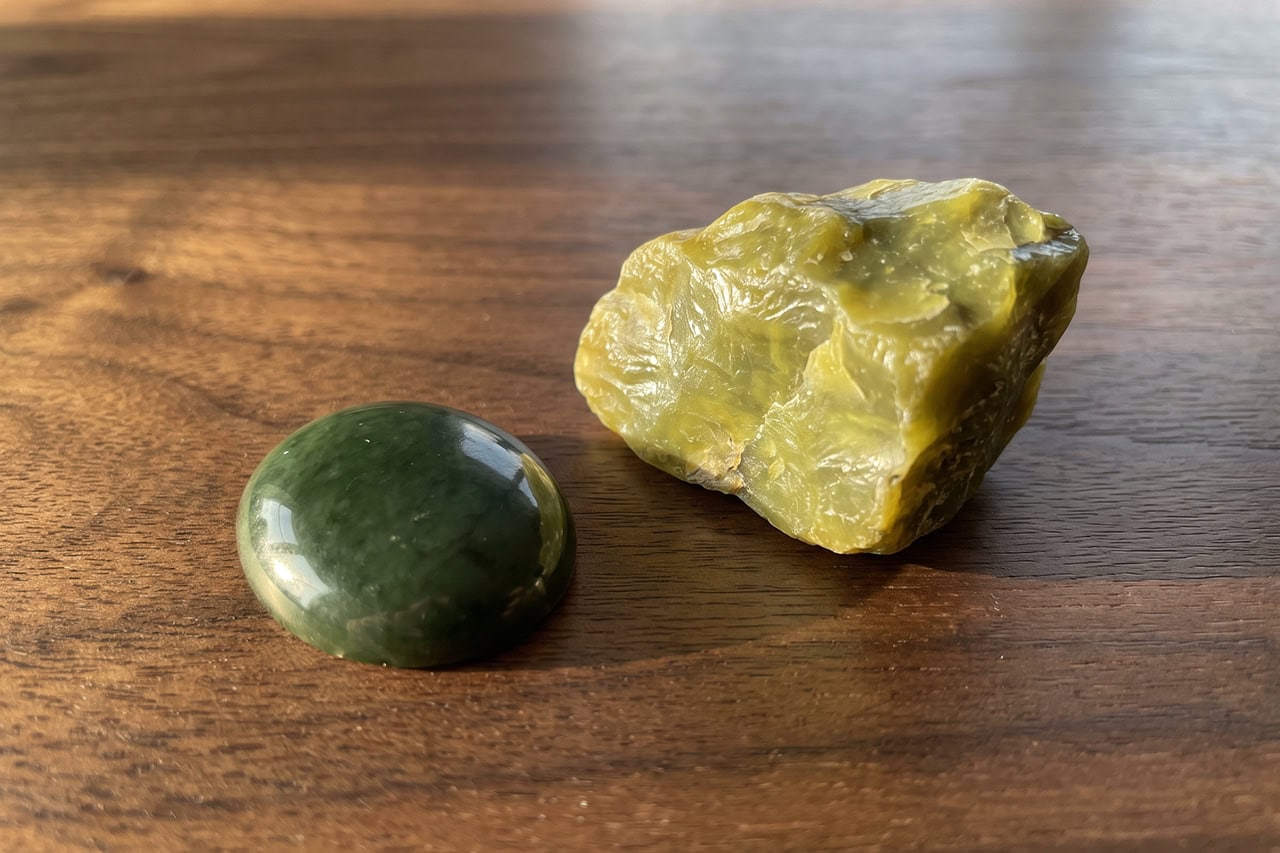
Serpentine is often sold as jade, under trade names like new jade, olive jade and Korean jade, but it is a different and generally softer stone. Real jade is either jadeite or nephrite, both dense and remarkably tough. The reliable checks are hardness, heft and price, and the first clue is usually the name itself.
For most of the time people have valued jade, nobody knew it was two minerals, and the word did not need them to. Jade named a quality first, a green stone hard enough to take an edge and tough enough not to shatter under the hammer, and it named that quality for thousands of years across cultures that never met. Chinese carvers worked it into ritual objects long before anyone in Europe could say what it was made of, and Mesoamerican workshops prized their own green stone on the other side of the world for the same reasons.
The confusion begins there, and it is less about the stones than about a word that was doing a job long before the science caught up with it.
A word older than the mineralogy
Jade is one of those names that describes what a stone does rather than what it is. A material earned the word by being green, dense, and tough enough to survive being carved thin, and that test admitted more than one mineral without anyone noticing or minding. The prestige attached to the quality, not to a chemical formula, which is why the name carried such weight and why it still does.
The reckoning came in the nineteenth century. The French mineralogist Alexis Damour established nephrite as a distinct mineral in 1846, and then in 1863 reported the more surprising half of the discovery, that some of what had always been called jade was a separate species again, which he named jadeite. The single revered material had turned out to be two unrelated minerals that happened to share a look and a name. The tradition had been right that jade was special and wrong only in assuming it was one thing.
The looseness of the category is what lets serpentine in. If the word already stretched across two minerals for want of anyone able to tell them apart, a third green stone with a waxy surface and a plausible heft could slip under the same umbrella with very little effort. It did not need to be disguised. The borrowed name did the work on its own.
Two jades, and then a third stone
Take the two real jades first. Jadeite is a pyroxene, a sodium-aluminium silicate, and it is the rarer and more valuable of the pair. Nephrite is an amphibole, from the tremolite-actinolite series, and it is the one with the longer history in Chinese carving. Both are genuinely jade by every traditional measure, and the distinction between them is the first of the two questions a green stone raises. We look at what practice makes of the material in is jade a healing crystal.
Serpentine is the third stone, and it is not jade at all. It is a group of hydrous magnesium silicates, softer and lighter, often with a smooth greasy or waxy lustre that a careful eye learns to read. Several of its varieties reach the market wearing borrowed names. New jade is the common one, a trade name for bowenite, which is a hard and fairly translucent variety of the serpentine mineral antigorite that resembles nephrite closely enough to pass a quick look. Olive jade and Korean jade are others. The pattern holds well enough to be a rule of thumb: when jade’s name comes with an extra word in front, that word is often the quiet signal that the stone is serpentine.
Serpentine is a real and likeable stone in its own right, worth understanding as itself rather than only as an impostor, and its own place in crystal practice is covered in what serpentine is good for. The trouble is never the stone. It is the stone sold under another’s name and at another’s price.
How the stones themselves differ
Once the names are set aside, a few physical differences separate them, and toughness is the one that made jade jade in the first place. Nephrite in particular is built from densely interfelted fibres, long thin crystals matted together, and that structure is what lets it survive carving that would split an ordinary stone. Toughness is not the same property as hardness. Hardness is resistance to scratching, toughness is resistance to breaking, and jade’s fame rests mostly on the second.
Hardness still helps as a check. Jadeite sits at roughly 6.5 to 7 and nephrite a little below it, around 6 to 6.5, both hard enough to resist a steel blade. Most serpentine is softer and more variable, spread somewhere across the range from about 3 up towards 6, with bowenite at the hard end where it can approach nephrite and defeat a casual scratch test. That overlap at the top is exactly why hardness alone will not settle a bowenite piece, and why the checks work best stacked together. Heft is the next one: jade, jadeite above all, is notably dense and feels heavy for its size, while serpentine tends to feel lighter in the hand. That gap is quicker to feel than to measure, a jade carving sitting heavier than a serpentine one of the same size, which is why experienced buyers weigh a piece in the palm before they do anything else with it. The last is lustre, where serpentine’s smoother, waxier, slightly greasy surface reads differently from jade’s tougher, subtler character, and nephrite can show a faint fibrous, felted texture under good light. Two or three of these together will catch most serpentine sold as jade.
Buying the name, not the stone
Two things are true here at once. There is nothing wrong with owning and enjoying serpentine, which is affordable, pleasant to carve and genuinely attractive, and its new-jade appearance is part of why it sells. Bought as serpentine, at serpentine prices, it is a good stone. What goes wrong is narrower, serpentine offered as jade, at jade’s price, to a buyer with no way to tell.
Serpentine is only the most common of jade’s understudies rather than the only one. Dyed and treated stones reach for the name too, coloured or worked to pass for the real thing, so the lesson generalises well beyond this single pair. The remedy is the plain one throughout. Ask directly whether a stone is jadeite, nephrite or serpentine, and buy from a seller who answers without shuffling. The more a material is revered, the more its look-alikes will borrow its name, and jade is revered as much as any stone on earth.
A green stone in front of you is really asking two questions in order, whether it is jade at all and, if so, which jade. The physical checks answer the first, a scratch and the heft of the thing, before the price is even discussed, and a little knowledge of the trade names answers the second. It holds for any revered material with cheaper look-alikes crowding its name. The Crystalance Mineral Library holds the fuller picture of jadeite and nephrite, for the day a stone arrives with an extra word in front of its name and you want to look twice.
Sources
- geology.com, Jade (jadeite as pyroxene NaAlSi2O6, nephrite as amphibole, toughness versus hardness, Mohs figures): https://geology.com/gemstones/jade/
- Encyclopaedia Britannica, Nephrite (tremolite-actinolite amphibole, interfelted fibrous structure): https://www.britannica.com/science/nephrite
- GIA, “The Jade Enigma” (Damour distinguishing nephrite in 1846 and jadeite in 1863): https://www.gia.edu/dam/migrated-assets/docs/doc1/The-Jade-Enigma.pdf
- Encyclopaedia Britannica, Serpentine (a group of hydrous magnesium silicates): https://www.britannica.com/science/serpentine-mineral