Both, and the pairing is the useful part. Crystal practice puts amazonite at the throat and at the heart, and those two centres are the two halves of one problem, which is working out what you feel and then saying it out loud to somebody.
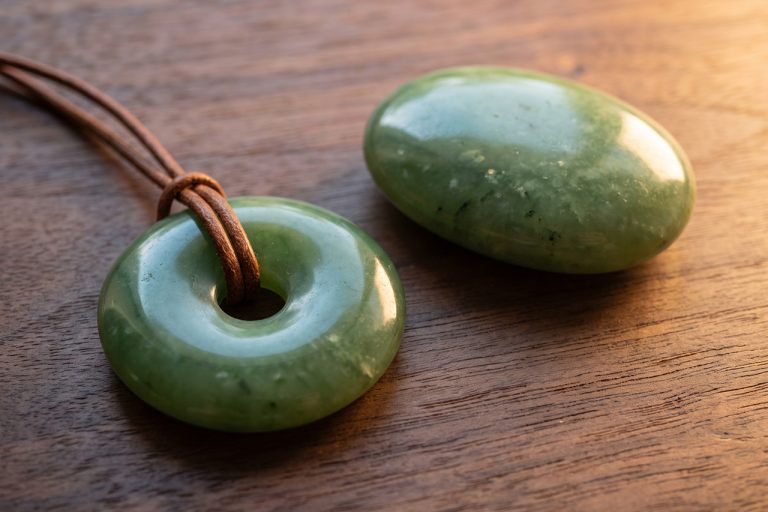
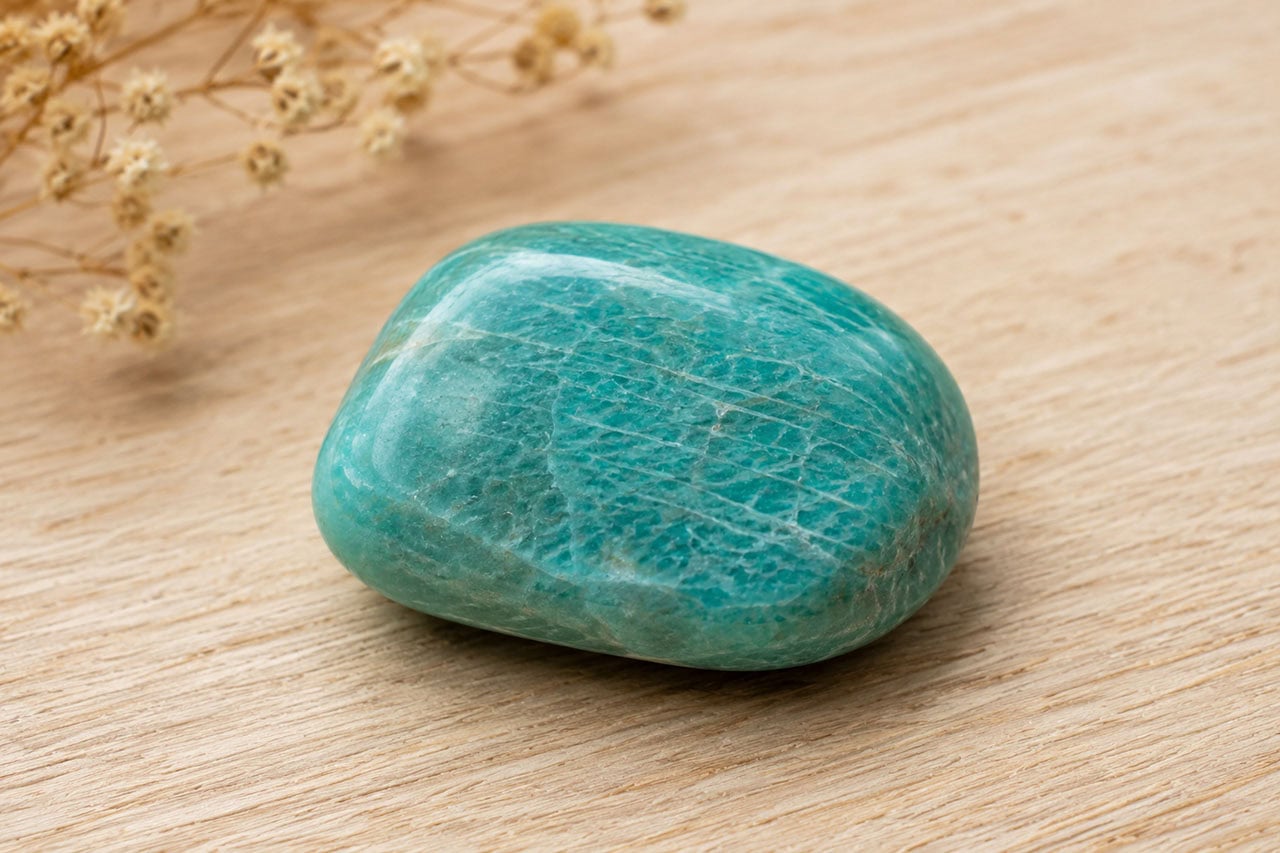
Green is the heart’s colour on a chakra chart and blue is the throat’s. Amazonite is both at once, a blue-green that leans one way or the other depending on the piece and on the light in the room. That is why it arrives with two centres beside its name where a stone of one settled colour arrives with one.
If you have owned a piece for a while and it has not seemed to do much, try using it for the other half of what it covers. The throat half has the obvious problem attached to it, so it tends to be the half that gets used.
Why one stone ends up with two centres
The chart sorts by colour. Practice gives the throat blue and the heart green, and a stone gets filed by the colour it reads as from across a table. That works cleanly when a stone commits. Rose quartz is pink. Sodalite is blue. Citrine is yellow and nothing else.
Amazonite does not commit. One piece reads as a washed pale green and the next as a proper sea blue, and a single tumble will look like the first by a window and the second under a warm lamp in the evening. Where a piece carries the white and cream veining, that softens the read further, so the stone’s answer to the sorting question changes with the hour.
Turquoise sits in the same blue-green band and picks up the same pair of listings from crystal practice, and so does chrysocolla. Once you have seen the pattern you can guess which stones will come with two centres before you look them up, which is a small and satisfying thing to be able to do in a shop.
Colour is behind the name too. The International Gem Society says there are no known sources of the mineral inside the Amazon rainforest or near the river it is named for, and that the stone has carried the association by name since 1701 and possibly earlier. The mineralogist August Breithaupt gave it the name amazonite in 1847, after a type locality he described only as near the Amazon River. Geology Science’s account of how the association started in the first place is that early explorers found green stones near the Amazon basin and connected them with this mineral. Somebody saw a green stone in the right part of the world, and a different green stone has been carrying the name ever since.
The two centres are two stages
The double listing earns its keep here, and I would not read it as the chart hedging.
Practice reads the heart centre as the one for knowing what you feel, and the throat centre as the one for getting it said. Put like that, they are obviously not two options. They are two stages of the same afternoon, and they run in that order, because you cannot say a thing you have not yet worked out.
A stone of one settled colour gets one centre, and one centre is one stage. Amazonite spans them, which makes it the stone to reach for at the point where you cannot tell which stage you are in. That point is easy to miss from the inside. You know something is wrong with a friendship or a job, and you have known for a while, and whether you are stuck on not knowing what is wrong or on not being able to say it is exactly the thing you cannot see from where you are standing.
A stone that covers both is not stronger for it. Covering both means you do not have to diagnose yourself before you can start.
Amazonite turns up on lists for the conversations that keep a friendship going, and there is more on that in what crystals are good for friendship.
Working it in order
The order is the whole method, and it is a week at the heart before a day at the throat.
The heart week is the quieter one and it is the one people skip. Keep the stone where you will pick it up while you are thinking instead of while you are talking, so a kettle or a desk rather than a coat pocket. Practice places that centre at the middle of the chest, and this week the position matters less than how often the stone ends up in your hand. The instruction, each time it does, is to sit with the thing you cannot name and to stop short of going looking for the words. The discomfort is the point and it does not lift. Words arriving too early are a good way to mislabel a feeling and then spend a month defending the label.
Then move it up. The throat placement is the base of the neck, and the job changes with the position. You are no longer waiting for the feeling to declare itself. You are trying the sentence you arrived at, quietly, on your own, and finding out whether it survives being said.
Eight days of returning to the same question in the same way is what the sequence gets you, and nobody does that without a small object making them.
If the heart week turns up nothing at all, that is a result and not a failure. Some difficulties really are just difficult to say, and in that case you were at the throat stage all along and you have spent seven days establishing it. I would still spend them.
In the Crystalance Mineral Library it sits with the feldspars, filed under the species name and not the trade name, so that is where to look for it.
One stage at a time, then. Run the two together and you get a week of half-thinking about a feeling and half-rehearsing a sentence, and that was your position before you bought the stone.
Sources
- International Gem Society, Amazonite (“there are no known sources of this mineral within the Amazon rainforest itself or near the eponymous river”; associated with the Amazon “by name, since 1701 and possibly earlier”; “The noted mineralogist August Breithaupt officially named the stone ‘amazonite’ in 1847, after an unspecified type locality ‘near’ the Amazon River”)
- Geology Science, Amazonite (“Despite its name, Amazonite is not found in the Amazon River region, the name likely originated from early explorers who discovered green stones near the Amazon basin and associated them with this beautiful mineral”)