The throat. Crystal practice places aquamarine at the base of the throat and links that centre with getting something said out loud, as against working out what to say in the first place.
The German word for spectacles is Brille, and it comes from the name of this stone.
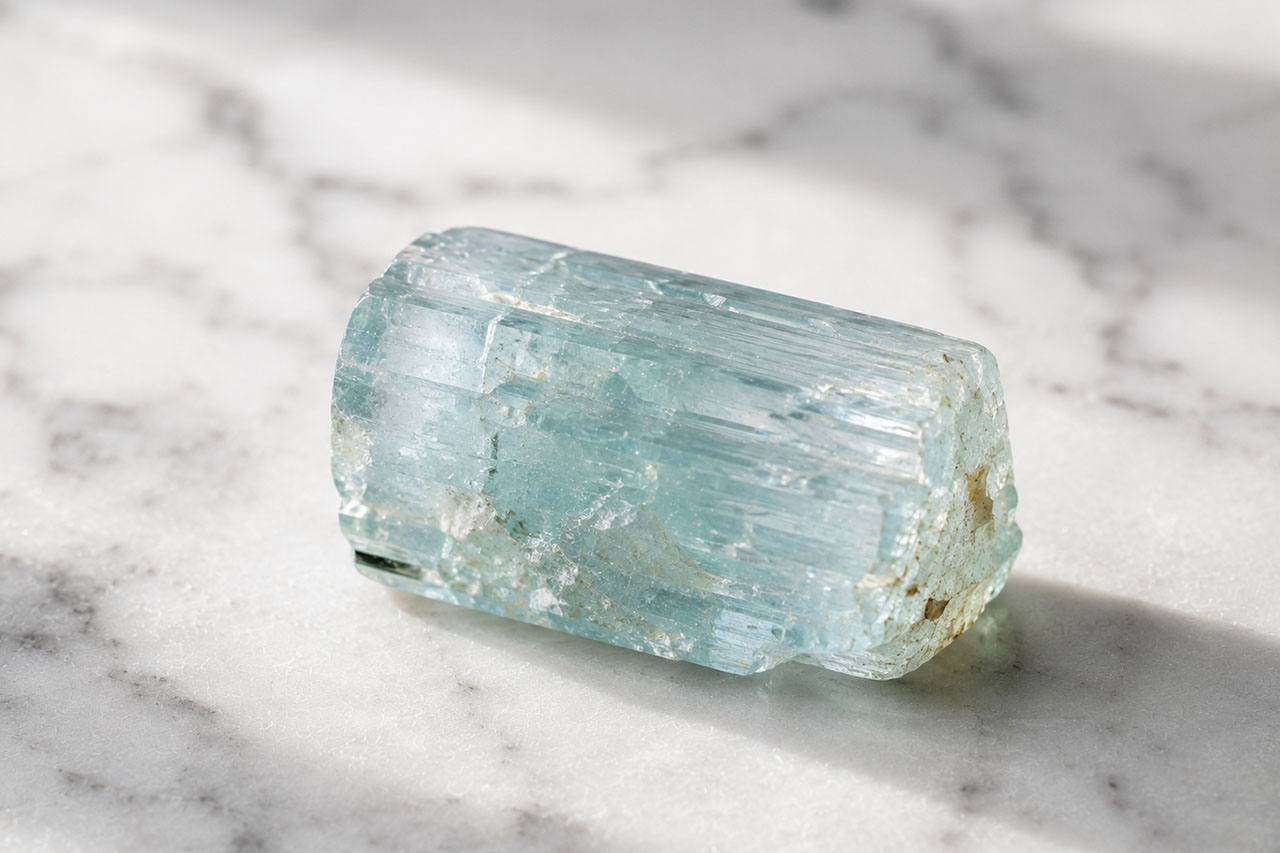
Aquamarine is a beryl. Medieval Latin used the word for beryl to mean eyeglasses among other things, and two European languages have carried the mineral’s name on their faces ever since. It is a long and slightly comic career for a stone that crystal practice now files under speaking.
Where the word came from
Merriam-Webster traces beryl backwards a long way. It arrived in Middle English as beril or berille from Anglo-French, which had it from Latin beryllus, which borrowed it from Greek bēryllos, itself a back-formation from bērýllion. Behind the Greek sits a Prakrit form, veruḷiya, a metathesised version of the Pali veḷuriya. And behind those, the dictionary says perhaps, is Vēḷur, a town in Karnataka in southern India that is called Belur today.
Only the last step carries a hedge, and it carries one for a good reason. Tracing a trade word back past the first language that wrote it down is guesswork by definition. The rest of the chain is a record of distance. Somebody was moving this material, and its name, most of the way across a continent, and Merriam-Webster dates the name’s arrival in English to the thirteenth century.
The word you looked this article up with is very much younger than that.
The stone people looked through
Etymonline gives medieval Latin three uses for berillus. It was applied to any precious stone of a pale green colour, and to fine crystal, and to eyeglasses, and the entry adds in brackets that the first spectacle lenses may have been made of beryl.
That bracket is a hedge and it stays one here. The words are not hedged at all. German has Brille for spectacles, from Middle High German berille, meaning beryl. French has besicles, altered in the fourteenth century from Old French bericle. Two living languages keep a mineral’s name in their ordinary word for a thing you put in front of your eyes, which is a good deal of evidence for an arrangement that nobody wrote an account of.
The name aquamarine is late by comparison. Etymonline gives its first English appearance as the 1590s, spelled agmarine at that point, from French or Provencal and behind that the Latin aqua marina. The colour sense, aquamarine as a shade and not a stone, is later again: Ruskin is apparently the first to use it that way, in 1846, and the clipped “aqua” for the colour is attested from 1936. Set the 1590s against Etymonline’s date of about 1300 for beryl and you get close to three hundred years in which English had a name for this mineral and it was not this one.
A material is allowed more than one career. The optical one is documented and finished. The one crystal practice gives it is current, and the rest of this is about doing that one.
Your aquamarine is probably in the wrong place
If yours came as jewellery, it is on your hand or at your ears. The placement the practice gives it is at the base of the throat. Nothing about wearing the stone puts it where the instruction wants it, and it is easy to read that mismatch as a sign you are doing the practice wrong.
You are not doing it wrong. Take it off.
This is the one place where being a gem works against aquamarine. Stones that come as tumbles go in a pocket and end up roughly where they are meant to be without anyone thinking about it. A ring stays on a finger, at the far end of an arm, and no chart has an opinion about fingers. The fix costs nothing and takes a second, and the reason to say it out loud is that a stone you cannot use as instructed will quietly stop being a stone you use.
I would not buy a second aquamarine for this, and I would say so to anyone about to. A faceted stone held in a fist does what a tumble does, the practice has never asked for a particular shape, and the piece you own already has the advantage that it will be with you on the day it matters.
Say the sentence
Lie down for five or ten minutes with the stone resting at the base of your throat, where practice puts it. Then say the sentence out loud, once, to nobody. Not the whole speech you have been building in the car, and not a summary of the situation. The one sentence you have been going round for weeks, the one that starts with I and that you have never yet got to the end of even alone in your own kitchen.
Say that. You find out within a few seconds whether you can reach the full stop, and if you cannot, you have found it out lying on your own floor and not halfway through a conversation you cannot restart.
It is oddly hard the first time and easier the third. Whether the stone has anything to do with that, I cannot tell you, and the practice does not settle it either. The placement does give you a reason to be lying still with your mouth free and nobody listening, and that situation does not arise by accident in an ordinary week.
Beryl is the species and aquamarine is one of its colours. The Crystalance Mineral Library is organised on species, which is why the same family keeps turning up there under a name you did not go in looking for.
Sources
- Merriam-Webster, beryl (Middle English beril, berille, from Anglo-French beril, from Latin beryllus, from Greek bēryllos, back-formation from bērýllion, from Prakrit veruḷiya, metathesised form of Pali veḷuriya, “perhaps from Vēḷur, Vēḷūr (modern Belur), town in Karnataka, southern India”; first known use in the 13th century)
- Etymonline, beryl (c. 1300; “In Medieval Latin berillus was applied to any precious stone of a pale green color, to fine crystal, and to eyeglasses (the first spectacle lenses may have been made of beryl), hence German Brille ‘spectacles,’ from Middle High German berille ‘beryl,’ and French besicles (plural) ‘spectacles,’ altered 14c. from Old French bericle”)
- Etymonline, aquamarine (1590s, “agmarine,” a bluish-green type of beryl, from French or Provencal, from Latin aqua marina “sea water”; of a colour, “apparently first used by Ruskin, 1846”; the abbreviation “aqua” attested from 1936)