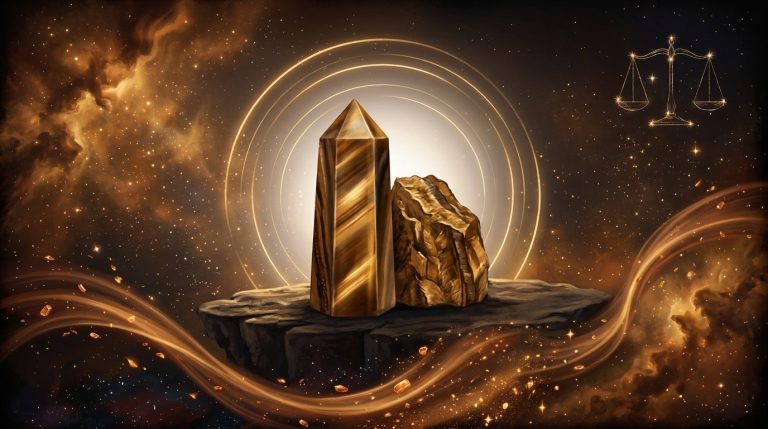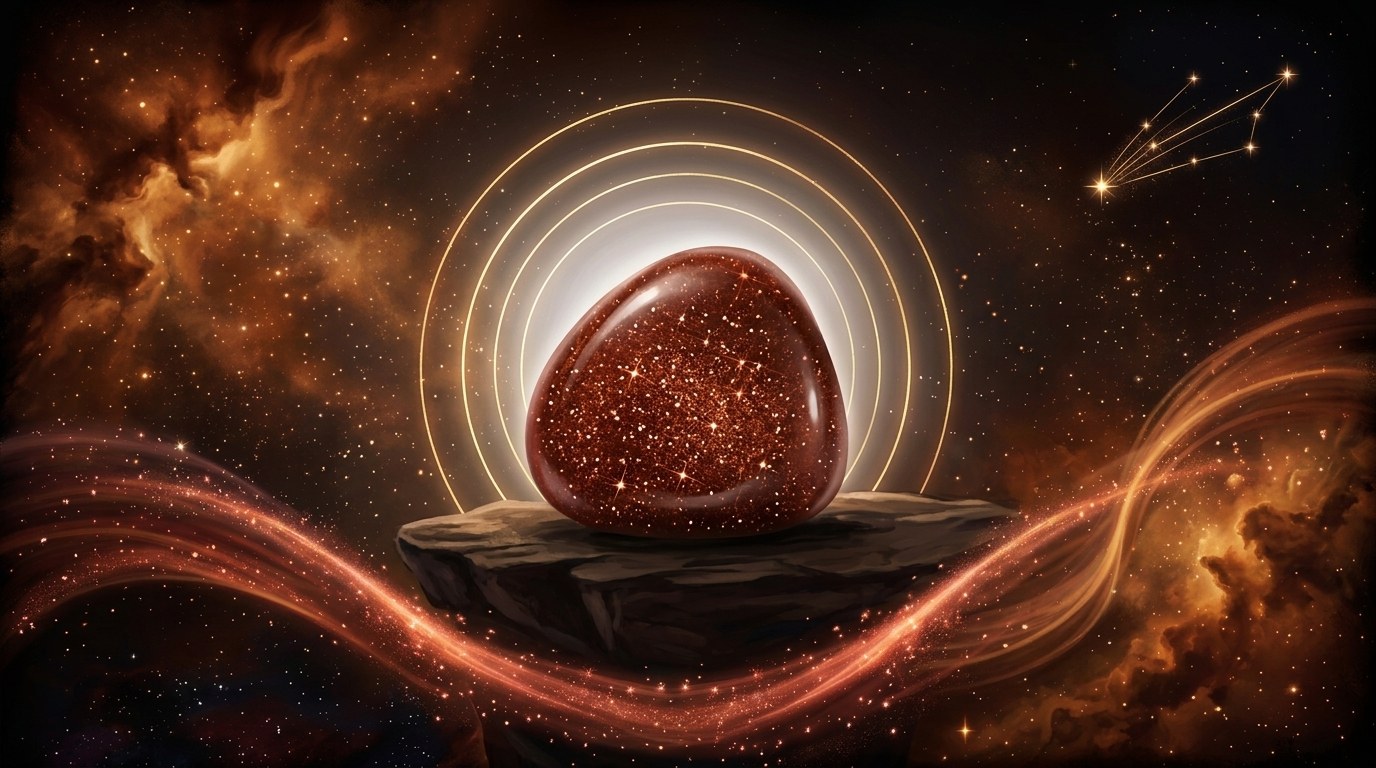
Goldstone is used for ambition and drive, and sits with the sacral and root centres. It is manufactured glass with copper suspended in it. Making it was difficult enough that some batches came out of the furnace worthless.
Failure was part of the price. Cormier’s 2025 review of aventurine glass quotes early records calling the composition unpredictable and deceptive, sometimes coming out excellently and other times not working at all, and records that the uncertainty contributed to what the material cost. Goldstone now sits in bowls by the till at pocket-money prices, the fake in the tray. Somebody had to be taught how to make it, which is not true of the stones sitting beside it.
How a batch was made
Cormier’s review puts the whole process at about a week. It sets out the sequence from the Darduin manuscript: a hundred pounds of opaque red cullet melted for around eighteen hours, then a pound of lead and tin calx, a pound and a half of red copper and eight ounces of iron oxide added to it, then two pounds of calcined steel eight hours after that, and then the melt left to cool very slowly in a reducing atmosphere.
The reducing is what decides the result. Copper sitting in a melt is normally an ion, and an ion gives you colour rather than glitter. To get metal you have to strip the oxygen off it, which is what the iron and the calcined steel are there for, and then the melt has to cool slowly enough for that metal to gather itself into flakes rather than stay dissolved. Cormier describes the atmosphere being held by limiting the air intake or by burning organic material in the chamber. Let air in and the copper crystals dissolve back into the glass, taking the sparkle with them.
Then somebody broke the crucible. That was how the material came out of the furnace, by smashing the cooled vessel and cutting or grinding the blocks inside into whatever they were going to be. Cormier notes that the glass is particularly awkward in blown work, because blowing happens in an oxidising atmosphere and prolonged annealing there dissolves the copper again.
Why it was worth keeping secret
The Miotti family in Murano held the method and passed it down inside the family across several generations. People do that with a process worth more as a secret than as a product. The economics here were unusual, because the failures were what made the successes valuable.
That is a strange sentence to be able to write about anything in a crystal shop. Secrecy in this trade normally attaches to where a stone came from and what was done to it after it was dug up. Here it attached to whether the thing could be made at all. Cormier adds that recent work on how the copper crystallises has improved process control, and that getting reproducible results still takes considerable expertise, which is not what you expect to read about a material now sold by the bowlful.
What happened after it stopped
Production appears to have declined or ceased in the early nineteenth century, and Cormier gives the high cost and the production difficulties as possible reasons. It came back around 1825 through Pietro Bigaglia, who showed aventurine glass at the Milan industrial exhibition of 1826 and who worked out how to sheathe the material in a coating of clear glass so that it could be handled hot after all. That is where blown pieces and drawn rods come from.
After that the story is the ordinary one. A cobalt-coloured blue version arrives in the late nineteenth century, black versions follow using manganese with iron oxide, and a thing a few families could make becomes a thing a factory can. The blue goldstone in the tray next to the brown one is the tail end of that.
What the shelf asks of it
By the time goldstone reached the modern crystal shelf, the difficult part had been over for well more than a century, and none of it came along. What arrived was the look.
Crystal practice reads goldstone as a stone for ambition and for the confidence to keep going at something after the first enthusiasm has worn off. It sends the stone to the sacral centre, the energy centre associated with creativity and appetite, with a secondary tie to the root. The blue kind goes upward instead, to the throat and the brow. Practitioners describe the reddish-brown as a warm and steady thing to have around rather than a forceful one, and it turns up in advice aimed at people who find heavier grounding stones too much.
All of that describes a colour and a sparkle, which is what was left once the making dropped out of the story. And crystal practice ranks an object by how it formed. A stone impresses because the earth took its time over it, so goldstone, having no formation to describe, gets filed as the exception and marked down for having been made. What it is marked down for is the hardest thing about it.
What a shopper gets told, meanwhile, is the disclosure and then the reassurance. It is man-made, and the meaning you bring to it is what counts. I have no argument with the reassurance. It is the disclosure I would change, because being man-made is offered as the awkward fact about goldstone and it is the interesting one.
The advice you will find attached to goldstone is the general tumble advice, carry it or keep it on the desk, and I am not going to add another version of that to the pile. The thing this particular object rewards is knowing what it is, which the Crystalance Mineral Library sets out alongside the natural sparkly stones people mix it up with.
A furnace with its air shut off, about a week of waiting, and a result the old records called deceptive. That history is sitting in the bowl by the till, under a label apologising for it.
Sources
- Cormier, L. (2025), “Synthetic (Goldstone) and Natural Aventurine – A Review”, Glass Europe 3, 165 to 181: tib-op.org