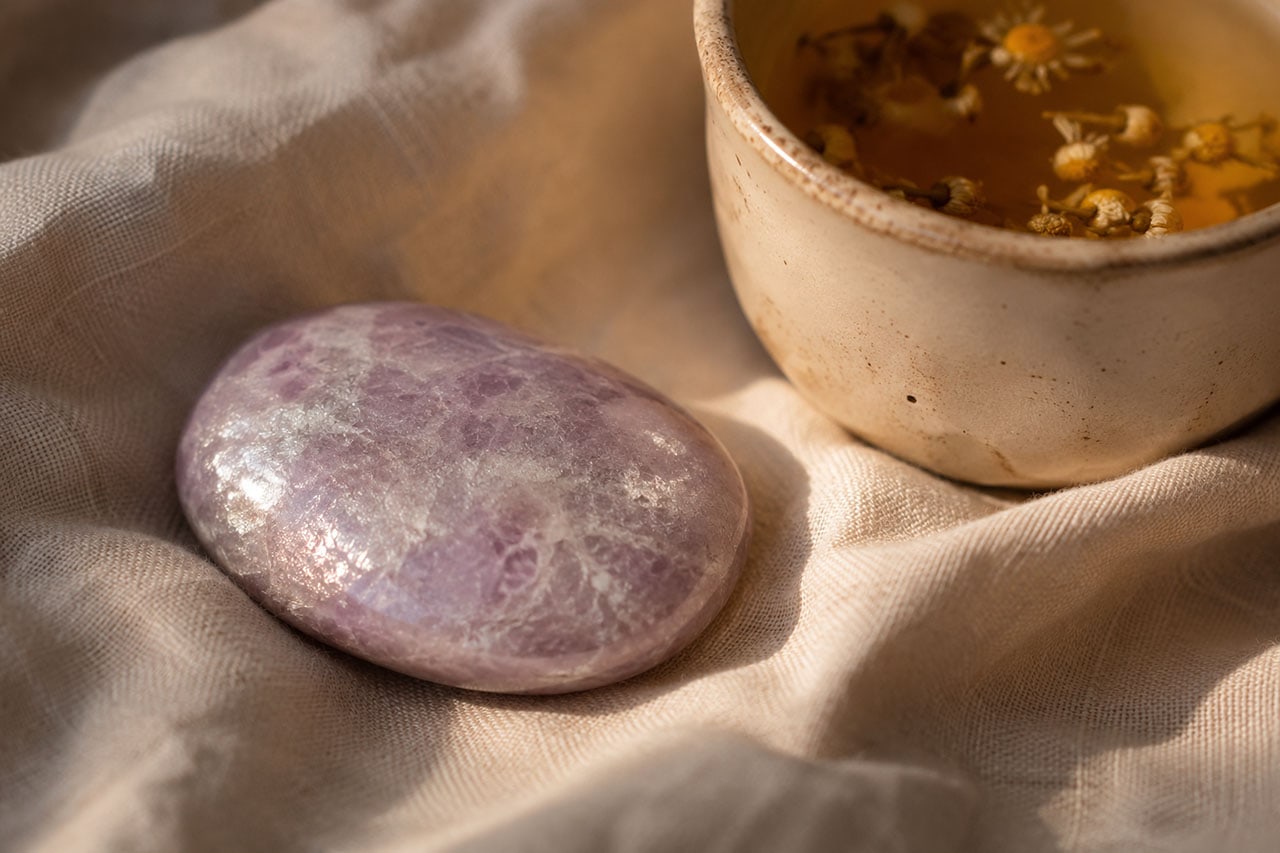
Carry it, or keep it where you sit. That is the method, and for this stone it is close to the whole method. Lepidolite comes with less procedure attached than nearly anything else on the shelf, and most of what does get attached can be dropped.
A lepidolite tumble costs a few pounds. Follow the advice that comes with it and you can end up with a stone that needs cleansing under running water, charging in moonlight, programming with a stated intention, placing at a particular point on the body, and slotting into a grid with four other stones.
That is a lot of scaffolding for a small purple pebble, and it is a good deal more than the tradition itself asks of this one. What has happened is that the general crystal procedure, developed around the stones that do have elaborate practices attached, gets applied uniformly to everything sold in the same shop. Lepidolite inherits it by proximity.
You can put most of it down.
What the procedure is for
None of this is a case against ritual, which does real work when it is doing real work.
Cleansing and charging exist to mark a break. You do them when a stone has been through something, or when what you want from it has changed, and the doing of them is what makes the change feel marked rather than merely decided. That is a genuine function, and for a stone you use in bursts, one you reach for around a specific event and then put away, the marking is the useful part.
Lepidolite is not that kind of stone. Crystal practice puts it with the everyday and the ongoing: the low hum rather than the event, the stone you have on you on an unremarkable Tuesday. Nothing in that use has a beginning or an end to mark. There is no session to open and close, so a procedure for opening and closing has nothing to attach to.
That is why the instructions given for it are so unlike the ones given for clear quartz or selenite. Carry it. Keep it by the bed. Have it on the desk. Those are not simplified rituals. They are the correct instructions for a stone whose use has no edges.
The one thing to keep
Set an intention once, on the day you start, and then leave it alone.
This is the piece worth not skipping, and the reason is not mystical. A stone in a pocket with no stated purpose becomes a stone in a pocket. Saying what it is there for, out loud or on paper, fixes what you will think of when your hand finds it, and that fixing is the difference between an object that keeps a subject in the room and one that is just lint. It takes about thirty seconds and you do it once.
Everything else is optional in a way the usual write-ups do not admit. If you enjoy putting stones out under a full moon, do it, and the enjoyment is a sufficient reason. If you would rather not think about a small purple stone more than once, you have not failed at anything, and the tradition’s own instructions for lepidolite are on your side.
One honest limit while we are here. Nothing about a stone in your pocket treats anything, and a calm-associated object is not a substitute for whatever you would otherwise do about a difficult stretch. What it can be is a small marker in a day, which is a real thing to have and a modest one.
Where the material does ask something of you
There is exactly one place lepidolite is fussier than its neighbours, and it has nothing to do with energy.
The Handbook of Mineralogy treats lepidolite as a group name within the micas rather than a single species, gives its hardness as 2.5 to 4, and lists one perfect cleavage on {001}, the sheet-splitting habit every mica has. In a pocket that means a stone at the soft end of what gets sold as jewellery, and one that will eventually part along a flat face if you keep working at an edge with a thumbnail.
Two consequences follow, and they are both small. Do not have it set into a ring, because a ring stone takes the most punishment of any format and this is not the material for it. And give it its own pocket, or its own corner of a bag, rather than a compartment shared with keys and coins.
That is the extent of the maintenance. No schedule, no water rule to memorise, nothing to look up. Lepidolite is a mica and the Crystalance Mineral Library breaks that side of it down properly.
The short version, which doubles as the long version: pick the stone up, say what it is for, put it somewhere you will meet it, and get on with your week.
Sources
- Handbook of Mineralogy, lepidolite: a group name within the mica group, hardness 2.5 to 4, perfect {001} cleavage, occurring in granite pegmatites.