Two placements, not twelve. One where you sleep, one where you stop moving during the day, set up a month apart so you can tell them apart. Amethyst by the bed, and fluorite or clear quartz where you sit. Black tourmaline by the door can come later.
You cannot turn your building round. That sounds like a strange place to start, but it is the first move of the only formal system anybody has for this, and knowing it is unavailable saves a lot of reading. Britannica defines feng shui as an ancient Chinese practice of orienting significant sites, buildings, and the spaces and objects within them in harmony with the flow of qi, the vital life force. Sites and buildings come first. The spaces and objects inside them come third.
The third item is the whole of what a crystal home guide can offer you, this one included. That is not a complaint. It is the reason the advice takes the shape it does, and it is also why the room-by-room list you were expecting is a poor way to spend money.
Why two, and not one in every room
Most home-placement advice wants a stone on every surface, and this is where the two of us part company.
A placement only does anything if you notice it, and noticing is a limited resource. Two stones in two chosen spots get looked at and get picked up. Spread twelve across twelve rooms and they stop being placements and turn into scenery, which goes invisible fast. You will walk past the one in the hall every day for a year and not see it once after the first fortnight.
There is a second reason and it is about being able to tell. If you put out one stone and something in the room changes for you, you know which stone. If you put out nine on a Sunday afternoon, you have run an experiment with nine variables and you will never untangle it. That is why the two go in a month apart rather than together. It costs nothing to wait and it is the difference between having an opinion about a placement and having a decoration.
Choosing the two
The first one is easy. It is wherever you sleep, and crystal practice associates amethyst with a quieted head and settled thinking, so it is the stone the lists put beside a bed. Celestite and lepidolite get roughly the same territory, for anyone who finds amethyst too present.
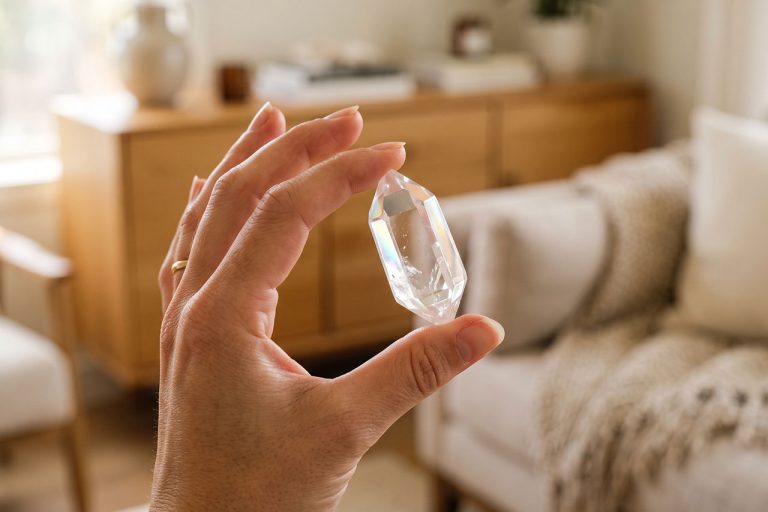
The second is the one worth thinking about, and the trick is to ignore the room name. Ask instead where in your home you stop moving. Not where you pass through, where you sit down and stay. For a lot of people that is a desk, and crystal practice reaches for fluorite there for clear thinking and pyrite for the confident, get-on-with-it end of the day. For plenty of others it is an armchair, or the end of a sofa, or a kitchen table at seven in the morning, and those are all better answers than a home office nobody uses. Clear quartz is the flexible one for a spot like that, because practice treats it as an amplifier, a stone that strengthens whatever sits near it, so it does not need you to have decided what the corner is for.
Front doors are the classic third placement, and black tourmaline is the stone the lists reach for, on its association with protection and a boundary. Leave it until the first two have settled. A doorway placement is one you walk past rather than sit with, so it is the one most likely to become scenery, and it earns its place better once you already have the habit.
Two rooms have their own answers and are not covered by any of this. Bathrooms need a separate think, because selenite and one or two others do not tolerate water and a steamy room is the wrong place for them, which is set out in what crystals are good for the bathroom. Desks with a lot of electronics on them bring up shungite, and the position on that is more complicated than the shelf-talkers make it, so it has a piece of its own.
Making one stick
There is a quiet test that decides which placements survive, and it has nothing to do with energy.
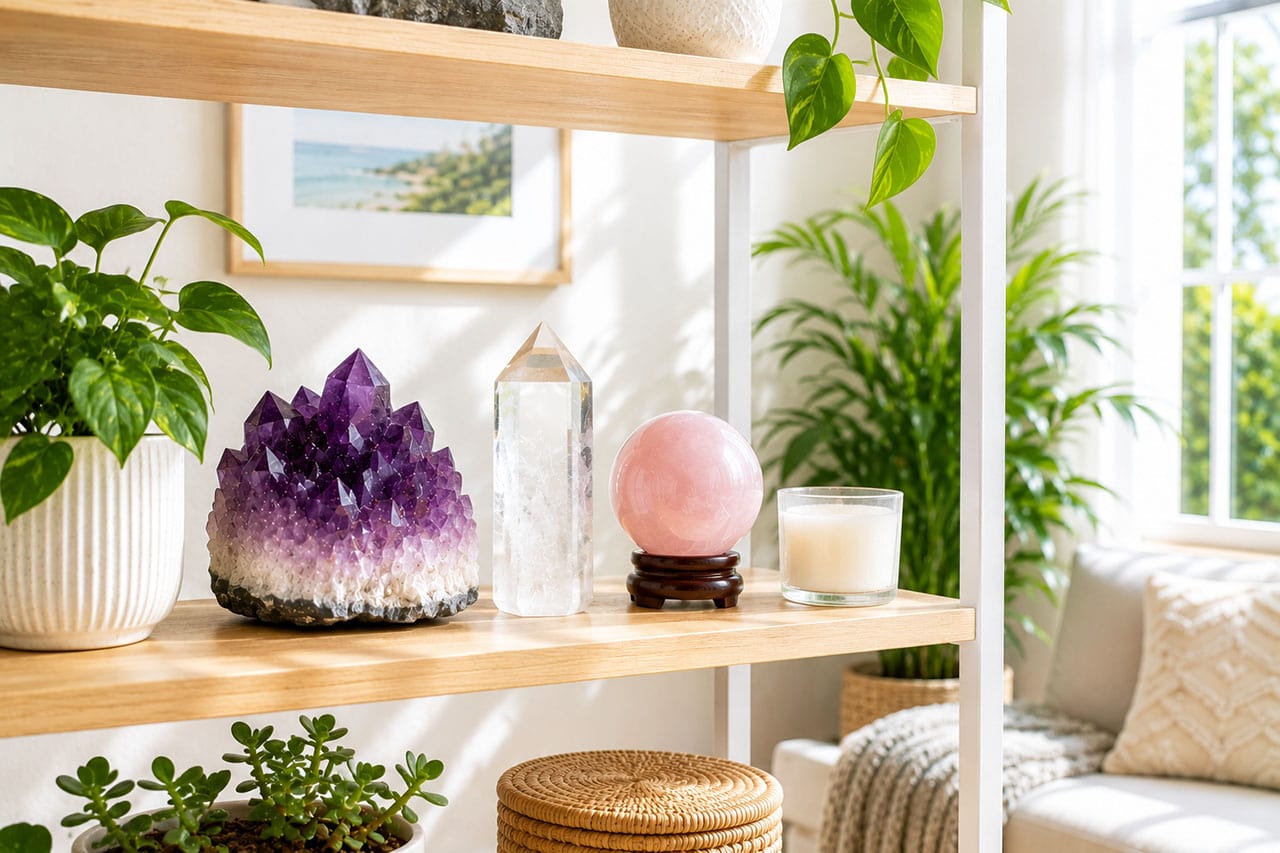
A stone that also works as an object you like looking at, in that particular spot, stays in that spot. An amethyst cluster that suits the wood of the bedside table is still there in three years. One bought because a list said bedroom, sitting somewhere it looks wrong against the lamp and the paperbacks, gets moved, and then moved again, and ends up in a drawer. Choose for the eye as well as the intention and you save yourself the relocating.
The practical side of that is size and finish rather than species. A cluster reads as an object and holds a surface; a single small tumble on a wide shelf reads as something someone put down and forgot. If the spot is a big one, buy bigger than feels necessary, or put the tumble in a small dish so it has an edge to sit against.
You will find each of these stones in the Crystalance Mineral Library, with the hardness and the care notes that decide what is safe in which room.
Two stones, a month apart, in the two places where you stop moving. The third one can wait until you have stopped noticing the first two.