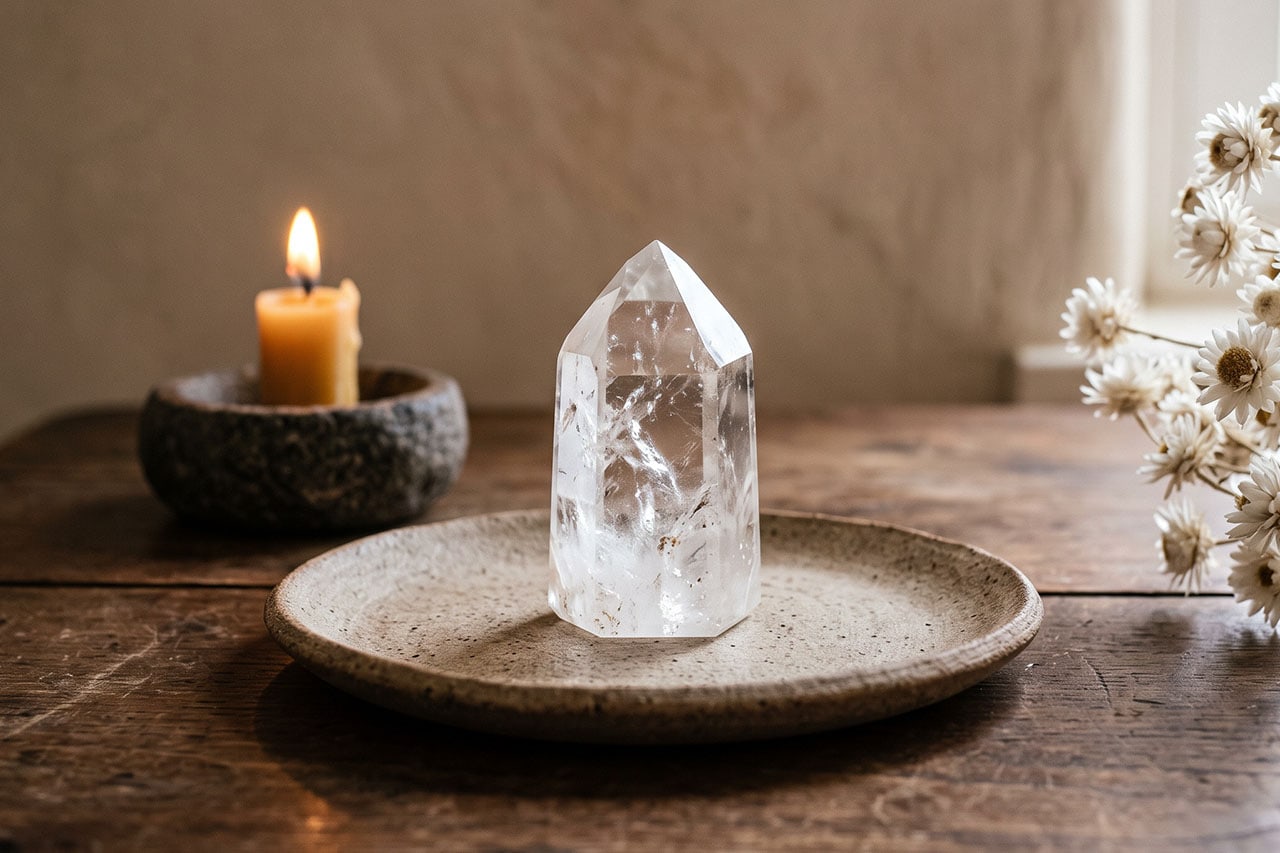
You do not need to buy anything. In crystal practice a beginning starts by clearing a stone you already own and naming what you want out of the next stretch. The usual list, if you want one, runs moonstone, labradorite, citrine, green aventurine, clear quartz and amazonite.
The first move at a threshold, in crystal practice, is subtraction. Something gets taken away before anything is added, and the practices that cluster around new starts are clearing practices rather than acquiring ones. Clearing is something you do to a stone that is already in the house.
The moon half of the practice runs on the same logic. The phase the tradition picks for starting something is the new moon, the moon at its darkest, and NASA counts the whole cycle from exactly there, new moon to new moon, 29.5 days, with the eight phases running out from that point and back to it. The beginning is the empty part.
Why the empty point is where a beginning goes
Picking the darkest phase rather than the fullest one looks backwards until you hear the reasoning, which is straightforward enough. You set an intention when there is room for it, and you let it build across the two weeks the moon is filling out. The full moon in this scheme is the point of completion rather than the point of departure.
The same logic runs underneath the crystal side. Before a stone gets an intention it gets cleared, and the tradition is unfussy about how: running water, a night on a windowsill, sound, smoke, a rest on dry salt. What all of those have in common is that they remove rather than add.
It also takes the urgency out of the timing. The moon comes back around every 29 or 30 days, and a beginning that missed the dark of the moon by four days has lost nothing that matters.
The reset, and how little it needs
Pick up a stone you already have. Clear it however you like. Say, out loud or not, what you want this next stretch to look like, in words specific enough that you would know whether it had happened. Then carry the stone for a few weeks.
That is the whole practice, and if you are working with a quartz the clearing step can be as casual as you like, because nothing you do to a quartz changes the quartz. Clear quartz is silicon dioxide at 7 on the Mohs hardness scale, with no discernible cleavage, and moonlight, a bowl of water and a bell all leave it exactly as they found it. For quartz, then, no method is chemically better than another and the one to use is the one you will keep doing. For a softer or soluble stone the choice matters a great deal, and how to cleanse, charge and activate crystals goes through which stones tolerate which method.
Naming the intention takes longer than the clearing and does more. A beginning is usually the moment you can see least clearly, and putting words to what you want from it is useful in the ordinary way that writing something down is useful, whatever else you believe is happening.
Be specific about it. “A fresh start” gives you nothing to hold against the next few weeks. “Two evenings a week that belong to me” does, and so does “say yes to the thing before I have talked myself out of it”. The stone is a reminder of a sentence, and a vague sentence makes a poor reminder. Fixing the wording and repeating it rather than improvising each time is the part that stops an intention drifting quietly into something easier.
The list, and what each one is asked to do
The six stones are not interchangeable, and a list that names all six without saying which part of a beginning each one belongs to is how people end up owning all six.
Moonstone and labradorite are the threshold stones. The practice runs moonstone through the lunar cycle, as the reminder that change is a rhythm rather than an event, and gives labradorite the stretch when you have started and cannot yet see where it lands. Both belong to the uncomfortable middle rather than the launch.
Citrine and green aventurine sit at the other end, on the momentum side. Citrine is associated with confidence and with expecting things to go well, and green aventurine with luck and with staying open to an opportunity you had not planned for. Both suit a beginning you chose, a new job or a new project, rather than one that arrived because something ended.
Clear quartz and amazonite handle the thinking. Clear quartz is the general-purpose stone of the tradition and is used here for clarity about what you are aiming at. Amazonite carries the practice’s association with saying and living what is true for you, which makes it the one for beginnings that came out of a decision to stop doing something that did not fit.
Two of those, at most, will match where you are. If your beginning followed a loss rather than a plan, what crystals help with letting go is closer to the right shelf than this list is.
When a new stone does earn its place
None of this is an argument against buying one. Marking a change with an object is old and human, and a stone chosen deliberately at a turning point ends up attached to that date in a way one you already owned does not. If that is what you want, buy it in person where you can, and choose the piece in front of you rather than the label on the bin.
The version to avoid is the one where the beginning turns into a shopping decision, six stones arrive in a padded envelope, and they sit in a bowl by the door untouched. One stone, cleared, with something said over it, is what the practice describes. If you want to know what you are holding before you choose, the Crystalance Mineral Library answers that for all six.
The next dark moon is never more than a month off, and the clearing takes a minute. If the beginning has already happened, start tonight and let the moon catch up.