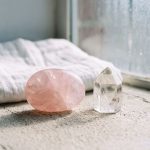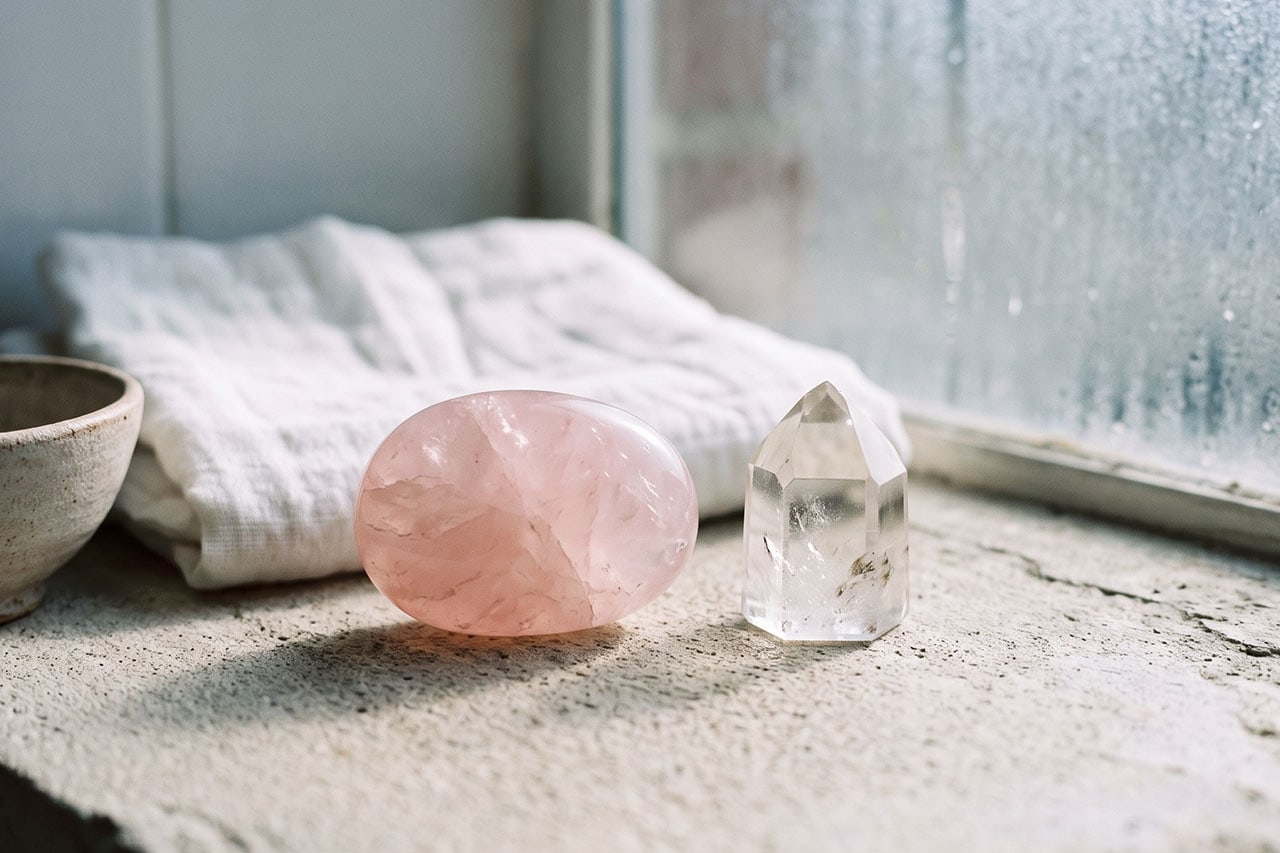
Quartz-family stones handle a bathroom without trouble. Selenite and pyrite do not. The deciding factor is the humidity the room sits at all day rather than the few seconds a stone spends under the tap.
A crystal bath is the only practice in the whole tradition where you and the stone end up in the same water at the same time. Everything else keeps a boundary. The stone goes under the pillow, or in the pocket, or on the windowsill, and you stay on your side of it. In the bath there is no boundary left, which is a large part of why the practice appeals and why the safety question follows it around.
The question that follows it is nearly always answered as though it were about immersion. Can this stone get wet, yes or no. A stone on a bathroom shelf is asking something else, because it is not visiting the water. It lives in the room. Whatever the room does for an hour every morning, it does to that stone every morning for years, and the number that settles it is a museum conservation number.
The room is the variable, not the tap
Conservators who look after mineral collections work to a humidity range rather than a wet-or-dry rule. The Natural Sciences Collections Association’s guidance on the care of geological specimens puts mixed store rooms “between 45% and 60% RH”. The Western Australian Museum’s manual cites a figure of 50 percent relative humidity at 15 to 20 degrees as ideal, while noting that no single set of conditions applies broadly, since different minerals fail in different ways. What it does say without hedging is that humidity control is the most critical factor of the lot, ahead of light and temperature, because the wrong humidity drives corrosion and cracks specimens through repeated swelling and shrinking.
Pyrite is the case both of them name. Above 60 percent relative humidity, iron pyrite reacts with atmospheric water to form hydrated iron sulphate and sulphur trioxide, and the NatSCA guidance says pyrite specimens should not be stored above 60 percent and preferably at 45 percent or lower. No water has to touch it. Damp air is the whole mechanism.
Now put that next to the number the US Environmental Protection Agency gives householders for mould, which is to keep indoor humidity below 60 percent and ideally between 30 and 50 percent, and to run the bathroom fan or open the window while showering. Two sets of guidance written by people with nothing in common picked the same ceiling. They overlap between 45 and 60 percent, which is roughly where a ventilated bathroom spends its day. Below 45 you have dropped out of the museum range while the mould guidance is still perfectly happy, which is a problem for hydrated minerals rather than for the quartz family.
None of that is something you can eyeball. A cheap hygrometer will tell you in a day what any amount of guessing will not. As a rough sanity check in the meantime, a mirror that clears within a few minutes of the shower stopping and grout that stays clean point to a room that is venting. A mirror still fogged twenty minutes later, with paint lifting near the ceiling, points to a room with a ventilation problem, and at that stage the crystals are the least of what it is doing.
What belongs on a bathroom shelf
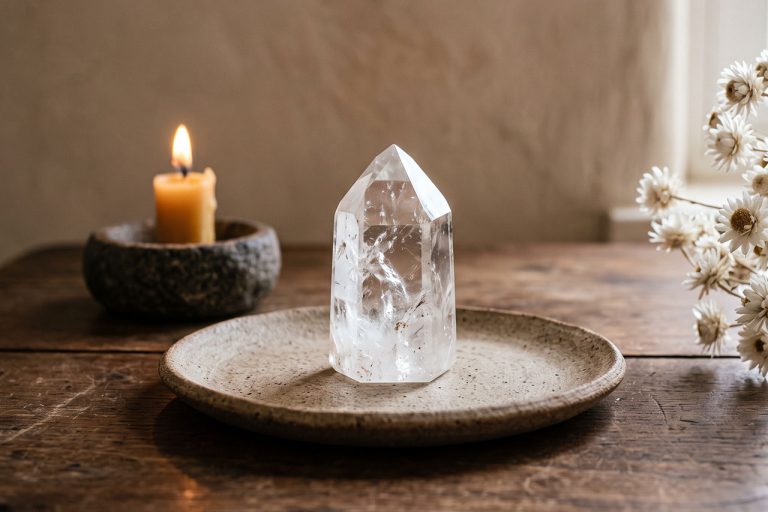
The quartz family covers the usual bathroom shortlist. Clear quartz, rose quartz, amethyst, smoky quartz, citrine, agate, jasper and tiger’s eye are all silicon dioxide or close relatives of it, running around 6.5 to 7 on the Mohs hardness scale with no discernible cleavage. Quartz is not soluble in water, so steam and a wet hand leave them where they were, and a bathroom short of direct light is a kinder place for the fade-sensitive ones than a sunny sill.
Beyond the mineralogy, a few placements do more work than others. A clear quartz point on the shelf by the mirror catches light and gives a morning routine something to land on. A rose quartz on the edge of the bath is the placement the practice points at for self-directed work, and a palm-sized piece suits it better than a cluster because it will get knocked. A smoky quartz near the door works for people who use the room as the place they decompress at the end of the day.
Size and weight decide more than any of this. A wet tiled floor and a heavy pointed specimen are a poor combination, and anything you would be upset to chip should live somewhere other than the ledge above a hard basin.
Can you put rose quartz in the bath?
Yes. Rose quartz is quartz, silicon dioxide, hardness 7 on the Mohs scale, with no discernible cleavage and no solubility in water. A bath does nothing to it that a rinse under the tap would not.
The practical notes are small. Bath salts and oils leave a film that dulls the polish over time, so wipe the stone dry afterwards. Keep it in your hand or on the rim rather than loose under you, where it can chip the tub or get sat on. And a bath is a self-directed ritual rather than a preparation of anything. Nobody has shown that water carries a stone’s quality into you, and if you are thinking about drinking stone-soaked water rather than sitting in it, the safety rules are stricter and how to use crystals for beauty and gemstone essences sets them out.
The stones to keep out
Selenite is the clear one. It is a crystal form of gypsum, soft at 2 to 2.5, and it is soluble, so water dissolves the surface and takes the satin sheen with it. Liquid water is the certain problem, which in a bathroom means the splash from a shower, a wet hand reaching past it, a puddle on a shelf. Put it in the bedroom and use something else in here.
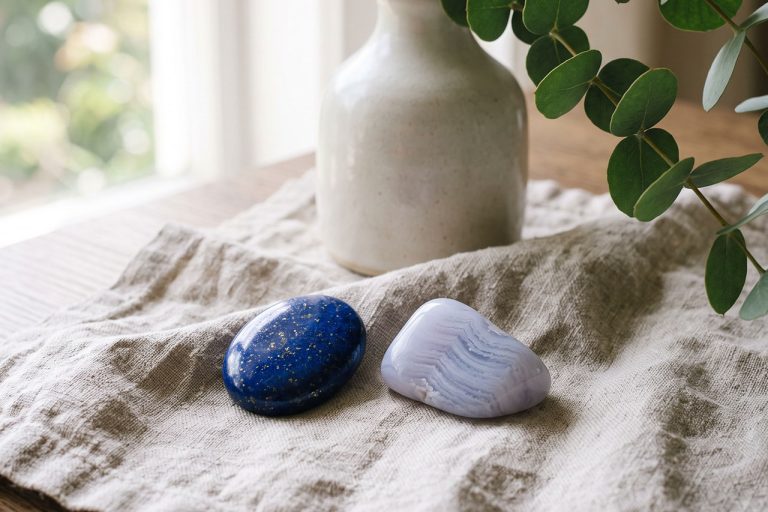
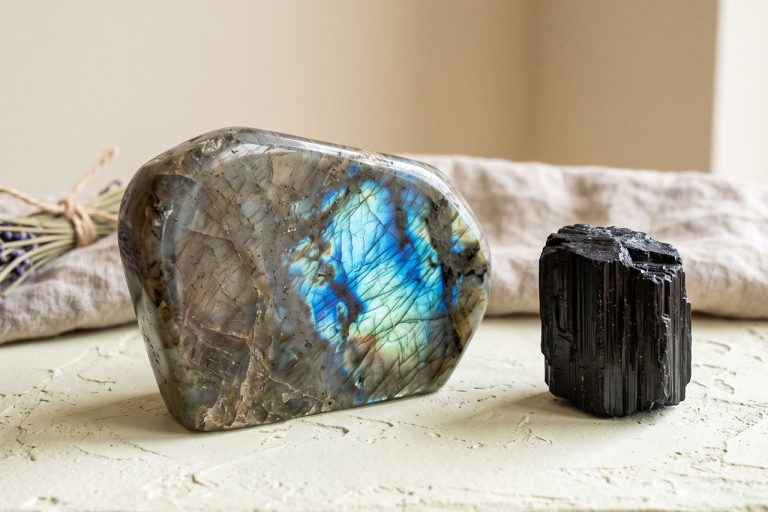
Pyrite is the other one, for the reason above, and it is the case where damp air alone has a documented mechanism behind it. Malachite and lapis lazuli are both soft and slightly porous, and a damp room is the wrong place for either of them. For the fuller map of what dissolves, what corrodes and what should never go near water you intend to drink, which crystals should not be put in water works through it stone by stone.
Hardness and solubility for each of these are in the Crystalance Mineral Library. For a stone that is not on this page, that is the faster way to settle it.
A ventilated bathroom sits inside the same humidity range a museum store room is held at. Keep the selenite dry, run the fan, and the rest of the shelf looks after itself.
Sources
- NatSCA, Care and conservation of geological specimens (store mixed geological collections between 45% and 60% RH; above 60% RH iron pyrite reacts with atmospheric water to form hydrated iron sulphate and sulphur trioxide; pyrite preferably at 45% RH or lower; fluctuations greater than 10% in an hour can split specimens)
- Western Australian Museum, Geological collections care manual (ideal conditions described as 50% relative humidity at 15 to 20 degrees C; relative humidity control the most critical factor; pyrite the named example)
- US EPA, A Brief Guide to Mold, Moisture and Your Home (keep indoor humidity below 60 percent, ideally between 30 and 50 percent; run the bathroom fan or open the window when showering)
- Minerals.net, quartz (SiO2, Mohs 7, cleavage indiscernible, brittle, conchoidal fracture)
- Geology Science, Selenite (gypsum, CaSO4 dot 2H2O, Mohs 2 to 2.5, soluble in water)