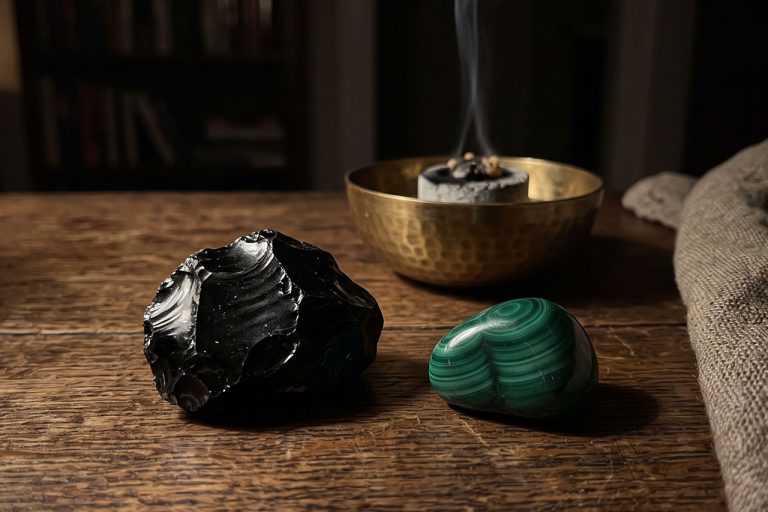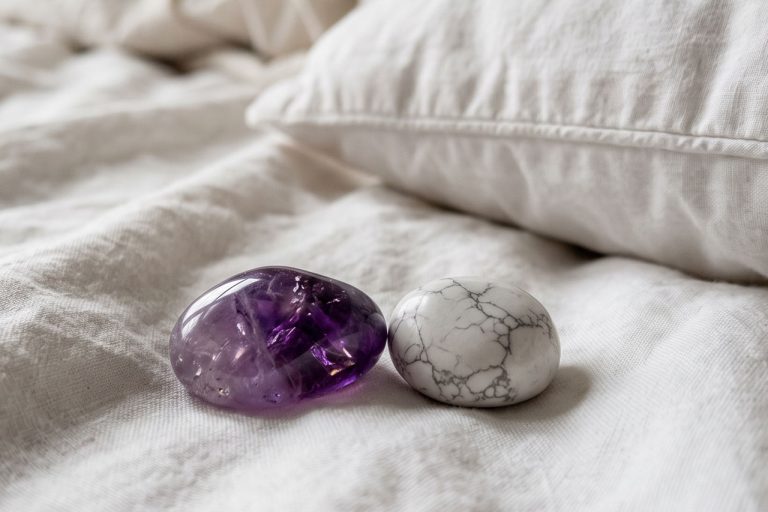
Amethyst, howlite, lepidolite, smoky quartz and black tourmaline are the stones crystal practice names here. Pick one rather than five, and keep it somewhere you can reach in the dark without sitting up, because a nightmare is a thing you wake up from.
You are only having a nightmare if you wake up. That is the line the NHS draws between the two things people mix up: a nightmare is a bad dream you wake up from and can remember, while in a night terror you may talk and move about but you are asleep, and it is rare to remember it afterwards. Nightmares happen later in the night. Night terrors happen early.
That means the thing you are shopping for has a conscious person in it. It sounds obvious and it is not, because the shape of crystal nightmare advice assumes the opposite: a stone set out at bedtime, doing something to a sleeping body for eight hours. The one moment in the whole business where you are available to an object at all is the moment you sit up.
Two kinds of bad night
Get the distinction straight before you buy anything, because the two situations do not want the same thing from you.
If someone has told you that you sat up and talked and had no idea about it in the morning, that is the second kind, and there is no moment in it where an object on a table meets a person who can use it. You were asleep the whole way through. Nothing on the nightstand is going to be picked up, because the part of you that picks things up was not there.
The kind people mean when they ask this question is the other one. You come out of it. You are awake, you know what the dream was, and you are lying there in the small hours with the whole of it still going. That is an unpleasant twenty minutes, and it is also, from a practical point of view, an opportunity, because you are present for it.
Why reach matters more than closeness
The rules you will read about crystals and sleep are rules about distance. Under the pillow or on the table. Whether it counts if it slides out in the night.
Drop all of that for a moment and ask what the object is being asked to do for someone who has just woken up frightened. It gives that stretch of time a beginning and an end. You reach out, you close your hand round something that has a bit of weight to it, you hold it while your breathing comes down, you put it back. The twenty minutes now has a shape, and it stops being an open-ended thing you are lying in the middle of.
Every part of that requires you to be able to find it, which is not the same thing as being near it. Distance stops mattering when your eyes are shut and you are groping at a bedside table. A tumble on a hard surface within arm’s length is findable. Put the same tumble under a pillow and you are sitting up and digging through bedding at the exact moment when getting further awake is the last thing you want. There is more on the under-pillow question and where it came from in what crystals can you put under your pillow.
Crystal practice associates amethyst with a quieted head, howlite and lepidolite with roughly the same, smoky quartz with grounding and black tourmaline with protection. Any of the five is fine for this. The association is what makes the object yours rather than a random pebble, and past that point what matters is whether your hand can find it at three in the morning.
Setting one up for the middle of the night
The setup is smaller than most of the advice on this subject.
One stone. A tumble rather than a cluster, because you will be finding it by feel with your eyes half shut and a cluster has points on it. On the bedside table rather than under the pillow. Somewhere your hand already goes, next to the glass of water or the base of the lamp, so that finding it is not itself a task.
Then, when you wake up out of one, you pick it up and hold it for a minute or two before you lie back down. That is the whole method, and it works for the reason already given: the twenty minutes now has an edge on both sides of it. Better still, it repeats at a time of night when nothing elaborate does.
Compare that with the setup these articles tend to describe: a piece at the bedroom door, one at each corner of the bed, a tumble under the pillow, a second stone added if the first one has not helped after a week. You are not going to get up at three in the morning and adjust a perimeter. The elaborate version is built for the person arranging their bedroom at seven in the evening, feeling organised. The simple one is built for the person the nightmare belongs to.
If your trouble is getting to sleep at all rather than what wakes you, that is a different question with a different answer, and it sits in can you sleep with celestite.
When it keeps happening
None of this is a treatment and this site is not going to pretend otherwise. A stone in your hand in the small hours is a small deliberate act that gives a bad twenty minutes an ending, and that is a real and useful thing for it to be. It is not the same kind of thing as an answer to why the dreams are coming.
If they keep coming, week after week, the stone is not the variable to keep adjusting. Swapping amethyst for howlite and then howlite for lepidolite is a way of feeling busy about something that is telling you it needs a different sort of attention, and that belongs with a doctor rather than with a shop. A recurring nightmare is not a question crystal practice is equipped to answer, whatever the versions of it that sell more stones than the question needs might imply.
Amethyst, howlite, lepidolite, smoky quartz and black tourmaline each turns up in the Crystalance Mineral Library with its composition and its care notes, and hardness is the one to check if the tumble is going to live on a hard surface next to a lamp.
One stone on the table, within reach, picked up when you wake and put down when you are ready to lie back down. That is a version of this you can still manage on the fourth bad night in a row.