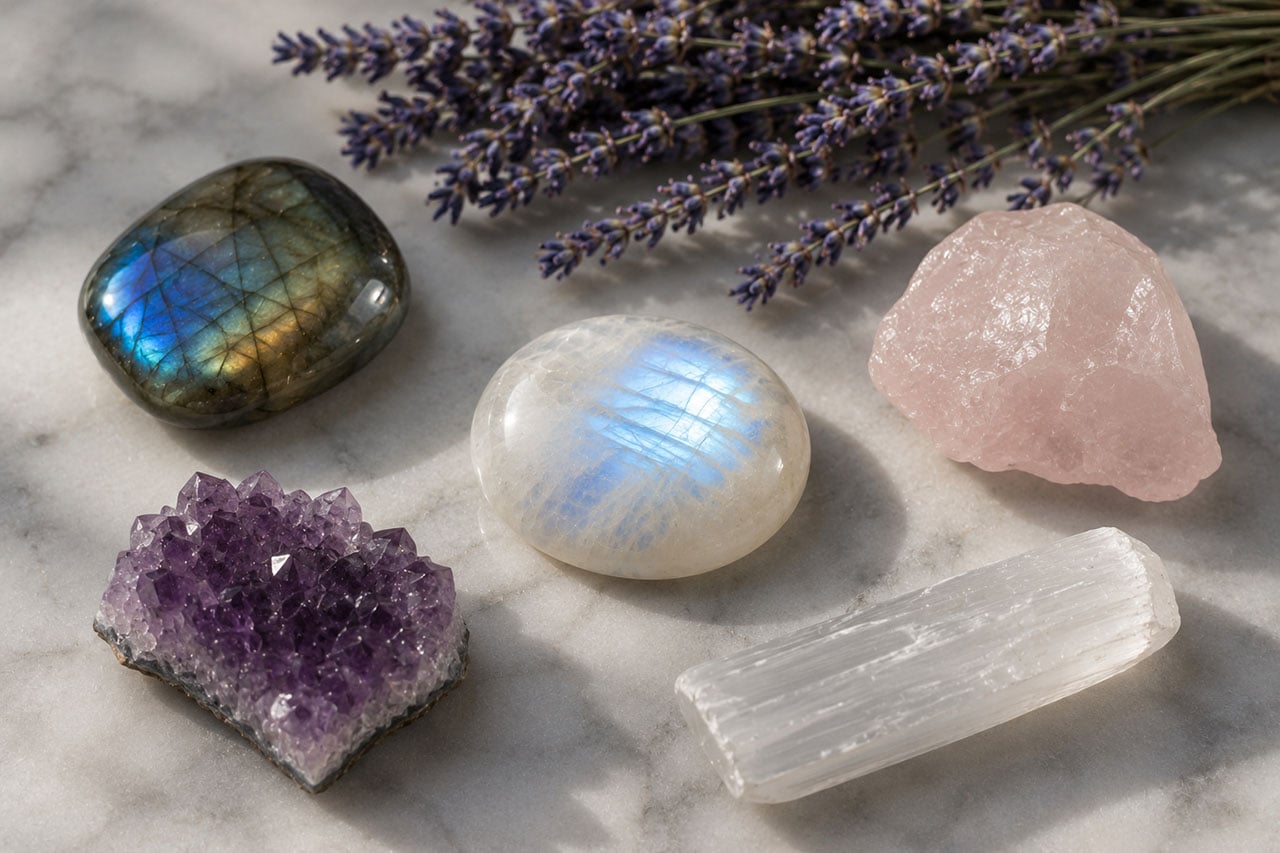
Moonstone pairs beautifully with labradorite for intuition, rose quartz for emotional warmth, and amethyst or selenite for quiet inner work. The partner that suits you depends on which moonstone you have, because white, peach and black moonstone each pull in a slightly different direction.
Ask what goes with moonstone and you have quietly skipped a question that changes the answer, which is which moonstone you mean. The pairing charts almost never ask it. They hand you the same six companion stones whether you are holding the milky white kind, the warm peach kind, or the dark grey-black kind, and those are not really one stone with one job. You can follow a chart to the letter and still end up with a combination that feels slightly off, because the chart assumed white moonstone and you were working with peach.
What ties the varieties together is the look. That floating light inside the stone, the sheen crystal sellers call adularescence, is what gives every moonstone its inward, slightly beyond-the-surface quality, and it is a real optical effect rather than a mood. Where the varieties part ways is in temperature, and that is what should steer the pairing.
Start with which moonstone you have
White and rainbow moonstone is the common one and the variety every general pairing recommendation is really describing. It carries the full range of what moonstone is known for in the tradition, intuition and emotional receptivity most of all, and it takes the classic partners well. Peach moonstone runs warmer and gentler, more nurturing than perceptive, which is why it sits so naturally beside rose quartz and the other heart stones. Black moonstone is the introspective one, associated in practice with new-moon energy and turning inward, and it holds up to the heavier company that would overwhelm the white kind, labradorite and smoky quartz among them.
None of this makes a pairing right or wrong. It shifts your choice. Match the partner to the temperature of the moonstone in your hand and most of the guesswork falls away.
The pairings for intuition and inner work
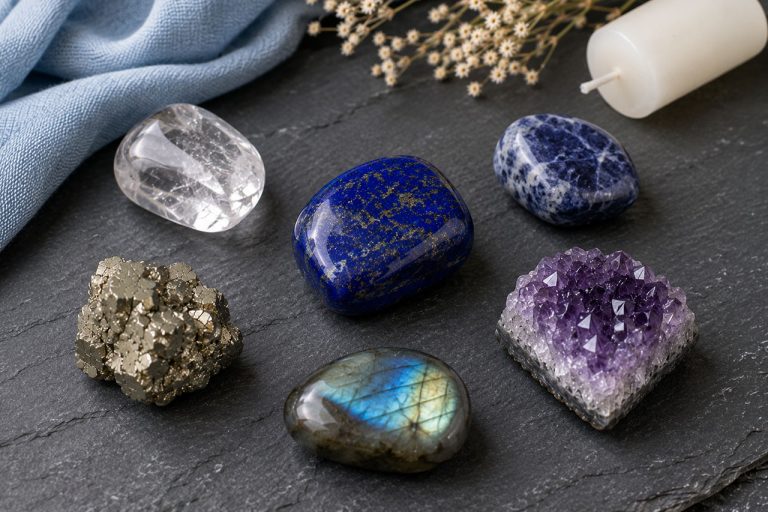
The pairing you will see celebrated above all others is moonstone with labradorite, and there is something fitting in it beyond the tradition, because the two stones are close relatives. Both are feldspars, and both get their glow from light playing off fine internal layers rather than off the polished surface. In moonstone that internal scattering shows as the soft white float of adularescence, which Geology.com describes as light bent and scattered between thin alternating layers of orthoclase and albite. In labradorite a related play of light from its own internal layering gives the electric blue-green flash called labradorescence. Practice links both to cycles and quiet perception, so together they read as one clear intention rather than two, and the pairing suits any stretch of genuine uncertainty when you are trying to trust your own read of things.
Amethyst is the steadier partner for that same inward work. The tradition treats it as calming and clarifying, a stone that gives moonstone’s more fluid quality somewhere firm to settle, which keeps meditation or journaling from drifting. Selenite takes the pairing lighter and more spiritual, a high, clean note that practice associates with clarity and reset, well suited to a dedicated meditation space though a little rarefied for everyday carrying.
The pairings for emotional warmth
When the aim is comfort rather than perception, moonstone turns toward the heart stones. Rose quartz is the natural first choice, gentle and warm where moonstone is soft and receptive, a pairing people reach for around self-kindness, relationship repair, or a hard emotional patch. It works as well on a nightstand as it does worn, and peach moonstone in particular seems made for it.
Aquamarine adds a cooler, more articulate note to the same family. Practice ties it to calm and honest expression, especially the kind you struggle to put into words, so beside moonstone’s receptive quality it suits anyone trying to say something true and finding it hard. Both are water-associated stones, and the pairing has that flowing, unforced character rather than the heavier charge of a stone like malachite.
Handling, and what not to pair
Moonstone asks for a little physical care that its partners do not. By Geology.com it sits at 6 to 6.5 on the Mohs scale of mineral hardness, softer than the quartz it often shares a dish with, and it has two directions of perfect cleavage, meaning it splits cleanly along flat internal planes if it is struck the wrong way. A knock against a harder tumble can chip or cleave it, so store moonstone apart, in its own pouch, away from your quartz and topaz.
Energetically the mismatches are worth naming too. Moonstone’s whole character is fluid and inward, so the dense activators pull against it. The tradition treats carnelian and red jasper as forward, physical, get-moving stones, and beside moonstone most people find that contrast simply incoherent rather than balancing. It is not a hard rule, and someone deliberately setting stillness against drive can make it work on purpose. As a default, keep the loud stones out of moonstone’s company and let the quiet ones do their work.
If the labradorite pairing is the one that draws you, the two stones are close enough to confuse in the shop, and moonstone versus labradorite sorts out which is which. For the full profile of the stone, the Crystalance Mineral Library covers moonstone under adularia, the feldspar that gives it both its name and its sheen.