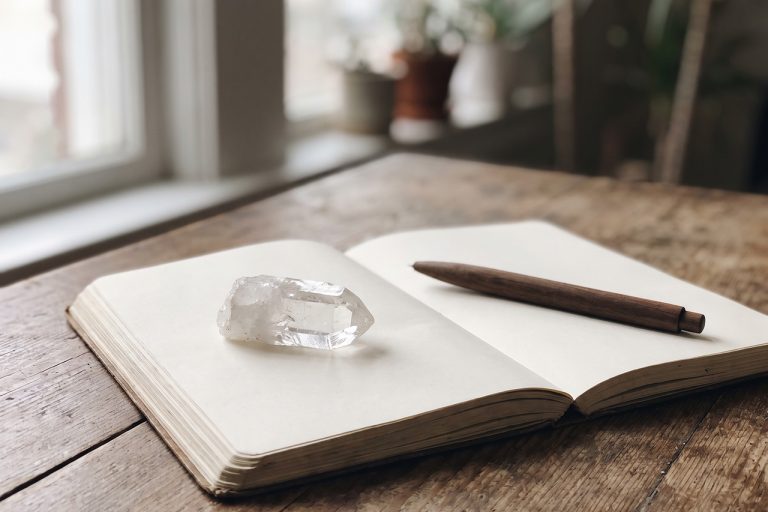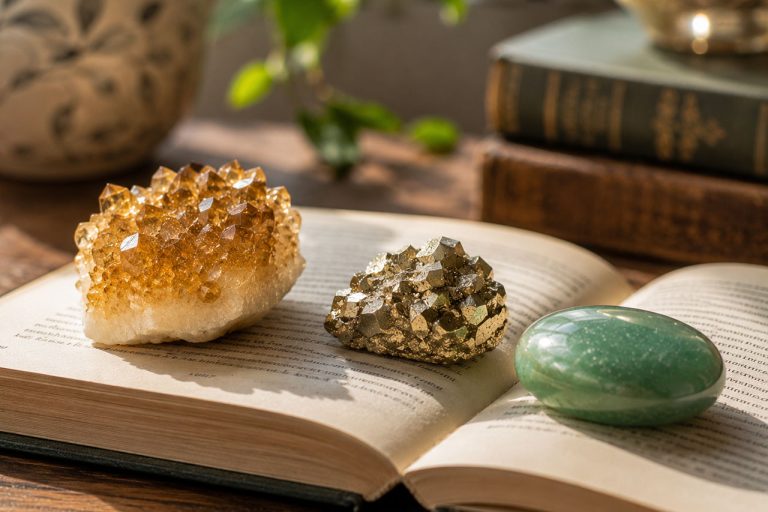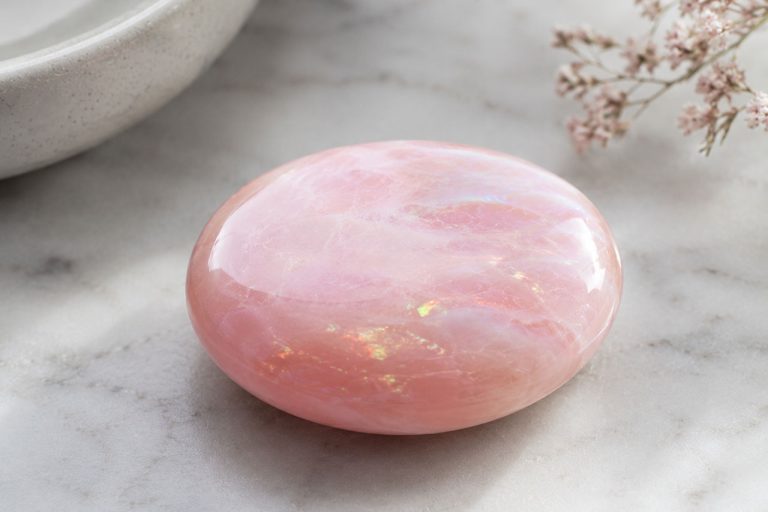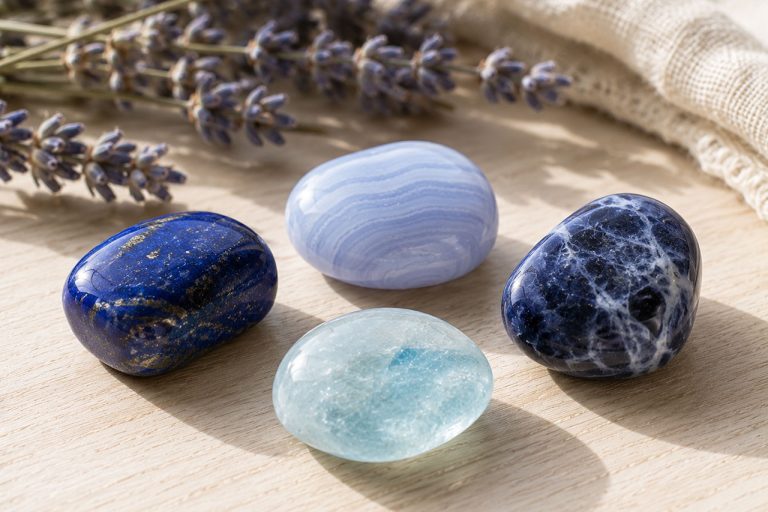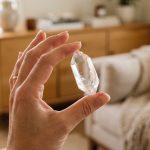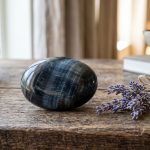
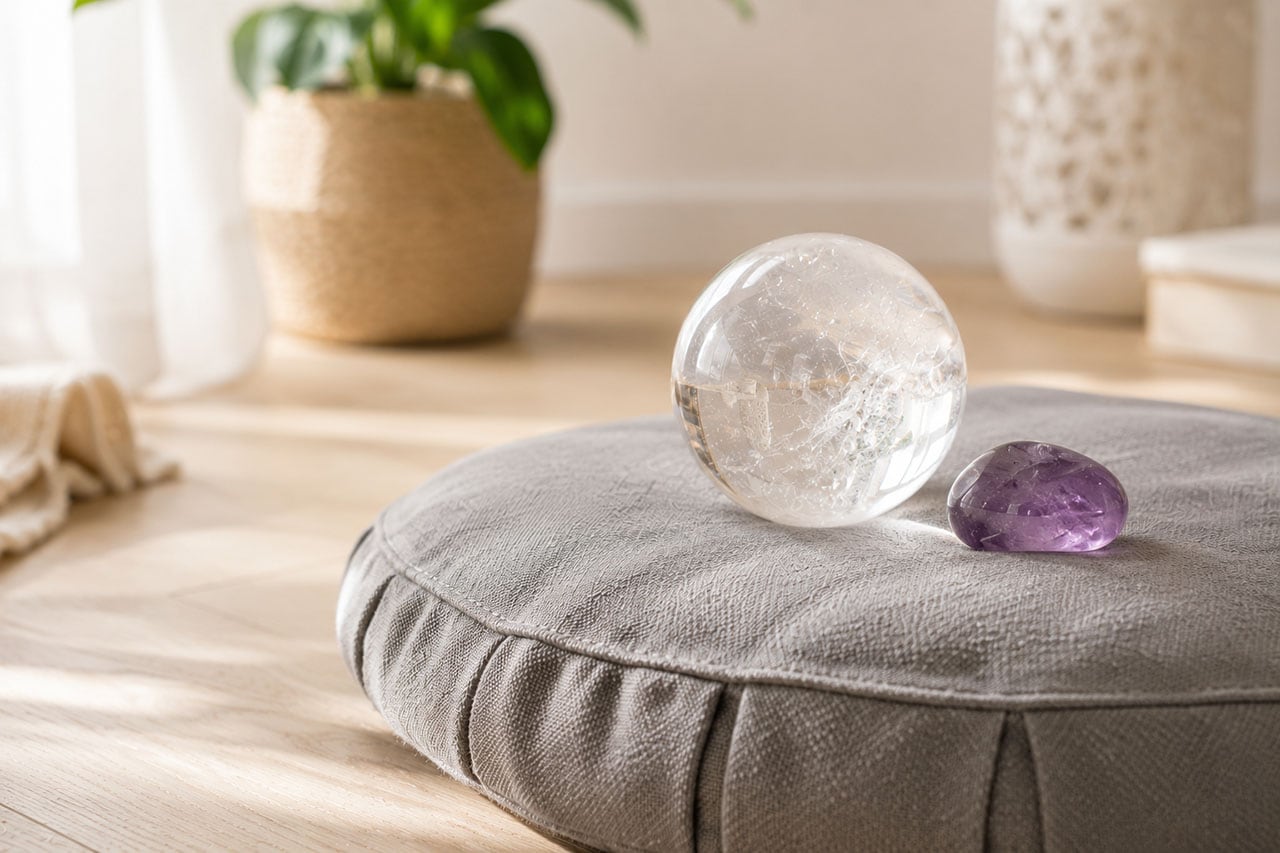
Two practices share this name. In one your eyes are shut and the stone is a weight in your hand. In the other they stay open and you are looking into it. Amethyst suits the first. A sphere or a piece of tourmalated quartz suits the second.
Almost every crystal meditation instruction finishes with the eyes closed, and the moment they close, the whole visible half of the stone stops counting. The colour you chose it for, the veils, the flash across a labradorite, the band moving over a tiger’s eye. None of it is in the room any more. What remains is a weight, a temperature and a surface texture, and a smooth river pebble supplies all three. That is not an argument against sitting with your eyes shut, which is a real practice and a good one. It does mean the stone you spent an hour choosing is contributing about as much as a pebble would, and the version where it contributes everything gets far less space in the instructions.
What the stone is doing while your eyes are shut
Quite a lot, and none of it visual.
A stone in cupped hands has weight, and weight is steadying in a way that is hard to argue with. It starts cool and warms to your skin over the first few minutes, so there is a slow change to notice without having to manufacture one. It has a surface, polished or rough, that the thumb finds without being told to. For a mind running at speed this works when abstract instructions do not, because there is something physical to come back to every time you drift.
What it means in practice is that the choice of stone narrows to physical questions and drops the symbolic ones. Whether it sits heavy in the hand without needing a grip. Whether it has anything sharp on it.
That last question rules out more than people expect. There is a raw black obsidian here, about fifteen centimetres and heavy for its size, and some edges along its fracture surfaces are sharp enough to open skin if you close a hand on it without looking. Obsidian is volcanic glass, cooled too fast for its atoms to arrange into any crystal structure, and it breaks along curved surfaces that leave genuinely keen edges. It lives on a shelf here rather than in a hand. Tumbled stones exist for exactly this reason and there is no loss in using one.
The practical shape of the eyes-closed sitting is short and unglamorous. Sit somewhere you will not be interrupted, hold the stone loosely in one hand or cupped in both, let the breath settle, and bring attention back to the stone each time you notice it has gone. Ten minutes. If the hand starts to ache, switch hands or set the stone in your lap and carry on, because a hand you are managing has stopped being useful.
The practice where you keep your eyes open
Set the stone on the table an arm’s length away instead, at a height you can look at without craning, and let your eyes rest on it half-focused. Nothing is gripped and your eyes stay open. You are looking into the stone rather than at it, and when attention wanders you find your way back by following something you can see.
This suits a particular kind of person. If shutting your eyes reliably puts you to sleep, or hands you fifteen minutes of tomorrow’s worries, the eyes-open version sidesteps both. It also gives you something to do on days when sitting still feels impossible, because looking is a lower bar than not-looking.
What it asks in return is a stone with an interior. Internal veils and fractures in clear quartz, the colour zoning across an amethyst cluster where the purple concentrates toward the tips, banding, a moving band of light, needles running in different directions. A flat opaque tumble offers the eye one surface and the whole thing slides after four minutes. Spheres suit this well, since the curved polish shows you more of the inside of the stone than a flat face does, and there is more on the form in how to use crystal spheres. ## Amethyst, spheres and tourmalated quartz
Amethyst is quartz that took up traces of iron as it grew, after which gamma rays from radioactive material in the surrounding rock irradiated that iron into purple. It runs 7 on the Mohs hardness scale and has no cleavage, so a tumbled piece takes daily handling without complaint. Crystal practice puts it with calm and contemplative work, which is why it is a common first stone for sitting. One caution before you leave yours on a sunny windowsill between sessions. Amethyst colour can fade under prolonged direct sunlight or bright display lighting, so a shelf out of the light is a kinder home than the cushion by the window.
A sphere is the eyes-open stone by construction, and a clear quartz one with visible internal veils gives you more to work with than a perfectly clean piece would.
Tourmalated quartz is clear quartz with needles and rods of black tourmaline caught inside it, trapped and enclosed as the quartz grew around them. Practice reads the pairing as amplification with something to hold it down, the quartz opening and the tourmaline steadying. Whatever you make of the reading, the needles run in several directions at once, which gives an eye somewhere to travel and somewhere to return to. If the looking practice appeals and you own one of these, start there.
Getting started on either one
Ten minutes, daily, for two weeks. That is enough of a trial to tell you which of the two you are, and it costs a fortnight of evenings.
Most sittings are unremarkable, and a run of unremarkable sittings is what the practice is made of. People who give up are usually the ones who arrived expecting each session to hand them something.
If a fortnight of one version has gone badly, change the version before you change the stone. Buying a labradorite to fix a problem caused by gripping an amethyst too tightly is a common and expensive detour.
What amethyst, quartz and tourmaline are as minerals, and how each one grew, is set out in the Crystalance Mineral Library, and there is a fuller account of the colour in the amethyst entry.
Give a stone ten minutes on the table in front of you, eyes open, tomorrow evening. If it goes badly, the other version is still there.
Sources
- Amethyst as quartz coloured by trace iron irradiated after crystallisation by gamma rays from the host rock, Mohs 7 with no cleavage, and its colour subject to fading under prolonged direct sunlight or bright display lights: Geology.com, Amethyst.
- Obsidian as volcanic glass formed when molten rock cools too fast for its atoms to arrange into a crystalline structure, breaking with a conchoidal fracture that produces very sharp edges: Geology.com, Obsidian.
- Tourmalinated quartz as quartz containing needle-like and rod-like inclusions of black tourmaline, trapped and encased as the quartz crystals grew: Geologyscience, Tourmalinated Quartz.