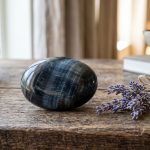

Crystal spheres are placement and meditation pieces. The spherical form is associated with even energy distribution in all directions, completeness, and balance in modern crystal practice. They are typically placed on stands as room centrepieces, held during meditation, or used as scrying tools in older traditions. The practice is the same across stones; the sphere form is what makes it distinctive.
The “how do you use the crystal sphere?” question shows up consistently because the form is unusual enough that the use feels less obvious than for a tumble or a pendant. A sphere is decorative; what does it actually do in practice? Here is the working answer.
What a Crystal Sphere Actually Is
A crystal sphere is a piece of stone carved and polished into a spherical shape. The sphere is entirely lapidary; no mineral grows naturally in a sphere form. The shape is created by grinding and polishing, often starting from a roughly cubic piece of raw material.
Spheres come in a wide size range, from small marbles (1 to 2 cm diameter) to large display pieces (15+ cm diameter, weighing several kilograms). The most common stones used as spheres are clear quartz, rose quartz, amethyst, smoky quartz, fluorite, sodalite, lapis lazuli, and obsidian. Any stone with reasonable hardness and a large enough raw chunk can be carved into a sphere.
The form does not change what the mineral is. A rose quartz sphere is the same mineral as a rose quartz tumble; the sphere is a different lapidary form of the same material.
What the Sphere Form Does in Practice
Three properties make the sphere form distinctive in modern crystal use.
Even directional distribution. A sphere has no point, no flat side, no preferential direction. In modern crystal practice this is read as the stone radiating its associated energy evenly in all directions, in contrast to a point (which directs) or a flat-sided piece (which emphasises one face). A sphere placed in the centre of a room is treated as radiating its intention to the whole space.
Tactile and visual completeness. The sphere is a symbolically complete shape across many traditions: the circle, the cycle, the whole. Holding a sphere has a different felt quality than holding an angular piece, and the difference is the practice element. Many practitioners describe the sphere as feeling “calmer” or “more contained” than the same mineral in a different form.
Visual depth. A polished sphere often shows internal structure (inclusions, colour zones, optical effects) in a way that no other form does, because the curved surface acts as a partial lens. Looking into a clear quartz sphere reveals internal rainbows and inclusions; looking into a labradorite sphere reveals the colour flash from multiple angles at once. The visual depth is part of why spheres are valued as meditation and contemplation objects.
How to Use One
A few common practices.
As a room centrepiece. Place the sphere on a stand in the centre of a room or in a prominent location. The intention is for the sphere to radiate the stone’s associated quality (calm for rose quartz, clarity for clear quartz, grounding for smoky quartz) to the whole space. The stand matters because spheres roll; an unsupported sphere on a flat surface will eventually fall.
For meditation. Hold a smaller sphere (5 to 8 cm) in cupped hands during quiet meditation. The weight and the rounded shape are tactile cues. Some practitioners gaze into the sphere for a longer focused-attention practice; this is the modern continuation of scrying traditions, where the sphere becomes a focus point for soft-focus visual attention.
As an intention anchor on a desk. A small sphere on a desk acts as a visual cue throughout the workday. The shape is unusual enough that the eye returns to it more than to a flat tumble. This makes spheres effective intention anchors for sustained attention work.
For crystal grids. A central sphere with smaller pointed stones radiating outward is a classic grid form. The sphere holds the central intention; the points direct it outward into the grid pattern. For more on point-based practices, see how do you use crystal points.
Practical Notes
Spheres roll. Always place on a stand or in a depression. A sphere falling from a desk or shelf will damage both itself and whatever it lands on.
Sphere weight is significant. Large spheres (10+ cm) weigh several kilograms. Choose stable surfaces and stable stands. A sphere falling from height onto a foot causes real injury.
Focal-light hazard. A clear or pale-coloured sphere placed in direct sunlight can focus light like a magnifying lens, with enough intensity to scorch fabric, paper, or wood directly behind it. Keep clear quartz spheres out of direct sun, or place them where the focused light beam (if any) does not hit anything flammable. This is a genuine safety concern that most sphere articles do not mention.
Fade-sensitive stones. Amethyst spheres, rose quartz spheres, and fluorite spheres can fade in prolonged direct sunlight just as the unpolished versions of the same minerals can. Keep these in indirect light placements.
Which Sphere for Which Intention
A short pairing guide.
Clear quartz sphere. Universal intention amplifier. Best for general clarity work or as a central piece in a grid.
Rose quartz sphere. Self-compassion and emotional gentleness, radiating to a whole room. Common in bedrooms.
Amethyst sphere. Calm and contemplative work. Common in meditation spaces.
Smoky quartz sphere. Grounding for a whole space, especially in transitional or release-focused work.
Selenite sphere. Clearing for a space, though selenite spheres are fragile (Mohs 2) and need especially careful placement.
Obsidian sphere. Shadow work and inner reflection. The opaque dark surface holds the meditation focus differently than transparent or translucent stones.
For more on individual stones, see the Crystalance Mineral Library. For the underlying intention practice, see how to set intentions with crystals. The sphere is one of the more aesthetically rich crystal forms because the shape itself does work that the mineral alone does not. Place it intentionally. Use the radiating-in-all-directions framing. The form holds the intention; the practice does the rest.