Hold the stone, say what you are cultivating in the present tense, keep it somewhere you will meet it, and say it again when it goes quiet. Clear quartz, citrine, labradorite, obsidian and amazonite are the stones most often used for it.
Practitioners rarely say they are setting an intention on a stone. They say they are programming it.
The word is borrowed from computing, and a borrowed word is always worth a pause, because it tells you what the borrower thinks is happening. Something gets written. It stays written until something overwrites it. Nearly every rule the practice keeps about intentions falls straight out of that, and once you can see where the rules come from you can follow them properly or set them aside on purpose.
What programming a stone means in the practice
Crystal practice treats a set intention as a thing now resident in the stone, rather than as a note you left about it.
Three rules follow, and they are consistent across teachers who agree on very little else. One intention per stone at a time, because a second one written over the first leaves you with neither clearly. Cleanse the stone before you set a new intention, because the practice holds that the old one is still there and needs clearing rather than simply replacing. And restate the intention on a cycle, weekly or monthly, because practitioners hold that it fades with use rather than sitting there indefinitely. The mechanics of that first clearing step, and the several ways people do it, are in how do you activate crystals.
Nothing in that model can be shown to you, and it does not have to be true for the rules to earn their place, because what they give you is a practice with edges. There is a start, there is a limit of one, and there is a scheduled return. Those edges are what most people are missing when a crystal habit fizzles out in the third week.
It also explains a thing beginners find odd, which is why practitioners get particular about lending stones out. Under the programming model a stone someone else has set is not blank, and handing it on without clearing it is closer to passing on a half-finished letter than to lending a book.
The grammar of an intention
Present tense, first person, one thing, short. “I am building something I can live on” over “I want more abundance”. The difference has nothing to do with positivity. The second sentence names a condition and the first names you doing something, and only one of those gives you anything to do on a Tuesday.
Make it something you can act on. An intention aimed squarely at another person’s decision is the one that reliably curdles, for the reasons worked through in how to manifest with crystals. Aim it at the part that is yours.
Then there is the stone itself. There is a small amethyst geode here, about twelve centimetres of crystal points on grey matrix, and it is heavy enough that nobody is carrying it anywhere. Advice to keep your intention stone with you quietly rules out most of a collection. Choose the stone by where it can live. A tumbled piece goes in a coat pocket. Anything larger belongs on a shelf you pass, which works perfectly well, because the point is meeting it rather than carrying it.
Say the sentence when you set it and again when you next pick the stone up. Rewrite it when it stops meaning anything.
The stones, and the logic that sorted them
Clear quartz is the blank one. It carries no strong colour symbolism of its own, which is precisely why practice hands it whatever intention you have rather than a particular lane. When a list has nothing that fits what you want, this is the one to use.
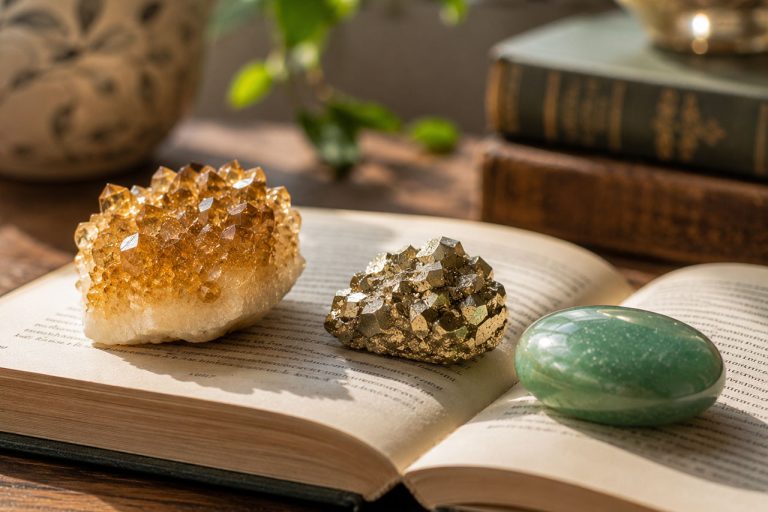
Citrine takes the abundance and confidence intentions on the strength of being gold. Most of the citrine in shops is amethyst that has been heated until it turns golden, and naturally yellow quartz is genuinely uncommon. That does not make a heated stone a fake, and plenty of people prefer the colour, but it does mean the gold in your hand usually started out purple.
Labradorite is a feldspar of the plagioclase series, and its blue and green flash comes from light striking a twinning surface inside the stone and reflecting back, which is why the effect depends so much on the angle it is cut and viewed at. A stone that visibly changes as you turn it was always going to end up carrying the transformation intentions.
Obsidian gets the releasing intentions, the ones about what you are putting down rather than picking up. It is volcanic glass, cooled too fast for its atoms to arrange into any crystal structure at all. The standard stone for letting something go turns out to be the one with no lattice to write anything into, which is a quiet joke on the programming model.
Amazonite is a green variety of microcline, a potassium feldspar, its colour thought to come from traces of lead. Practice puts it with speaking clearly and saying the difficult thing. It runs 6 to 6.5 on the Mohs scale with perfect cleavage in two directions meeting at close to a right angle, so a dropped piece is liable to split cleanly along a cleavage plane. Keep it off tiled floors.
What each of those five is underneath its association, and how it grew, is what the Crystalance Mineral Library holds.
Set one intention on one stone and leave it a month before you touch it again. A month is long enough to tell whether the sentence was any good.
Sources
- Most citrine on the market as heated amethyst, with naturally yellow quartz rare: GIA, Is Citrine Treated?.
- Labradorite as a feldspar mineral of the plagioclase series, and labradorescence as light entering the stone, striking a twinning surface and reflecting from it, with the effect depending on the angle of cut and view: Geology.com, Labradorite.
- Obsidian as volcanic glass formed when molten rock cools too fast for atoms to arrange into a crystalline structure: Geology.com, Obsidian.
- Amazonite as a colour variety of microcline, a potassium-rich feldspar, its colour thought to be caused by trace amounts of lead, Mohs 6 to 6.5, with perfect cleavage in two directions intersecting at or close to 90 degrees: Geology.com, Amazonite.